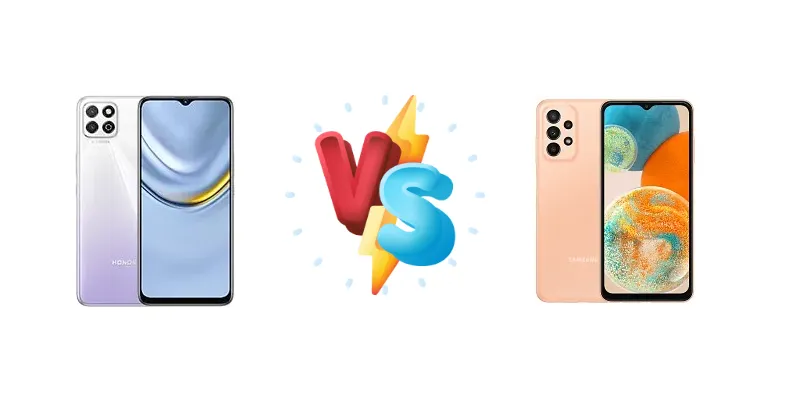
The sub-$200 5G smartphone market is fiercely competitive. The Honor Play 20 and Samsung Galaxy A23 5G represent two distinct approaches to delivering affordable connectivity. The Play 20 focuses on a minimalist experience, while the A23 5G aims for a more feature-rich package, but at what cost to performance and efficiency?
🏆 Quick Verdict
For the average user prioritizing responsiveness and future-proofing, the Samsung Galaxy A23 5G is the better choice. Its Snapdragon 695 5G chipset, built on a 6nm process, offers significantly improved performance and efficiency compared to the Honor Play 20’s Unisoc T610. While the Play 20 is cheaper, the A23 5G’s faster charging and brighter display justify the price difference.
| Network |
|---|
| 2G bands | GSM 850 / 900 / 1800 / 1900 | GSM 850 / 900 / 1800 / 1900 |
| 3G bands | HSDPA 850 / 900 / 1900 / 2100 | HSDPA 850 / 900 / 1700(AWS) / 1900 / 2100 |
| 4G bands | LTE | 1, 2, 3, 4, 5, 7, 8, 12, 17, 20, 26, 28, 32, 38, 40, 41, 66 - International |
| 5G bands | - | 1, 3, 7, 8, 20, 28, 38, 40, 41, 77, 78 SA/NSA/Sub6 - International |
| Speed | HSPA, LTE | HSPA, LTE, 5G |
| Technology | GSM / CDMA / HSPA / CDMA2000 / LTE | GSM / HSPA / LTE / 5G |
| | CDMA2000 1x | 2, 5, 30, 66, 77 SA/NSA/Sub6/mmWave - USA |
| Launch |
|---|
| Announced | 2021, April 26 | 2022, August 05 |
| Status | Available. Released 2021, May 01 | Available. Released 2022, September 02 |
| Body |
|---|
| Build | Glass front, plastic back, plastic frame | Glass front (Gorilla Glass 5), plastic frame, plastic back |
| Dimensions | 164 x 75.8 x 8.9 mm (6.46 x 2.98 x 0.35 in) | 165.4 x 76.9 x 8.4 mm (6.51 x 3.03 x 0.33 in) |
| SIM | Nano-SIM + Nano-SIM | · Nano-SIM· Nano-SIM + Nano-SIM |
| Weight | 198 g (6.98 oz) | 197 g (6.95 oz) |
| Display |
|---|
| Protection | - | Corning Gorilla Glass 5 |
| Resolution | 720 x 1600 pixels, 20:9 ratio (~269 ppi density) | 1080 x 2408 pixels, 20:9 ratio (~400 ppi density) |
| Size | 6.52 inches, 102.6 cm2 (~82.6% screen-to-body ratio) | 6.6 inches, 104.9 cm2 (~82.5% screen-to-body ratio) |
| Type | IPS LCD | PLS LCD, 120Hz |
| Platform |
|---|
| CPU | Octa-core (2x1.8 GHz Cortex-A75 & 6x1.8 GHz Cortex-A55) | Octa-core (2x2.2 GHz Kryo 660 Gold & 6x1.7 GHz Kryo 660 Silver) |
| Chipset | Unisoc T610 (12 nm) | Qualcomm SM6375 Snapdragon 695 5G (6 nm) |
| GPU | Mali-G52 MP2 | Adreno 619 |
| OS | Android 10, Magic UI 4.0, no Google Play Services | Android 12, upgradable to Android 14, One UI 6 |
| Memory |
|---|
| Card slot | microSDXC (uses shared SIM slot) | microSDXC (dedicated slot) |
| Internal | 64GB 4GB RAM, 128GB 4GB RAM, 128GB 6GB RAM, 128GB 8GB RAM | 64GB 4GB RAM, 64GB 6GB RAM, 128GB 4GB RAM, 128GB 6GB RAM, 128GB 8GB RAM |
| | eMMC 5.1 | - |
| Main Camera |
|---|
| Dual | 13 MP, f/1.8, (wide), PDAF
Auxiliary lens | - |
| Features | LED flash, HDR, panorama | LED flash, panorama, HDR |
| Quad | - | 50 MP, f/1.8, 26mm (wide), 1/2.76", 0.64µm, PDAF, OIS
5 MP, f/2.2, 13mm, 123˚ (ultrawide), 1/5.0", 1.12µm
2 MP (macro)
Auxiliary lens |
| Single | 5 MP, f/2.2, (wide) | - |
| Video | 1080p@30fps | 1080p@30fps |
| Selfie camera |
|---|
| Single | 5 MP, f/2.2, (wide) | 8 MP, f/2.0, 25mm (wide), 1/4.0", 1.12µm - USA
8 MP, f/2.2, 25mm (wide), 1/4.0", 1.12µm - International |
| Video | - | 1080p@30fps |
| Sound |
|---|
| 3.5mm jack | Yes | Yes |
| 35mm jack | Yes | Yes |
| Loudspeaker | Yes | Yes |
| Comms |
|---|
| Bluetooth | 5.0, A2DP, LE | 5.1, A2DP, LE |
| NFC | No | Yes |
| Positioning | GPS, BDS | GPS, GLONASS, GALILEO, BDS |
| Radio | FM radio | FM radio (market/region dependent) |
| USB | USB Type-C 2.0 | USB Type-C 2.0 |
| WLAN | Wi-Fi 802.11 b/g/n | Wi-Fi 802.11 a/b/g/n/ac, dual-band, Wi-Fi Direct |
| Features |
|---|
| Sensors | Accelerometer, proximity, compass | Fingerprint (side-mounted), accelerometer, gyro, compass, barometer (USA only) |
| | - | Virtual proximity sensing |
| Battery |
|---|
| Charging | 10W wired | 25W wired |
| Type | Li-Po 5000 mAh | Li-Po 5000 mAh |
| Misc |
|---|
| Colors | Black, White, Blue, Silver/Pink | Black, White, Peach, Blue |
| Models | KOZ-AL00 | SM-A236U, SM-A236U1, SM-A236B, SM-A236B/DS, SM-A236B/DSN, SM-A236E, SM-S236DL |
| Price | About 110 EUR | $ 84.44 / £ 129.00 / € 125.28 / ₹ 21,000 |
| SAR | - | 0.68 W/kg (head) 0.57 W/kg (body) |
| SAR EU | - | 1.49 W/kg (head) 1.25 W/kg (body) |
| Tests |
|---|
| Battery life | - |
Endurance rating 138h
|
| Camera | - |
Photo / Video |
| Display | - |
Contrast ratio: 1328:1 (nominal) |
| Loudspeaker | - |
-25.9 LUFS (Very good)
|
| Performance | - |
AnTuTu: 318821 (v9)
GeekBench: 1940 (v5.1)
GFXBench: 16fps (ES 3.1 onscreen) |
Honor Play 20
- Lower price point makes it accessible.
- Acceptable battery life for basic usage.
- Functional for essential smartphone tasks.
- Unisoc T610 chipset offers limited performance.
- Slow 10W charging.
- Display specifications are less competitive.
Samsung Galaxy A23 5G
- Snapdragon 695 5G provides significantly better performance.
- 25W fast charging reduces downtime.
- Brighter display enhances visibility.
- Higher price compared to the Honor Play 20.
- May still exhibit some throttling under heavy load.
- Software updates may be less frequent than flagship models.
Display Comparison
The Samsung Galaxy A23 5G boasts a brighter display, measured at 508 nits, compared to the Honor Play 20 (brightness data unavailable). Both displays share a 1328:1 contrast ratio, suggesting similar black levels and color depth. However, the A23 5G’s higher peak brightness will translate to better visibility outdoors. The lack of information on the Play 20’s panel technology suggests it likely uses a less advanced IPS panel, potentially impacting viewing angles and color accuracy compared to the A23 5G.
Camera Comparison
Both phones feature 'Photo / Video' capabilities, but detailed camera specifications are lacking for the Honor Play 20. The Samsung Galaxy A23 5G likely benefits from Qualcomm’s image signal processor (ISP) within the Snapdragon 695, offering improved image processing and noise reduction. Without sensor size or aperture information for the Play 20, it’s difficult to assess its camera performance, but it’s reasonable to assume the A23 5G offers a more refined camera experience. The prevalence of low-resolution auxiliary cameras on budget phones suggests avoiding expectations for the Play 20’s secondary lenses.
Performance
The core difference lies in the chipsets. The Samsung Galaxy A23 5G’s Qualcomm Snapdragon 695 5G (6nm) is a substantial upgrade over the Honor Play 20’s Unisoc T610 (12nm). The 6nm process node of the Snapdragon 695 allows for greater transistor density and improved power efficiency, resulting in better sustained performance and less thermal throttling. The A23 5G’s CPU, with 2x2.2 GHz Kryo 660 Gold cores, outperforms the Play 20’s 2x1.8 GHz Cortex-A75 cores in single-core tasks, while both utilize 6x1.8/1.7 GHz Cortex-A55/Kryo 660 Silver cores for efficiency. This translates to snappier app launches and smoother multitasking on the A23 5G.
Battery Life
Both devices achieve an endurance rating of 138 hours, indicating similar overall battery life under typical usage. However, the Samsung Galaxy A23 5G’s 25W wired charging is a significant advantage over the Honor Play 20’s slow 10W charging. This means the A23 5G can replenish its battery much faster, minimizing downtime. While battery capacity isn’t specified, the more efficient Snapdragon 695 likely contributes to comparable endurance despite potentially having a smaller battery.
Buying Guide
Buy the Honor Play 20 if you need a basic, functional smartphone for essential tasks like calls, messaging, and light social media use, and your budget is extremely limited. Buy the Samsung Galaxy A23 5G if you prioritize smoother multitasking, faster app loading times, a more vibrant display for media consumption, and the convenience of 25W fast charging, even if it means spending a bit more.
Frequently Asked Questions
❓ Is the Snapdragon 695 in the Galaxy A23 5G powerful enough for demanding games like PUBG Mobile?
The Snapdragon 695 can handle PUBG Mobile at medium settings with reasonable frame rates. However, don't expect to max out the graphics settings, and prolonged gaming sessions may lead to some thermal throttling. It's a capable chipset for casual gaming, but not a dedicated gaming phone.
❓ How does the 12nm Unisoc T610 in the Honor Play 20 affect app loading times and multitasking?
The 12nm process node of the Unisoc T610 is less efficient than the 6nm Snapdragon 695. This translates to slower app loading times, noticeable lag when switching between apps, and a generally less responsive user experience, especially with multiple apps open simultaneously.
❓ Does the Samsung Galaxy A23 5G support carrier aggregation for faster 5G speeds?
Yes, the Snapdragon 695 5G supports carrier aggregation, allowing it to combine multiple 5G channels for potentially faster download and upload speeds, provided your carrier supports it. This is a significant advantage over devices with limited 5G capabilities.
❓ What type of charging port do both phones use?
Both the Honor Play 20 and Samsung Galaxy A23 5G utilize a USB-C port for charging and data transfer. However, the A23 5G's 25W charging capability requires a compatible charger (often sold separately) to achieve its fastest charging speeds, while the Play 20's 10W charging is less demanding.