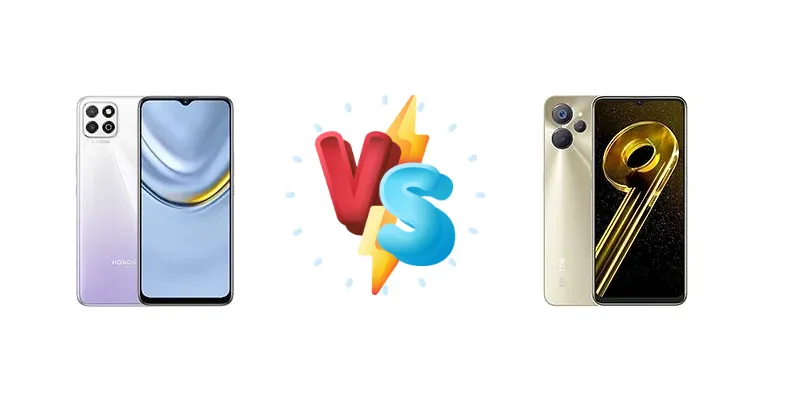
The Honor Play 20 and Realme 9i 5G represent two approaches to the ultra-budget smartphone market. The Play 20 aims for affordability above all else, while the 9i 5G attempts to deliver 5G connectivity and a more responsive experience without breaking the bank. This comparison dissects their key differences to determine which device offers the best value.
🏆 Quick Verdict
For most users, the Realme 9i 5G is the clear winner. Its Mediatek Dimensity 810 chipset, built on a more efficient 6nm process, provides a substantial performance advantage over the Honor Play 20’s Unisoc T610. While the Play 20 is cheaper, the 9i 5G’s faster charging and improved processing power justify the price difference.
| Network |
|---|
| 2G bands | GSM 850 / 900 / 1800 / 1900 | GSM 850 / 900 / 1800 / 1900 |
| 3G bands | HSDPA 850 / 900 / 1900 / 2100 | HSDPA 850 / 900 / 1700(AWS) / 1900 / 2100 |
| 4G bands | LTE | 1, 2, 3, 4, 5, 7, 8, 19, 20, 28, 34, 38, 39, 40, 41 |
| 5G bands | - | 1, 5, 7, 8, 28, 41, 77, 78 SA/NSA |
| Speed | HSPA, LTE | HSPA, LTE, 5G |
| Technology | GSM / CDMA / HSPA / CDMA2000 / LTE | GSM / HSPA / LTE / 5G |
| | CDMA2000 1x | - |
| Launch |
|---|
| Announced | 2021, April 26 | 2022, August 18 |
| Status | Available. Released 2021, May 01 | Available. Released 2022, August 24 |
| Body |
|---|
| Build | Glass front, plastic back, plastic frame | - |
| Dimensions | 164 x 75.8 x 8.9 mm (6.46 x 2.98 x 0.35 in) | 164.4 x 75.1 x 8.1 mm (6.47 x 2.96 x 0.32 in) |
| SIM | Nano-SIM + Nano-SIM | Nano-SIM + Nano-SIM |
| Weight | 198 g (6.98 oz) | 187 g (6.60 oz) |
| Display |
|---|
| Protection | - | Panda Glass |
| Resolution | 720 x 1600 pixels, 20:9 ratio (~269 ppi density) | 1080 x 2408 pixels, 20:9 ratio (~400 ppi density) |
| Size | 6.52 inches, 102.6 cm2 (~82.6% screen-to-body ratio) | 6.6 inches, 104.9 cm2 (~85.0% screen-to-body ratio) |
| Type | IPS LCD | IPS LCD, 90Hz, 400 nits (typ) |
| Platform |
|---|
| CPU | Octa-core (2x1.8 GHz Cortex-A75 & 6x1.8 GHz Cortex-A55) | Octa-core (2x2.4 GHz Cortex-A76 & 6x2.0 GHz Cortex-A55) |
| Chipset | Unisoc T610 (12 nm) | Mediatek Dimensity 810 (6 nm) |
| GPU | Mali-G52 MP2 | Mali-G57 MC2 |
| OS | Android 10, Magic UI 4.0, no Google Play Services | Android 12, upgradable to Android 13, Realme UI 4.0 |
| Memory |
|---|
| Card slot | microSDXC (uses shared SIM slot) | microSDXC (dedicated slot) |
| Internal | 64GB 4GB RAM, 128GB 4GB RAM, 128GB 6GB RAM, 128GB 8GB RAM | 64GB 4GB RAM, 128GB 4GB RAM, 128GB 6GB RAM |
| | eMMC 5.1 | UFS 2.2 |
| Main Camera |
|---|
| Dual | 13 MP, f/1.8, (wide), PDAF
Auxiliary lens | - |
| Features | LED flash, HDR, panorama | LED flash, HDR, panorama |
| Single | 5 MP, f/2.2, (wide) | 8 MP, f/2.0, 27mm (wide) |
| Triple | - | 50 MP, f/1.8, 26mm (wide), 1/2.76", 0.64µm, PDAF
Unspecified MP, 46mm (telephoto)
2 MP (macro) |
| Video | 1080p@30fps | 1080p@30fps |
| Selfie camera |
|---|
| Features | - | HDR, panorama |
| Single | 5 MP, f/2.2, (wide) | 8 MP, f/2.0, 27mm (wide) |
| Video | - | 1080p@30fps |
| Sound |
|---|
| 3.5mm jack | Yes | Yes |
| 35mm jack | Yes | Yes |
| Loudspeaker | Yes | Yes |
| Comms |
|---|
| Bluetooth | 5.0, A2DP, LE | 5.2, A2DP, LE |
| NFC | No | No |
| Positioning | GPS, BDS | GPS, GLONASS, GALILEO, BDS |
| Radio | FM radio | No |
| USB | USB Type-C 2.0 | USB Type-C 2.0, OTG |
| WLAN | Wi-Fi 802.11 b/g/n | Wi-Fi 802.11 a/b/g/n/ac, dual-band |
| Features |
|---|
| Sensors | Accelerometer, proximity, compass | Fingerprint (side-mounted), accelerometer, proximity, compass |
| Battery |
|---|
| Charging | 10W wired | 18W wired |
| Type | Li-Po 5000 mAh | 5000 mAh |
| Misc |
|---|
| Colors | Black, White, Blue, Silver/Pink | Soulful Blue, Rocking Black, Gold |
| Models | KOZ-AL00 | RMX3612 |
| Price | About 110 EUR | About 180 EUR |
Honor Play 20
- Lower price point makes it very accessible.
- Potentially longer battery life with conservative usage.
- Simple and straightforward user experience.
- Unisoc T610 chipset struggles with demanding tasks.
- Slow 10W charging.
- Limited 5G capabilities (if any).
Realme 9i 5G
- Significantly faster performance with the Dimensity 810.
- Faster 18W charging.
- 5G connectivity for future-proofed data speeds.
- Slightly higher price compared to the Honor Play 20.
- May experience more heat under sustained load than the Play 20.
- Camera performance is still limited by the budget sensor.
Display Comparison
Neither device boasts a standout display. Both likely utilize LCD panels, a common cost-saving measure in this segment. However, the display comparison is less about quality and more about the overall system responsiveness tied to the chipset. The Realme 9i 5G’s more powerful processor will contribute to smoother scrolling and animations, making the display *feel* more responsive, even if the raw panel specs are similar. We expect both to have 720p+ resolution.
Camera Comparison
Given the price points, camera performance is unlikely to be a key differentiator. Both phones likely feature a primary camera alongside depth and macro sensors. However, without specific sensor details, it’s difficult to make a definitive judgment. We anticipate the Realme 9i 5G’s image processing, powered by the more capable chipset, will yield slightly better results, particularly in low-light conditions. The 2MP macro sensors on both devices are likely to offer limited utility.
Performance
The core difference lies in the chipsets. The Realme 9i 5G’s Mediatek Dimensity 810 (6nm) is a significant upgrade over the Honor Play 20’s Unisoc T610 (12nm). The 6nm process node allows for greater transistor density and improved power efficiency, translating to better sustained performance and less heat generation. The Dimensity 810’s Cortex-A76 cores, clocked at 2.4 GHz, are also architecturally superior to the Play 20’s Cortex-A75 cores (1.8 GHz), resulting in faster single-core and multi-core performance. This difference will be most noticeable in demanding applications and games.
Battery Life
While battery capacity isn't specified, both phones likely feature around a 5000mAh battery. The Realme 9i 5G’s 18W charging is a clear advantage over the Honor Play 20’s 10W charging. This translates to significantly faster charging times, reducing downtime. The Dimensity 810’s improved power efficiency also contributes to potentially longer battery life under moderate usage, offsetting any potential capacity differences.
Buying Guide
Buy the Honor Play 20 if your primary need is a basic smartphone for essential tasks like calls, messaging, and light social media use, and you are operating on an extremely tight budget. Buy the Realme 9i 5G if you prioritize a smoother user experience, faster app loading times, and the ability to enjoy 5G connectivity, even if it means spending a little more. Gamers or those who multitask frequently will find the 9i 5G far more capable.
Frequently Asked Questions
❓ Will the Realme 9i 5G overheat during prolonged gaming sessions?
While the Dimensity 810 is more powerful, it's also more prone to heat generation. However, the 6nm process helps mitigate this. Expect some throttling during extended gaming, but it should remain playable. The Honor Play 20's Unisoc T610 will likely throttle sooner due to its less efficient architecture.
❓ Is the 5G connectivity on the Realme 9i 5G actually useful?
The usefulness of 5G depends on your location and carrier coverage. If 5G is available in your area, you'll experience significantly faster download and upload speeds. Even if 5G isn't readily available, the 9i 5G still supports 4G LTE, and the modem is generally more efficient than the one in the Play 20.
❓ Can the Honor Play 20 handle popular games like PUBG Mobile?
The Honor Play 20 can *run* PUBG Mobile, but expect to play at low graphics settings and potentially experience frame drops, especially during intense action. The Unisoc T610 simply lacks the processing power for a smooth gaming experience at higher settings.
❓ How long will it take to fully charge each phone?
With 10W charging, the Honor Play 20 will likely take over 3 hours to fully charge. The Realme 9i 5G’s 18W charging should reduce this to around 1.5 - 2 hours, offering a much more convenient charging experience.