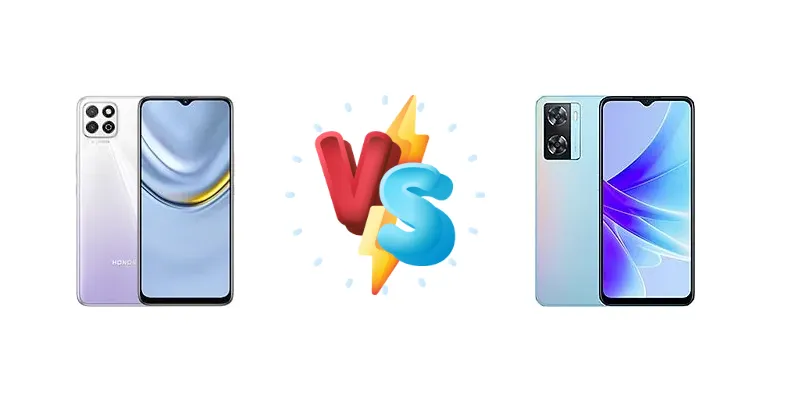
The Honor Play 20 and Oppo A57s represent compelling options in the ultra-budget smartphone segment. Both aim to deliver essential functionality at a low price point, but they take different approaches to achieving this. The Honor Play 20 relies on a Unisoc chipset, while the Oppo A57s opts for a MediaTek Helio G35. This comparison will dissect their key differences, focusing on performance, battery, and charging to determine which device offers the best value.
🏆 Quick Verdict
For the average user prioritizing quick charging and slightly better responsiveness in everyday tasks, the Oppo A57s is the stronger choice. Its 33W charging capability significantly reduces downtime, and the Helio G35, while not a powerhouse, offers a modest performance edge over the Unisoc T610. However, the Honor Play 20 remains a viable option for those on an extremely tight budget.
| Network |
|---|
| 2G bands | GSM 850 / 900 / 1800 / 1900 | GSM 850 / 900 / 1800 / 1900 |
| 3G bands | HSDPA 850 / 900 / 1900 / 2100 | HSDPA 850 / 900 / 2100 |
| 4G bands | LTE | 1, 3, 5, 7, 8, 20, 28, 38, 40, 41 |
| Speed | HSPA, LTE | HSPA, LTE |
| Technology | GSM / CDMA / HSPA / CDMA2000 / LTE | GSM / HSPA / LTE |
| | CDMA2000 1x | - |
| Launch |
|---|
| Announced | 2021, April 26 | 2022, August 31 |
| Status | Available. Released 2021, May 01 | Available. Released 2022, September 12 |
| Body |
|---|
| Build | Glass front, plastic back, plastic frame | Glass front (Panda Glass), plastic frame, plastic back |
| Dimensions | 164 x 75.8 x 8.9 mm (6.46 x 2.98 x 0.35 in) | 163.8 x 75 x 8 mm (6.45 x 2.95 x 0.31 in) |
| SIM | Nano-SIM + Nano-SIM | Nano-SIM + Nano-SIM |
| Weight | 198 g (6.98 oz) | 187 g (6.60 oz) |
| | - | IP5X (dust), IPX4 (water) resistance |
| Display |
|---|
| Protection | - | Panda Glass |
| Resolution | 720 x 1600 pixels, 20:9 ratio (~269 ppi density) | 720 x 1612 pixels, 20:9 ratio (~269 ppi density) |
| Size | 6.52 inches, 102.6 cm2 (~82.6% screen-to-body ratio) | 6.56 inches, 103.4 cm2 (~84.2% screen-to-body ratio) |
| Type | IPS LCD | IPS LCD, 480 nits (typ), 600 nits (HBM) |
| Platform |
|---|
| CPU | Octa-core (2x1.8 GHz Cortex-A75 & 6x1.8 GHz Cortex-A55) | Octa-core (4x2.3 GHz Cortex-A53 & 4x1.8 GHz Cortex-A53) |
| Chipset | Unisoc T610 (12 nm) | Mediatek MT6765G Helio G35 (12 nm) |
| GPU | Mali-G52 MP2 | PowerVR GE8320 |
| OS | Android 10, Magic UI 4.0, no Google Play Services | Android 12, ColorOS 12.1 |
| Memory |
|---|
| Card slot | microSDXC (uses shared SIM slot) | microSDXC |
| Internal | 64GB 4GB RAM, 128GB 4GB RAM, 128GB 6GB RAM, 128GB 8GB RAM | 64GB 4GB RAM, 128GB 4GB RAM |
| | eMMC 5.1 | eMMC 5.1 |
| Main Camera |
|---|
| Dual | 13 MP, f/1.8, (wide), PDAF
Auxiliary lens | 50 MP, f/1.8, 27mm (wide), PDAF
Auxiliary lens |
| Features | LED flash, HDR, panorama | LED flash, HDR, panorama |
| Single | 5 MP, f/2.2, (wide) | 8 MP, f/2.0, 26mm (wide) |
| Video | 1080p@30fps | 1080p@30fps |
| Selfie camera |
|---|
| Features | - | Panorama |
| Single | 5 MP, f/2.2, (wide) | 8 MP, f/2.0, 26mm (wide) |
| Video | - | 1080p@30fps |
| Sound |
|---|
| 3.5mm jack | Yes | Yes |
| 35mm jack | Yes | Yes |
| Loudspeaker | Yes | Yes, with stereo speakers |
| Comms |
|---|
| Bluetooth | 5.0, A2DP, LE | 5.3, A2DP, LE, aptX HD |
| NFC | No | Yes |
| Positioning | GPS, BDS | GPS, GLONASS, BDS, GALILEO, QZSS |
| Radio | FM radio | No |
| USB | USB Type-C 2.0 | USB Type-C 2.0, OTG |
| WLAN | Wi-Fi 802.11 b/g/n | Wi-Fi 802.11 a/b/g/n/ac, dual-band, Wi-Fi Direct |
| Features |
|---|
| Sensors | Accelerometer, proximity, compass | Fingerprint (side-mounted), accelerometer, proximity, compass |
| Battery |
|---|
| Charging | 10W wired | 33W wired, 100% in 69 min |
| Type | Li-Po 5000 mAh | Li-Po 5000 mAh |
| Misc |
|---|
| Colors | Black, White, Blue, Silver/Pink | Starry Black, Sky Blue |
| Models | KOZ-AL00 | CPH2385 |
| Price | About 110 EUR | - |
Honor Play 20
- Potentially lower price point
- Unisoc T610 offers decent efficiency for basic tasks
- Functional for essential smartphone use
- Significantly slower 10W charging
- Unisoc T610 may struggle with multitasking
- Likely less responsive user experience
Oppo A57s
- 33W fast charging (100% in 69 minutes)
- Helio G35 offers a slight performance edge
- More responsive for everyday tasks
- May be slightly more expensive
- Helio G35 is still an entry-level chipset
- Battery capacity not specified
Display Comparison
Neither device boasts a standout display. Both utilize 12nm chipsets, suggesting a focus on cost optimization over premium display features. While specific display specs (resolution, panel type) are missing, the focus here is on the processing power needed to drive the display, which is addressed in the performance section. Bezels are likely to be substantial on both devices, typical of this price bracket. Color accuracy is expected to be standard, prioritizing power efficiency over color fidelity.
Camera Comparison
Camera performance is likely to be similar on both devices, with both likely featuring a primary sensor paired with auxiliary lenses of limited utility. Without specific sensor details, it’s difficult to make a definitive judgment. However, the image signal processor (ISP) within the Helio G35 might offer slightly better image processing capabilities, potentially resulting in marginally improved image quality in favorable lighting conditions. The absence of optical image stabilization (OIS) on either device means low-light performance will be a challenge.
Performance
The core difference lies in the chipsets. The Oppo A57s’ MediaTek Helio G35 features four Cortex-A53 cores clocked at 2.3 GHz, alongside four more at 1.8 GHz. This contrasts with the Honor Play 20’s Unisoc T610, which uses a more heterogeneous approach: two Cortex-A75 cores at 1.8 GHz and six Cortex-A55 cores at the same speed. While the A75 cores in the T610 are individually more powerful, the higher clock speed and more numerous A53 cores in the Helio G35 likely translate to a smoother experience in everyday tasks. The Helio G35’s GPU is also likely to offer a slight advantage in gaming, though neither phone is designed for demanding titles. RAM configurations are not specified, but LPDDR4X is a likely candidate for both, limiting memory bandwidth.
Battery Life
The Oppo A57s’ 33W wired charging is a significant advantage. A full charge in 69 minutes is considerably faster than the Honor Play 20’s 10W charging. While battery capacity isn’t specified, the faster charging speed mitigates the impact of a potentially smaller battery. The Honor Play 20 will require considerably longer to reach a full charge, making it less convenient for users who need to quickly top up their device. The 12nm process node of both chipsets suggests similar power efficiency, meaning battery life will largely depend on usage patterns.
Buying Guide
Buy the Honor Play 20 if you need a functional smartphone for basic tasks like calls, messaging, and light social media use, and are willing to accept slower charging speeds. Buy the Oppo A57s if you prioritize faster charging, a slightly more responsive user experience, and don't mind spending a little extra for the convenience of getting back up to 100% in under 70 minutes. The A57s is better suited for users who occasionally play less demanding mobile games.
Frequently Asked Questions
❓ Is the Helio G35 in the Oppo A57s capable of running popular games like PUBG Mobile?
The Helio G35 can run PUBG Mobile, but likely at lower graphics settings and frame rates to maintain a playable experience. Expect to prioritize smoothness over visual fidelity. It's suitable for casual gaming, but not for demanding gamers.
❓ How long will it realistically take to fully charge the Honor Play 20 from 0%?
With only 10W charging, a full charge for the Honor Play 20 will likely take over 3 hours, potentially closer to 4, depending on the battery capacity. This is a significant drawback compared to the Oppo A57s’ 33W fast charging.
❓ Does the Oppo A57s support reverse charging to charge other devices?
Based on typical specifications for phones in this price range, it is highly unlikely that the Oppo A57s supports reverse charging. This feature is generally reserved for higher-end models.
❓ What type of USB port do both phones use?
Both the Honor Play 20 and Oppo A57s almost certainly use a USB-C port for charging and data transfer, which is the current standard for most smartphones.