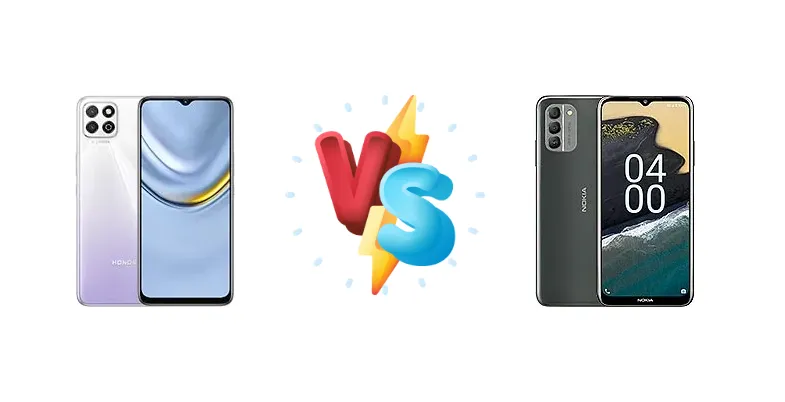
The Honor Play 20 and Nokia G400 represent two distinct approaches to the budget 5G smartphone market. The Play 20 aims for affordability with a Unisoc chipset, while the G400 leverages Qualcomm's Snapdragon 480+ for a more robust experience. This comparison dissects their key differences to determine which device delivers the best value.
🏆 Quick Verdict
For most users, the Nokia G400 is the superior choice. Its Snapdragon 480+ chipset, built on an 8nm process, provides a noticeable performance advantage over the Honor Play 20’s 12nm Unisoc T610. The faster 20W charging with PD3.0 support further sweetens the deal, making it a more practical daily driver.
| Network |
|---|
| 2G bands | GSM 850 / 900 / 1800 / 1900 | GSM 850 / 900 / 1800 / 1900 |
| 3G bands | HSDPA 850 / 900 / 1900 / 2100 | HSDPA 850 / 1700(AWS) / 1900 |
| 4G bands | LTE | 2, 4, 5, 12, 13, 25, 26, 41, 66, 71 |
| 5G bands | - | 2, 5, 25, 41, 66, 71, 77 SA/NSA |
| Speed | HSPA, LTE | HSPA, LTE, 5G |
| Technology | GSM / CDMA / HSPA / CDMA2000 / LTE | GSM / HSPA / LTE / 5G |
| | CDMA2000 1x | - |
| Launch |
|---|
| Announced | 2021, April 26 | 2022, January 05 |
| Status | Available. Released 2021, May 01 | Available. Released 2022, August 24 |
| Body |
|---|
| Build | Glass front, plastic back, plastic frame | Glass front (Gorilla Glass 3), aluminum frame |
| Dimensions | 164 x 75.8 x 8.9 mm (6.46 x 2.98 x 0.35 in) | 166.4 x 76.7 x 8.8 mm (6.55 x 3.02 x 0.35 in) |
| SIM | Nano-SIM + Nano-SIM | Nano-SIM |
| Weight | 198 g (6.98 oz) | 198 g (6.98 oz) |
| Display |
|---|
| Protection | - | Corning Gorilla Glass 3 |
| Resolution | 720 x 1600 pixels, 20:9 ratio (~269 ppi density) | 1080 x 2408 pixels, 20:9 ratio (~401 ppi density) |
| Size | 6.52 inches, 102.6 cm2 (~82.6% screen-to-body ratio) | 6.58 inches, 104.3 cm2 (~81.7% screen-to-body ratio) |
| Type | IPS LCD | IPS LCD, 120Hz |
| Platform |
|---|
| CPU | Octa-core (2x1.8 GHz Cortex-A75 & 6x1.8 GHz Cortex-A55) | Octa-core (2x2.2 GHz Kryo 460 & 6x1.9 GHz Kryo 460) |
| Chipset | Unisoc T610 (12 nm) | Qualcomm SM4350-AC Snapdragon 480+ 5G (8 nm) |
| GPU | Mali-G52 MP2 | Adreno 619 |
| OS | Android 10, Magic UI 4.0, no Google Play Services | Android 12 |
| Memory |
|---|
| Card slot | microSDXC (uses shared SIM slot) | microSDXC (dedicated slot) |
| Internal | 64GB 4GB RAM, 128GB 4GB RAM, 128GB 6GB RAM, 128GB 8GB RAM | 64GB 4GB RAM |
| | eMMC 5.1 | - |
| Main Camera |
|---|
| Dual | 13 MP, f/1.8, (wide), PDAF
Auxiliary lens | - |
| Features | LED flash, HDR, panorama | LED flash, HDR, panorama |
| Single | 5 MP, f/2.2, (wide) | 16 MP, (wide) |
| Triple | - | 48 MP, f/1.8, (wide), PDAF
5 MP, f/2.2, 115˚ (ultrawide)
Auxiliary lens |
| Video | 1080p@30fps | 1080p@30/60fps |
| Selfie camera |
|---|
| Single | 5 MP, f/2.2, (wide) | 16 MP, (wide) |
| Video | - | 1080p@30fps |
| Sound |
|---|
| 3.5mm jack | Yes | Yes |
| 35mm jack | Yes | Yes |
| Loudspeaker | Yes | Yes |
| Comms |
|---|
| Bluetooth | 5.0, A2DP, LE | 5.1, A2DP, LE, aptX HD, aptX Adaptive |
| NFC | No | Yes |
| Positioning | GPS, BDS | GPS, GALILEO |
| Radio | FM radio | FM radio |
| USB | USB Type-C 2.0 | USB Type-C 2.0, OTG |
| WLAN | Wi-Fi 802.11 b/g/n | Wi-Fi 802.11 b/g/n/ac |
| Features |
|---|
| Sensors | Accelerometer, proximity, compass | Fingerprint (side-mounted), accelerometer, gyro, proximity, compass, barometer |
| Battery |
|---|
| Charging | 10W wired | 20W wired, PD3.0 |
| Type | Li-Po 5000 mAh | Li-Po 5000 mAh |
| Misc |
|---|
| Colors | Black, White, Blue, Silver/Pink | Meteor Grey |
| Models | KOZ-AL00 | TA-1530, TA-1448, TA-1476, N1530DL |
| Price | About 110 EUR | About 70 EUR |
| SAR | - | 1.05 W/kg (head) 1.09 W/kg (body) |
Honor Play 20
- Potentially lower price point
- Simple and straightforward user experience
- Acceptable for basic tasks
- Significantly weaker performance
- Slow 10W charging
- Less future-proof chipset
Nokia G400
- Faster Snapdragon 480+ 5G chipset
- 20W fast charging with PD3.0
- Better 5G connectivity
- May be slightly more expensive
- Software updates may be slower
- Larger size may not suit all users
Display Comparison
Neither device boasts a standout display. Details on panel type and resolution are missing, but the focus here is on performance. The absence of high refresh rates on both suggests a cost-cutting approach. The Nokia G400’s larger screen size (6.6 inches vs. 6.5 inches on the Play 20) may offer a more immersive viewing experience, but without knowing the panel quality, it’s difficult to definitively declare a winner.
Camera Comparison
Without detailed camera specs beyond the chipsets, a direct comparison is limited. However, the Snapdragon 480+ typically supports more advanced image signal processors (ISPs), potentially leading to better image quality and faster processing times on the Nokia G400. The Honor Play 20 likely relies on the Unisoc T610’s ISP, which is less sophisticated. The presence of a 5G modem in the Snapdragon 480+ also suggests better video recording capabilities.
Performance
The core difference lies in the chipsets. The Nokia G400’s Qualcomm Snapdragon 480+ (8nm) significantly outperforms the Honor Play 20’s Unisoc T610 (12nm). The 8nm process allows for greater transistor density and improved power efficiency, translating to better sustained performance and less thermal throttling. The Snapdragon’s Kryo 460 cores, clocked at up to 2.2 GHz, also have an architectural advantage over the Cortex-A75 cores in the Unisoc chip, which peak at 1.8 GHz. This difference will be most noticeable in demanding applications and multitasking.
Battery Life
While battery capacity isn’t specified, the Nokia G400’s 20W wired charging with PD3.0 is a clear advantage over the Honor Play 20’s slow 10W charging. PD3.0 allows for faster and more efficient charging, reducing downtime. Even if the Play 20 has a slightly larger battery, the G400’s faster charging will likely result in a more convenient user experience.
Buying Guide
Buy the Honor Play 20 if your primary need is a very basic smartphone for essential tasks like calls, texts, and light social media, and you're operating on an extremely tight budget. Buy the Nokia G400 if you prioritize smoother performance, faster charging, and a more future-proof 5G experience, even if it means spending a bit more.
Frequently Asked Questions
❓ Will the Nokia G400’s Snapdragon 480+ handle demanding games like PUBG Mobile?
While the Snapdragon 480+ isn’t a gaming powerhouse, it’s capable of running PUBG Mobile at medium settings with acceptable frame rates. The Unisoc T610 in the Honor Play 20 will struggle with the same game, requiring significantly lower settings and potentially experiencing lag.
❓ How much faster is the 20W charging on the Nokia G400 compared to the 10W charging on the Honor Play 20?
The 20W charging on the Nokia G400 can potentially reduce charging time by 50% or more, depending on the battery capacity. A full charge on the Honor Play 20 could take upwards of 3 hours, while the G400 could achieve a full charge in around 1.5 to 2 hours.
❓ Does the Nokia G400 support carrier aggregation for improved 5G speeds?
The Snapdragon 480+ generally supports carrier aggregation, which allows the phone to combine multiple 5G channels for faster data speeds. This is a significant advantage over the Honor Play 20, which likely has limited 5G capabilities due to its older chipset.