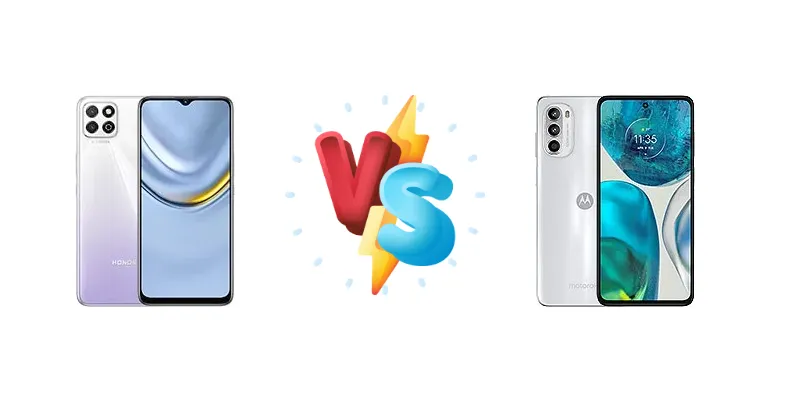
The Honor Play 20 and Motorola Moto G52 represent compelling options in the crowded budget smartphone market. While both aim to deliver essential features at an accessible price point, they diverge significantly in their core hardware, particularly in their chipsets and charging capabilities. This comparison dissects these differences to determine which device offers the best value for your money.
🏆 Quick Verdict
For the average user prioritizing responsiveness and future-proofing, the Motorola Moto G52 is the superior choice. Its Snapdragon 680, built on a 6nm process, delivers noticeably better performance and efficiency compared to the Honor Play 20’s Unisoc T610. The 30W charging is a significant advantage, offsetting the potentially smaller battery capacity.
| Network |
|---|
| 2G bands | GSM 850 / 900 / 1800 / 1900 | GSM 850 / 900 / 1800 / 1900 |
| 3G bands | HSDPA 850 / 900 / 1900 / 2100 | HSDPA 850 / 900 / 1700(AWS) / 1900 / 2100 |
| 4G bands | LTE | LTE |
| Speed | HSPA, LTE | HSPA, LTE |
| Technology | GSM / CDMA / HSPA / CDMA2000 / LTE | GSM / HSPA / LTE |
| | CDMA2000 1x | - |
| Launch |
|---|
| Announced | 2021, April 26 | 2022, April 12 |
| Status | Available. Released 2021, May 01 | Available. Released 2022, April 20 |
| Body |
|---|
| Build | Glass front, plastic back, plastic frame | - |
| Dimensions | 164 x 75.8 x 8.9 mm (6.46 x 2.98 x 0.35 in) | 160.1 x 74.5 x 8 mm (6.30 x 2.93 x 0.31 in) |
| SIM | Nano-SIM + Nano-SIM | Nano-SIM + Nano-SIM |
| Weight | 198 g (6.98 oz) | 169 g (5.96 oz) |
| | - | Water-repellent design |
| Display |
|---|
| Resolution | 720 x 1600 pixels, 20:9 ratio (~269 ppi density) | 1080 x 2400 pixels, 20:9 ratio (~402 ppi density) |
| Size | 6.52 inches, 102.6 cm2 (~82.6% screen-to-body ratio) | 6.6 inches, 103.6 cm2 (~86.9% screen-to-body ratio) |
| Type | IPS LCD | AMOLED, 90Hz |
| Platform |
|---|
| CPU | Octa-core (2x1.8 GHz Cortex-A75 & 6x1.8 GHz Cortex-A55) | Octa-core (4x2.4 GHz Kryo 265 Gold & 4x1.9 GHz Kryo 265 Silver) |
| Chipset | Unisoc T610 (12 nm) | Qualcomm SM6225 Snapdragon 680 4G (6 nm) |
| GPU | Mali-G52 MP2 | Adreno 610 |
| OS | Android 10, Magic UI 4.0, no Google Play Services | Android 12, planned upgrade to Android 13 |
| Memory |
|---|
| Card slot | microSDXC (uses shared SIM slot) | microSDXC (uses shared SIM slot) |
| Internal | 64GB 4GB RAM, 128GB 4GB RAM, 128GB 6GB RAM, 128GB 8GB RAM | 64GB 4GB RAM, 128GB 4GB RAM, 128GB 6GB RAM, 256GB 6GB RAM |
| | eMMC 5.1 | - |
| Main Camera |
|---|
| Dual | 13 MP, f/1.8, (wide), PDAF
Auxiliary lens | - |
| Features | LED flash, HDR, panorama | LED flash, HDR, panorama |
| Single | 5 MP, f/2.2, (wide) | - |
| Triple | - | 50 MP, f/1.8 (wide), 1/2.76", 0.64µm, PDAF
8 MP, f/2.2, 118˚ (ultrawide), 1/4.0", 1.12µm
2 MP (macro) |
| Video | 1080p@30fps | 1080p@30fps |
| Selfie camera |
|---|
| Single | 5 MP, f/2.2, (wide) | 16 MP, f/2.5, (wide), 1.0µm |
| Video | - | 1080p@30fps |
| Sound |
|---|
| 3.5mm jack | Yes | Yes |
| 35mm jack | Yes | Yes |
| Loudspeaker | Yes | Yes, with stereo speakers |
| Comms |
|---|
| Bluetooth | 5.0, A2DP, LE | 5.0, A2DP, LE |
| NFC | No | Yes (market/region dependent) |
| Positioning | GPS, BDS | GPS, GLONASS, GALILEO |
| Radio | FM radio | Unspecified |
| USB | USB Type-C 2.0 | USB Type-C 2.0 |
| WLAN | Wi-Fi 802.11 b/g/n | Wi-Fi 802.11 a/b/g/n/ac, dual-band, Wi-Fi Direct |
| Features |
|---|
| Sensors | Accelerometer, proximity, compass | Fingerprint (side-mounted), accelerometer, gyro, proximity, compass |
| Battery |
|---|
| Charging | 10W wired | 30W wired |
| Type | Li-Po 5000 mAh | Li-Po 5000 mAh |
| Misc |
|---|
| Colors | Black, White, Blue, Silver/Pink | Charcoal Gray, Porcelain White |
| Models | KOZ-AL00 | XT2221-1, XT2221-2 |
| Price | About 110 EUR | About 470 EUR |
Honor Play 20
- Potentially lower price point
- Acceptable for basic smartphone tasks
- Simple and straightforward user experience
- Slow 10W charging
- Less powerful Unisoc T610 chipset
- Likely lower performance in demanding apps
Motorola Moto G52
- Faster and more efficient Snapdragon 680 chipset
- 30W fast charging
- Better multitasking and app responsiveness
- May be slightly more expensive
- Potentially less battery life if battery capacity is significantly smaller
- Software updates may be less frequent than Honor
Display Comparison
Neither device boasts a standout display. Details regarding panel type (IPS vs AMOLED) and resolution are missing, but both likely feature 1080p+ displays typical of this price bracket. The key difference lies elsewhere. The focus here is on internal performance, not visual fidelity.
Camera Comparison
Without detailed camera specifications beyond the chipsets, a direct comparison is limited. However, the Snapdragon 680 typically supports more advanced image signal processors (ISPs) than those found in Unisoc T610-powered devices. This translates to potentially better image processing, dynamic range, and low-light performance on the Moto G52. The absence of information regarding sensor sizes and lens apertures makes a definitive statement impossible, but the chipset advantage leans towards Motorola.
Performance
The Motorola Moto G52’s Qualcomm Snapdragon 680 4G (6nm) represents a substantial leap over the Honor Play 20’s Unisoc T610 (12nm). The 6nm fabrication process inherently offers better power efficiency, translating to less heat generation and sustained performance. While both are octa-core CPUs, the Snapdragon 680 utilizes a more modern architecture with 4x2.4 GHz Kryo 265 Gold cores and 4x1.9 GHz Kryo 265 Silver cores, compared to the Honor Play 20’s 2x1.8 GHz Cortex-A75 and 6x1.8 GHz Cortex-A55 configuration. This architectural difference, combined with the process node advantage, means the Moto G52 will handle demanding apps and multitasking with greater ease. The Unisoc T610, while adequate for basic tasks, will likely exhibit more noticeable slowdowns under load.
Battery Life
The Motorola Moto G52’s 30W wired charging is a game-changer in this segment. The Honor Play 20’s 10W charging is comparatively slow, requiring significantly longer to reach a full charge. While battery capacity isn’t specified, the Snapdragon 680’s superior power efficiency means the Moto G52 can likely deliver comparable or even better battery life despite potentially having a smaller battery. The faster charging speed is a major convenience factor for users who need to quickly top up their device.
Buying Guide
Buy the Honor Play 20 if your primary need is a basic smartphone for light tasks like calls, messaging, and occasional social media browsing, and you are on an extremely tight budget. Buy the Motorola Moto G52 if you prioritize smoother multitasking, a more responsive user experience, and significantly faster charging, even if it means spending a little more upfront. The Moto G52 is also a better choice for users who anticipate using their phone for more than just basic communication.
Frequently Asked Questions
❓ Will the Unisoc T610 in the Honor Play 20 struggle with modern mobile games like PUBG or Call of Duty?
Yes, the Unisoc T610 is likely to struggle with graphically demanding games. While playable at low settings, you'll likely experience frame drops and stuttering, especially during intense action. The Snapdragon 680 in the Moto G52 offers a significantly smoother gaming experience, even at medium settings.
❓ How long does it realistically take to fully charge the Honor Play 20 with its 10W charger?
Expect a full charge from 0% to 100% on the Honor Play 20 to take approximately 3-4 hours with the included 10W charger. This is considerably slower than the Motorola Moto G52, which can reach a full charge in around an hour with its 30W charger.
❓ Does the Motorola Moto G52 support VoLTE and VoWiFi for improved call quality?
The Motorola Moto G52 generally supports VoLTE (Voice over LTE) and VoWiFi (Voice over Wi-Fi) depending on carrier compatibility. This provides clearer call quality and faster connection times compared to older 2G/3G networks. Check with your specific carrier to confirm compatibility.
❓ Is the software experience significantly different between the Honor Play 20 and Motorola Moto G52?
Yes. The Honor Play 20 likely runs Magic UI based on Android, which has a distinct interface and pre-installed apps. The Moto G52 runs a near-stock Android experience with Motorola's 'My UX' customizations, offering a cleaner and more streamlined interface with fewer bloatware apps.