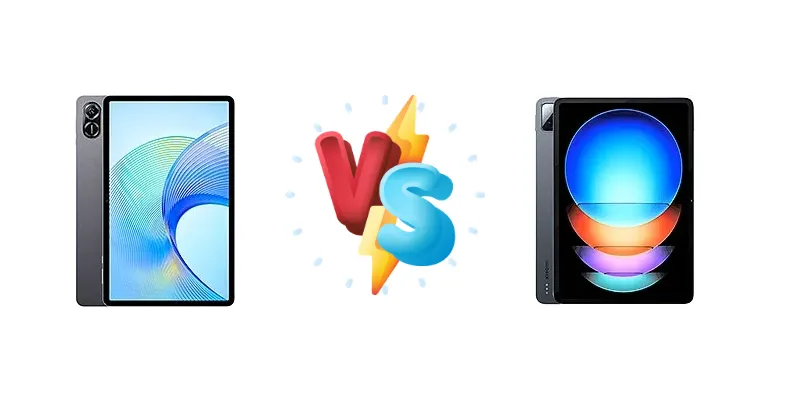
The tablet market is heating up, with options ranging from budget-friendly media consumption devices to full-fledged productivity powerhouses. We're pitting the Honor Pad X9, a champion of battery endurance, against the Xiaomi Pad 6S Pro 12.4, a tablet boasting flagship-level performance thanks to the Snapdragon 8 Gen 2. This comparison will dissect their strengths and weaknesses to help you choose the right tablet for your needs.
🏆 Quick Verdict
For the average user prioritizing raw power and a premium experience, the Xiaomi Pad 6S Pro 12.4 is the clear winner. Its Snapdragon 8 Gen 2 chipset offers significantly faster performance. However, if battery life is paramount and you're on a tighter budget, the Honor Pad X9 provides exceptional longevity.
| Network |
|---|
| 2G bands | GSM 850 / 900 / 1800 / 1900 | N/A |
| 3G bands | HSDPA 900 / 2100 | N/A |
| 4G bands | LTE | - |
| EDGE | - | N/A |
| GPRS | - | N/A |
| Speed | HSPA, LTE - cellular model only | - |
| Technology | GSM / HSPA / LTE | No cellular connectivity |
| Launch |
|---|
| Announced | 2023, July 06 | 2024, February 22 |
| Status | Available. Released 2023, July 06 | Available. Released 2024, February 22 |
| Body |
|---|
| Build | Glass front, aluminum frame, aluminum back | Glass front (Gorilla Glass 5), aluminum frame, aluminum back |
| Dimensions | 267.3 x 167.4 x 6.9 mm (10.52 x 6.59 x 0.27 in) | 278.7 x 191.6 x 6.3 mm (10.97 x 7.54 x 0.25 in) |
| SIM | Nano-SIM (cellular model only) | No |
| Weight | 495 g or 499 g (1.09 lb) | 590 g (1.30 lb) |
| Display |
|---|
| Protection | - | Corning Gorilla Glass 5 |
| Resolution | 1200 x 2000 pixels, 5:3 ratio (~203 ppi density) | 2032 x 3048 pixels, 3:2 ratio (~295 ppi density) |
| Size | 11.5 inches, 376.4 cm2 (~84.1% screen-to-body ratio) | 12.4 inches, 457.8 cm2 (~85.7% screen-to-body ratio) |
| Type | TFT LCD, 120Hz | IPS LCD, 68B colors, 144Hz, HDR10, Dolby Vision, 900 nits (peak) |
| Platform |
|---|
| CPU | Octa-core (4x2.8 GHz Cortex-A73 & 4x1.9 GHz Cortex-A53) | Octa-core (1x3.2 GHz Cortex-X3 & 2x2.8 GHz Cortex-A715 & 2x2.8 GHz Cortex-A710 & 3x2.0 GHz Cortex-A510) |
| Chipset | Qualcomm SM6225 Snapdragon 685 (6 nm) | Qualcomm SM8550-AB Snapdragon 8 Gen 2 (4 nm) |
| GPU | Adreno 610 | Adreno 740 |
| OS | Android 13, MagicOS 7.1 | Android 14, up to 3 major Android upgrades, HyperOS |
| Memory |
|---|
| Card slot | No | No |
| Internal | 128GB 4GB RAM | 256GB 8GB RAM, 256GB 12GB RAM, 512GB 12GB RAM, 1TB 16GB RAM |
| Main Camera |
|---|
| Dual | - | 50 MP, f/1.8, (wide), 1/2.76", 0.64µm, PDAF
Auxiliary lens |
| Features | HDR | LED flash, HDR, panorama |
| Single | 5 MP, f/2.2, AF | - |
| Video | 1080p@30fps | 4K@30/60fps, 1080p@30/60fps |
| Selfie camera |
|---|
| Single | 5 MP, f/2.2 | 32 MP, f/2.2, (wide), 1/3.6", 0.61µm |
| Video | 1080p@30fps | 1080p@30fps |
| Sound |
|---|
| 35mm jack | No | No |
| Loudspeaker | Yes, with stereo speakers (6 speakers) | Yes, with stereo speakers (6 speakers) |
| Comms |
|---|
| Bluetooth | 5.1, A2DP, LE | 5.3, A2DP, LE, LHDC |
| NFC | No | Yes (file transfer only) |
| Positioning | GPS - cellular model only | No |
| Radio | No | No |
| USB | USB Type-C, OTG | USB Type-C 3.2, accessory connector |
| WLAN | Wi-Fi 802.11 a/b/g/n/ac, dual-band | Wi-Fi 802.11 a/b/g/n/a/6/7, dual-band, Wi-Fi Direct |
| Features |
|---|
| Sensors | Accelerometer | Fingerprint (side-mounted), accelerometer, gyro, proximity (accessories only), compass |
| Battery |
|---|
| Charging | 22.5W wired | 120W wired, PD3.0, QC4, 45% in 10 min, 100% in 35 min |
| Type | Li-Po 7250 mAh | 10000 mAh |
| Misc |
|---|
| Colors | Space Gray | Black, Blue, Green |
| Models | - | 24018RPACG |
| Price | About 250 EUR | About 700 EUR |
| SAR EU | - | 0.99 W/kg (body) |
Honor Pad X9
- Exceptional battery life (13:17h active use)
- More affordable price point
- Higher contrast ratio (1603:1)
- Significantly slower processor (Snapdragon 685)
- Slower charging speed (22.5W)
Xiaomi Pad 6S Pro 12.4
- Flagship-level performance (Snapdragon 8 Gen 2)
- Ultra-fast 120W charging
- Brighter display (848 nits)
- Shorter battery life (11:14h active use)
- Higher price tag
Display Comparison
The Xiaomi Pad 6S Pro 12.4 boasts a significantly brighter display, reaching 848 nits compared to the Honor Pad X9’s 452 nits. This makes the Xiaomi tablet far more usable outdoors or in brightly lit environments. While both displays offer a respectable contrast ratio (1378:1 for Xiaomi, 1603:1 for Honor), the Xiaomi’s higher brightness is a substantial advantage. We lack information on panel technology (LTPO, refresh rate) for both, but the brightness difference is the key differentiator here.
Camera Comparison
Given the tablet form factor, camera performance isn't usually a primary concern. However, the Xiaomi Pad 6S Pro 12.4 likely benefits from the superior image signal processor (ISP) within the Snapdragon 8 Gen 2, potentially leading to better image quality. Without specific camera specs for either device, it's difficult to make a definitive statement, but the Xiaomi’s chipset provides a foundation for superior image processing capabilities. We'll assume both devices have similar basic camera setups, focusing on the processing power advantage of the Xiaomi.
Performance
The performance gap between these two tablets is substantial. The Xiaomi Pad 6S Pro 12.4’s Snapdragon 8 Gen 2 (4nm) is a generational leap ahead of the Honor Pad X9’s Snapdragon 685 (6nm). The 8 Gen 2 features a Cortex-X3 prime core clocked at 3.2 GHz, alongside Cortex-A715 and A710 performance cores, offering significantly faster processing speeds and improved efficiency. The Honor Pad X9’s Cortex-A73 cores, while capable, are older architecture and will struggle with demanding tasks. The 4nm process node of the Snapdragon 8 Gen 2 also contributes to better thermal management, reducing the likelihood of performance throttling during sustained workloads.
Battery Life
The Honor Pad X9 shines in battery life, achieving an active use score of 13:17 hours, surpassing the Xiaomi Pad 6S Pro 12.4’s 11:14 hours. However, the Xiaomi compensates with incredibly fast 120W wired charging, reaching 45% charge in just 10 minutes and a full charge in 35 minutes. The Honor Pad X9’s 22.5W charging is considerably slower. This means while the Honor Pad X9 lasts longer on a single charge, the Xiaomi can quickly top up when needed, mitigating the difference in overall endurance.
Buying Guide
Buy the Honor Pad X9 if you need a tablet primarily for extended media consumption, reading, or light productivity tasks where battery life is critical and you don't require demanding performance. Buy the Xiaomi Pad 6S Pro 12.4 if you prefer a tablet capable of handling demanding games, video editing, or multitasking without compromise, and you value the speed and responsiveness of a flagship processor.
Frequently Asked Questions
❓ Does the Snapdragon 8 Gen 2 in the Xiaomi Pad 6S Pro 12.4 get hot during extended gaming sessions?
While the Snapdragon 8 Gen 2 is a powerful chip, its 4nm process and likely optimized thermal design in the Xiaomi Pad 6S Pro 12.4 should mitigate significant overheating. However, prolonged, graphically intensive gaming will inevitably generate heat. Expect some performance throttling after extended periods, but it should be less pronounced than on devices with less efficient chipsets.
❓ Is the 22.5W charging on the Honor Pad X9 slow enough to be a major inconvenience?
Compared to the Xiaomi's 120W charging, 22.5W is considerably slower. A full charge will take significantly longer. However, the Honor Pad X9's exceptional battery life means you may not need to charge it as frequently, lessening the impact of the slower charging speed. It's best suited for overnight charging.
❓ Can the Xiaomi Pad 6S Pro 12.4 handle demanding productivity tasks like video editing?
Absolutely. The Snapdragon 8 Gen 2 is more than capable of handling demanding productivity tasks like video editing, photo editing, and running multiple applications simultaneously. The ample RAM (spec not provided, but likely LPDDR5x) further enhances multitasking performance.
❓ What type of user would benefit most from the Honor Pad X9's long battery life?
The Honor Pad X9 is ideal for users who frequently travel, consume a lot of media on the go, or need a tablet that can last through a full workday without needing to be plugged in. Students, commuters, and anyone who prioritizes endurance will appreciate its long-lasting battery.