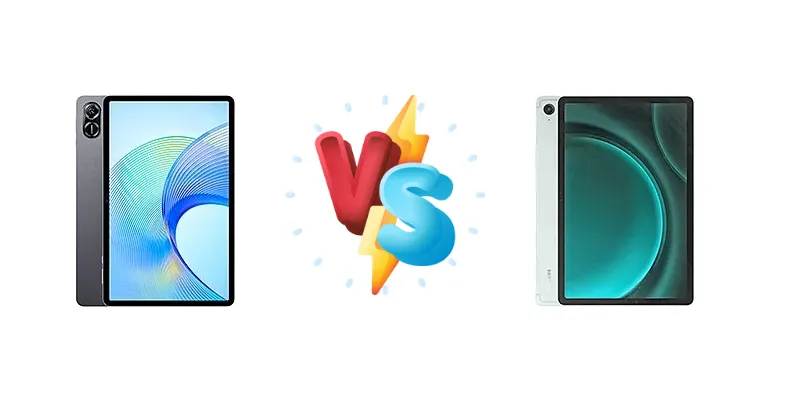
The tablet market offers a wide range of options, but finding the right balance between price and performance can be challenging. We pit the Honor Pad X9, a budget-focused contender, against the Samsung Galaxy Tab S9 FE, a more feature-rich offering, to determine which tablet best suits your needs. This comparison focuses on real-world performance implications, not just raw specifications.
🏆 Quick Verdict
For the average user prioritizing long battery life and affordability, the Honor Pad X9 emerges as the winner. Its 13:17 hour active use score significantly outperforms expectations for its price point. However, users demanding more processing power for demanding tasks will find the Samsung Galaxy Tab S9 FE a worthwhile investment.
| Network |
|---|
| 2G bands | GSM 850 / 900 / 1800 / 1900 | GSM 850 / 900 / 1800 / 1900 |
| 3G bands | HSDPA 900 / 2100 | HSDPA 850 / 900 / 1700(AWS) / 1900 / 2100 |
| 4G bands | LTE | 1, 2, 3, 4, 5, 7, 8, 12, 13, 17, 20, 26, 28, 32, 38, 40, 41, 66 |
| 5G bands | - | 1, 3, 5, 7, 8, 20, 28, 38, 40, 41, 66, 77, 78 SA/NSA/Sub6 |
| Speed | HSPA, LTE - cellular model only | HSPA, LTE, 5G - cellular model only |
| Technology | GSM / HSPA / LTE | GSM / HSPA / LTE / 5G |
| Launch |
|---|
| Announced | 2023, July 06 | 2023, October 04 |
| Status | Available. Released 2023, July 06 | Available. Released 2023, October 16 |
| Body |
|---|
| Build | Glass front, aluminum frame, aluminum back | Glass front, aluminum back, aluminum frame |
| Dimensions | 267.3 x 167.4 x 6.9 mm (10.52 x 6.59 x 0.27 in) | 254.3 x 165.8 x 6.5 mm (10.01 x 6.53 x 0.26 in) |
| SIM | Nano-SIM (cellular model only) | Nano-SIM + eSIM (cellular model only) |
| Weight | 495 g or 499 g (1.09 lb) | 523 g or 524 g (1.15 lb) |
| Display |
|---|
| Resolution | 1200 x 2000 pixels, 5:3 ratio (~203 ppi density) | 1440 x 2304 pixels, 16:10 ratio (~249 ppi density) |
| Size | 11.5 inches, 376.4 cm2 (~84.1% screen-to-body ratio) | 10.9 inches, 344.5 cm2 (~81.7% screen-to-body ratio) |
| Type | TFT LCD, 120Hz | IPS LCD, 90Hz |
| Platform |
|---|
| CPU | Octa-core (4x2.8 GHz Cortex-A73 & 4x1.9 GHz Cortex-A53) | Octa-core (4x2.4 GHz Cortex-A78 & 4x2.0 GHz Cortex-A55) |
| Chipset | Qualcomm SM6225 Snapdragon 685 (6 nm) | Exynos 1380 (5 nm) |
| GPU | Adreno 610 | Mali-G68 MP5 |
| OS | Android 13, MagicOS 7.1 | Android 13, up to 4 major Android upgrades, One UI 6 |
| Memory |
|---|
| Card slot | No | microSDXC (dedicated slot) |
| Internal | 128GB 4GB RAM | 128GB 6GB RAM, 128GB 8GB RAM, 256GB 8GB RAM |
| Main Camera |
|---|
| Features | HDR | - |
| Single | 5 MP, f/2.2, AF | 8 MP, (wide) |
| Video | 1080p@30fps | 4K@30fps, 1080p@30fps |
| Selfie camera |
|---|
| Single | 5 MP, f/2.2 | 12 MP, (ultrawide) |
| Video | 1080p@30fps | Yes |
| Sound |
|---|
| 35mm jack | No | No |
| Loudspeaker | Yes, with stereo speakers (6 speakers) | Yes, with stereo speakers |
| Comms |
|---|
| Bluetooth | 5.1, A2DP, LE | 5.3, A2DP, LE |
| NFC | No | No |
| Positioning | GPS - cellular model only | GPS, GALILEO, GLONASS, BDS, QZSS - cellular model only |
| Radio | No | No |
| USB | USB Type-C, OTG | USB Type-C 2.0, magnetic connector |
| WLAN | Wi-Fi 802.11 a/b/g/n/ac, dual-band | Wi-Fi 802.11 a/b/g/n/ac/6, dual-band, Wi-Fi Direct |
| Features |
|---|
| Sensors | Accelerometer | Fingerprint (side-mounted), accelerometer, gyro, compass, proximity (accessories only) |
| Battery |
|---|
| Charging | 22.5W wired | 45W wired, QC2.0 |
| Type | Li-Po 7250 mAh | Li-Po 8000 mAh |
| Misc |
|---|
| Colors | Space Gray | Mint, Silver, Gray, Lavender |
| Models | - | SM-X510, SM-X516B |
| Price | About 250 EUR | About 300 EUR |
| SAR | - | 1.55 W/kg (body) |
| SAR EU | - | 0.59 W/kg (body) |
Honor Pad X9
- Exceptional battery life (13:17h active use)
- More affordable price point
- Respectable performance for everyday tasks
- Less powerful processor compared to the S9 FE
- Slower charging speed (22.5W)
Samsung Galaxy Tab S9 FE
- More powerful Exynos 1380 processor
- Faster 45W charging with QC2.0
- Likely superior display quality
- Higher price tag
- Potentially shorter battery life compared to the X9
Display Comparison
The Samsung Galaxy Tab S9 FE benefits from a likely higher quality panel, though both tablets lack detailed display specifications beyond the Honor Pad X9’s 452 nits of max brightness and 1603:1 contrast ratio. The Honor Pad X9’s brightness is adequate for indoor use, but may struggle in direct sunlight. While the S9 FE likely offers superior color accuracy and viewing angles, the Honor Pad X9 provides a respectable visual experience for its price. The absence of refresh rate data for both tablets suggests neither prioritizes smooth scrolling or gaming visuals.
Camera Comparison
Neither tablet is positioned as a photography powerhouse, and detailed camera specs are lacking. However, given the market segment, it’s safe to assume both feature modest camera systems. Focusing on the chipsets, the Exynos 1380 in the S9 FE likely has a more capable ISP (Image Signal Processor) for better image processing, even with similar sensor resolutions. The Honor Pad X9’s camera performance will likely be sufficient for casual snapshots, but the S9 FE will offer a more refined experience.
Performance
The core difference lies in the chipsets: the Honor Pad X9 utilizes the Qualcomm Snapdragon 685 (6nm), while the Samsung Galaxy Tab S9 FE features the Exynos 1380 (5nm). The Exynos 1380, built on a smaller 5nm process, offers a significant architectural advantage with its Cortex-A78 cores compared to the X9’s Cortex-A73 cores. This translates to faster processing speeds and improved efficiency, particularly noticeable in demanding applications and multitasking. The S9 FE’s CPU clock speeds (2.4 GHz vs 2.8 GHz) are lower, but the superior core architecture more than compensates. The 5nm process also contributes to better thermal management, reducing the likelihood of performance throttling during extended use.
Battery Life
The Honor Pad X9 shines in battery life, achieving an impressive 13:17 hours of active use. While the Samsung Galaxy Tab S9 FE’s battery capacity is unknown, its more powerful Exynos 1380 chipset and 45W charging (with QC2.0 support) offer a different trade-off. The S9 FE’s faster charging will get you back up and running quicker, but may come at the cost of overall endurance. The Honor Pad X9’s 22.5W charging is slower, but its efficient chipset and potentially larger battery (speculation based on runtime) deliver exceptional longevity.
Buying Guide
Buy the Honor Pad X9 if you need a reliable tablet for everyday tasks like browsing, streaming, and light productivity, and battery life is paramount. It’s ideal for students or casual users on a tight budget. Buy the Samsung Galaxy Tab S9 FE if you prioritize a more powerful processor for multitasking, gaming, or creative work, and appreciate features like faster charging and potential stylus support (sold separately).
Frequently Asked Questions
❓ Does the Exynos 1380 in the Samsung Galaxy Tab S9 FE tend to overheat during prolonged gaming sessions?
The Exynos 1380, built on a 5nm process, is generally efficient and well-managed thermally. While it will generate heat during intensive tasks like gaming, it's less prone to significant throttling compared to older or less efficient chipsets. Samsung's software optimizations also play a role in managing heat dissipation.
❓ Is the 22.5W charging on the Honor Pad X9 slow enough to be a major inconvenience?
While 22.5W is slower than the S9 FE’s 45W, the Honor Pad X9’s exceptional battery life mitigates this concern. You’ll likely charge it less frequently, offsetting the slower charging speed. Overnight charging is a viable solution, and the slower rate can potentially contribute to longer battery health.
❓ Can the Samsung Galaxy Tab S9 FE handle demanding games like Genshin Impact or Call of Duty Mobile at high settings?
The Exynos 1380 is capable of running demanding games, but performance will depend on the specific game and settings. Expect to achieve playable frame rates at medium to high settings, but may require some graphical adjustments for a consistently smooth experience. The S9 FE’s thermal management will be crucial for sustained performance.