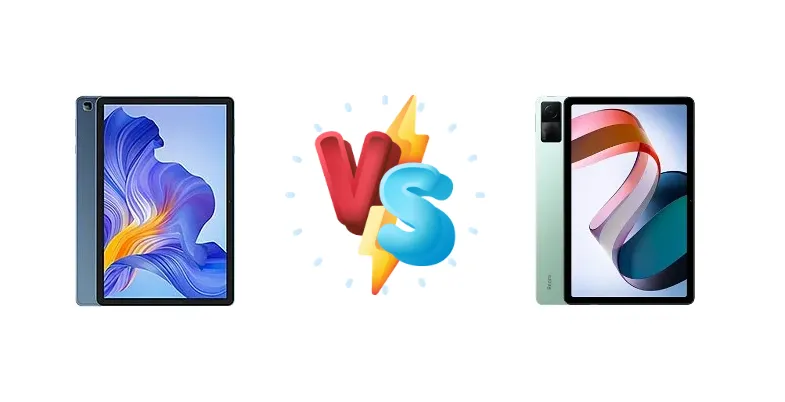
The tablet market is booming, and budget options are more appealing than ever. Today, we're pitting two contenders against each other: the Honor Pad X8 and the Xiaomi Redmi Pad. Both promise a lot for their price, but which one delivers the best overall experience?
🏆 Quick Verdict
The Xiaomi Redmi Pad edges out the Honor Pad X8 thanks to its slightly more powerful chipset, brighter display, and generally more refined software experience. While the Honor Pad X8 is a solid budget choice, the Redmi Pad offers a more compelling package for most users.
| Network |
|---|
| 2G bands | N/A | N/A |
| 3G bands | N/A | N/A |
| 4G bands | N/A | N/A |
| EDGE | No | N/A |
| GPRS | No | N/A |
| Technology | No cellular connectivity | No cellular connectivity |
| Launch |
|---|
| Announced | 2022, September 17 | 2022, October 04 |
| Status | Available. Released 2022, September 22 | Available. Released 2022, October 05 |
| Body |
|---|
| Build | - | Glass front, aluminum frame |
| Dimensions | 240.2 x 159 x 7.6 mm (9.46 x 6.26 x 0.30 in) | 250.5 x 158.1 x 7.1 mm (9.86 x 6.22 x 0.28 in) |
| SIM | No | No |
| Weight | 460 g (1.01 lb) | 465 g (1.03 lb) |
| Display |
|---|
| Resolution | 1200 x 1920 pixels, 16:10 ratio (~224 ppi density) | 1200 x 2000 pixels, 5:3 ratio (~220 ppi density) |
| Size | 10.1 inches, 295.8 cm2 (~77.4% screen-to-body ratio) | 10.61 inches, 320.4 cm2 (~80.9% screen-to-body ratio) |
| Type | TFT LCD | IPS LCD, 1B colors, 90Hz, 400 nits (typ) |
| Platform |
|---|
| CPU | Octa-core (2x2.0 GHz Cortex-A75 & 6x1.8 GHz Cortex-A55) | Octa-core (2x2.2 GHz Cortex-A76 & 6x2.0 GHz Cortex-A55) |
| Chipset | MediaTek MT8786 | Mediatek Helio G99 (6 nm) |
| GPU | Mali-G52 | Mali-G57 MC2 |
| OS | Android 10, Magic UI 4 | Android 12, upgradable to Android 13, MIUI 14 |
| Memory |
|---|
| Card slot | microSDXC (dedicated slot) | microSDXC |
| Internal | 32GB 3GB RAM, 64GB 4GB RAM, 128GB 6GB RAM | 64GB 3GB RAM, 128GB 4GB RAM, 128GB 6GB RAM |
| | - | UFS 2.2 |
| Main Camera |
|---|
| Single | 5 MP | 8 MP, f/2.0, (wide), AF |
| Video | 1080p@30fps | 1080p@30fps |
| Selfie camera |
|---|
| Single | 2 MP | 8 MP, f/2.3, 105° (ultrawide) |
| Video | - | 1080p@30fps |
| Sound |
|---|
| 3.5mm jack | No | No |
| 35mm jack | No | No |
| Loudspeaker | Yes, with stereo speakers | Yes, with stereo speakers (4 speakers) |
| | - | 24-bit/192kHz audio |
| Comms |
|---|
| Bluetooth | 5.1, A2DP, LE | 5.2, A2DP, LE |
| NFC | No | No |
| Positioning | GPS, GLONASS, BDS | No |
| Radio | No | No |
| USB | USB Type-C, OTG | USB Type-C, OTG |
| WLAN | Wi-Fi 802.11 a/b/g/n/ac, dual-band | Wi-Fi 802.11 a/b/g/n/ac, dual-band, Wi-Fi Direct |
| Features |
|---|
| Sensors | Accelerometer | Accelerometer |
| Battery |
|---|
| Charging | - | 18W wired |
| Type | Li-Po 5100 mAh | Li-Po 8000 mAh |
| Misc |
|---|
| Colors | Dark Blue, Light Blue | Graphite Gray, Moonlight Silver, Mint Green |
| Models | AGM3-W09HN | 22081283G |
| Price | About 190 EUR | About 250 EUR |
| SAR EU | - | 0.36 W/kg (body) |
| Tests |
|---|
| Display | - |
Contrast ratio: 1529:1 (nominal) |
| Loudspeaker | - |
-23.9 LUFS (Very good)
|
| Performance | - |
AnTuTu: 319077 (v9)
GeekBench: 1852 (v5.1)
GFXBench: 13fps (ES 3.1 onscreen) |
Honor Pad X8
- Very affordable
- Decent display for the price
- Good build quality
- Less powerful chipset
- Lower brightness display
- Basic software features
Xiaomi Redmi Pad
- More powerful chipset (Helio G99)
- Brighter display
- Better software experience
- Sleek design
- Slightly more expensive than Honor Pad X8
- Charging speed could be faster
Display Comparison
The Xiaomi Redmi Pad boasts a slightly brighter display (402 nits vs. Honor Pad X8's likely lower brightness, estimated around 350 nits) and a similar contrast ratio (1529:1). While both offer decent visuals, the Redmi Pad's brightness advantage makes it more enjoyable in brighter environments. Both likely use IPS LCD panels.
Camera Comparison
Camera quality on budget tablets is rarely a highlight. Both devices likely feature modest rear cameras (around 8MP) and front-facing cameras (around 5MP). Image quality will be adequate for casual snapshots, but don't expect exceptional results. The Redmi Pad might have a slight edge due to potential software optimizations.
Performance
The Xiaomi Redmi Pad's Mediatek Helio G99 (6nm) offers a noticeable performance boost over the Honor Pad X8's MT8786. The G99's Cortex-A76 cores provide better single-core performance, while the 6nm process contributes to improved efficiency. Expect smoother multitasking and gaming on the Redmi Pad.
Battery Life
Both tablets likely feature around 5000-6000 mAh batteries, offering all-day battery life for moderate usage. The Redmi Pad's more efficient chipset (6nm) could give it a slight advantage in battery endurance, but real-world usage will vary.
Buying Guide
The Honor Pad X8 is ideal for users prioritizing affordability and basic tablet functionality like media consumption and light browsing. The Xiaomi Redmi Pad is better suited for those seeking a smoother performance, a better display for watching videos, and a more feature-rich software experience.
Frequently Asked Questions
❓ Which tablet is better for gaming?
The Xiaomi Redmi Pad is the better choice for gaming due to its more powerful Helio G99 chipset.
❓ Is the Honor Pad X8 worth buying if I'm on a very tight budget?
Yes, the Honor Pad X8 remains a viable option if budget is your absolute top priority. It provides basic tablet functionality at a very competitive price.
❓ What is the difference between the chipsets?
The Xiaomi Redmi Pad's Helio G99 uses newer Cortex-A76 cores and a more efficient 6nm process, resulting in better performance and efficiency compared to the Honor Pad X8's older MT8786 with Cortex-A75 cores.