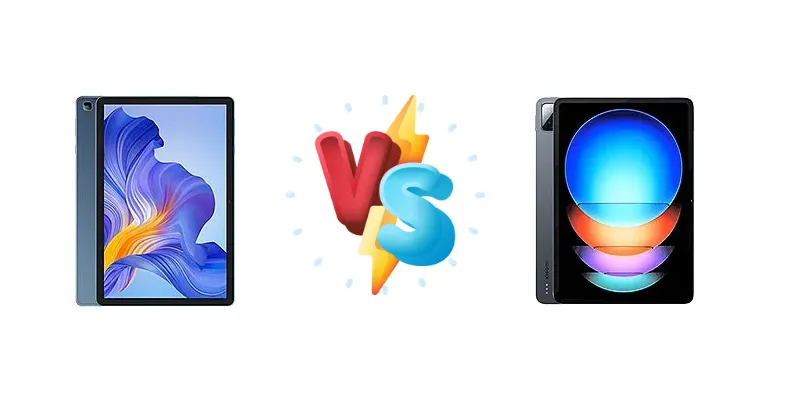
The tablet market is heating up, with options ranging from budget-friendly media consumption devices to full-fledged productivity powerhouses. We’re pitting the Xiaomi Pad 6S Pro 12.4, boasting a cutting-edge Snapdragon 8 Gen 2, against the Honor Pad X8, a more accessible option powered by a MediaTek MT8786. This comparison will dissect their strengths and weaknesses to help you determine which tablet best suits your needs.
🏆 Quick Verdict
For users demanding top-tier performance for demanding tasks like gaming and video editing, the Xiaomi Pad 6S Pro 12.4 is the clear winner. However, the Honor Pad X8 provides a compelling value proposition for everyday use, offering a functional experience at a significantly lower price point.
| Network |
|---|
| 2G bands | N/A | N/A |
| 3G bands | N/A | N/A |
| 4G bands | N/A | - |
| EDGE | No | N/A |
| GPRS | No | N/A |
| Technology | No cellular connectivity | No cellular connectivity |
| Launch |
|---|
| Announced | 2022, September 17 | 2024, February 22 |
| Status | Available. Released 2022, September 22 | Available. Released 2024, February 22 |
| Body |
|---|
| Build | - | Glass front (Gorilla Glass 5), aluminum frame, aluminum back |
| Dimensions | 240.2 x 159 x 7.6 mm (9.46 x 6.26 x 0.30 in) | 278.7 x 191.6 x 6.3 mm (10.97 x 7.54 x 0.25 in) |
| SIM | No | No |
| Weight | 460 g (1.01 lb) | 590 g (1.30 lb) |
| Display |
|---|
| Protection | - | Corning Gorilla Glass 5 |
| Resolution | 1200 x 1920 pixels, 16:10 ratio (~224 ppi density) | 2032 x 3048 pixels, 3:2 ratio (~295 ppi density) |
| Size | 10.1 inches, 295.8 cm2 (~77.4% screen-to-body ratio) | 12.4 inches, 457.8 cm2 (~85.7% screen-to-body ratio) |
| Type | TFT LCD | IPS LCD, 68B colors, 144Hz, HDR10, Dolby Vision, 900 nits (peak) |
| Platform |
|---|
| CPU | Octa-core (2x2.0 GHz Cortex-A75 & 6x1.8 GHz Cortex-A55) | Octa-core (1x3.2 GHz Cortex-X3 & 2x2.8 GHz Cortex-A715 & 2x2.8 GHz Cortex-A710 & 3x2.0 GHz Cortex-A510) |
| Chipset | MediaTek MT8786 | Qualcomm SM8550-AB Snapdragon 8 Gen 2 (4 nm) |
| GPU | Mali-G52 | Adreno 740 |
| OS | Android 10, Magic UI 4 | Android 14, up to 3 major Android upgrades, HyperOS |
| Memory |
|---|
| Card slot | microSDXC (dedicated slot) | No |
| Internal | 32GB 3GB RAM, 64GB 4GB RAM, 128GB 6GB RAM | 256GB 8GB RAM, 256GB 12GB RAM, 512GB 12GB RAM, 1TB 16GB RAM |
| Main Camera |
|---|
| Dual | - | 50 MP, f/1.8, (wide), 1/2.76", 0.64µm, PDAF
Auxiliary lens |
| Features | - | LED flash, HDR, panorama |
| Single | 5 MP | - |
| Video | 1080p@30fps | 4K@30/60fps, 1080p@30/60fps |
| Selfie camera |
|---|
| Single | 2 MP | 32 MP, f/2.2, (wide), 1/3.6", 0.61µm |
| Video | - | 1080p@30fps |
| Sound |
|---|
| 3.5mm jack | No | - |
| 35mm jack | No | No |
| Loudspeaker | Yes, with stereo speakers | Yes, with stereo speakers (6 speakers) |
| Comms |
|---|
| Bluetooth | 5.1, A2DP, LE | 5.3, A2DP, LE, LHDC |
| NFC | No | Yes (file transfer only) |
| Positioning | GPS, GLONASS, BDS | No |
| Radio | No | No |
| USB | USB Type-C, OTG | USB Type-C 3.2, accessory connector |
| WLAN | Wi-Fi 802.11 a/b/g/n/ac, dual-band | Wi-Fi 802.11 a/b/g/n/a/6/7, dual-band, Wi-Fi Direct |
| Features |
|---|
| Sensors | Accelerometer | Fingerprint (side-mounted), accelerometer, gyro, proximity (accessories only), compass |
| Battery |
|---|
| Charging | - | 120W wired, PD3.0, QC4, 45% in 10 min, 100% in 35 min |
| Type | Li-Po 5100 mAh | 10000 mAh |
| Misc |
|---|
| Colors | Dark Blue, Light Blue | Black, Blue, Green |
| Models | AGM3-W09HN | 24018RPACG |
| Price | About 190 EUR | About 700 EUR |
| SAR EU | - | 0.99 W/kg (body) |
Honor Pad X8
- Affordable price point
- Decent performance for everyday tasks
- Likely good battery life for basic usage
- Outmatched by the Snapdragon 8 Gen 2 in performance
- Display likely lacks the brightness and color accuracy of the Xiaomi
- Slower charging speeds
Xiaomi Pad 6S Pro 12.4
- Exceptional performance with Snapdragon 8 Gen 2
- Bright and high-contrast display
- Ultra-fast 120W charging
- Higher price tag
- May require more frequent charging with intensive use
- Potentially more heat generation under heavy load
Display Comparison
The Xiaomi Pad 6S Pro 12.4 boasts a significantly brighter display, reaching a measured 848 nits, compared to an unspecified brightness for the Honor Pad X8. This higher brightness translates to better visibility outdoors. Furthermore, the 1378:1 contrast ratio on the Xiaomi suggests deeper blacks and more vibrant colors. While the Honor Pad X8’s display specifications are limited, it’s likely to be an IPS panel geared towards cost-effectiveness, potentially lacking the color accuracy and viewing angles of a higher-end display found on the Xiaomi.
Camera Comparison
Given the context data, a detailed camera comparison is limited. Both tablets likely feature modest camera setups geared towards video conferencing and casual snapshots. The Xiaomi Pad 6S Pro 12.4, being a higher-end device, may incorporate a more sophisticated image signal processor (ISP) within the Snapdragon 8 Gen 2, resulting in better image quality. However, without specific sensor details for either device, it’s difficult to draw definitive conclusions. We can assume the Xiaomi will have a more capable main sensor.
Performance
The performance gap between these tablets is substantial. The Xiaomi Pad 6S Pro 12.4’s Snapdragon 8 Gen 2 (4nm) chipset, featuring a Cortex-X3 prime core clocked at 3.2 GHz, represents a massive leap over the Honor Pad X8’s MediaTek MT8786. The Snapdragon 8 Gen 2’s architecture – incorporating Cortex-A715 and A710 cores alongside A510 efficiency cores – delivers significantly faster processing speeds and improved multi-tasking capabilities. The 4nm process node also contributes to better thermal efficiency, minimizing throttling during sustained workloads. The Honor Pad X8’s MT8786, while capable for basic tasks, will struggle with demanding games and applications. The Xiaomi’s likely LPDDR5x RAM further enhances performance.
Battery Life
The Xiaomi Pad 6S Pro 12.4 shines in battery and charging capabilities. Its active use score of 11:14 hours demonstrates excellent endurance. Crucially, the 120W wired charging is a game-changer, achieving 45% charge in just 10 minutes and a full charge in 35 minutes. The Honor Pad X8’s battery capacity and charging speed are not specified, but it’s reasonable to assume it will charge significantly slower and offer less overall runtime, prioritizing affordability over rapid replenishment.
Buying Guide
Buy the Honor Pad X8 if you need a reliable tablet for casual browsing, streaming video, and light productivity tasks, prioritizing affordability and all-day battery life. Buy the Xiaomi Pad 6S Pro 12.4 if you prioritize raw processing power for demanding applications, gaming, and professional workflows, and are willing to pay a premium for the best possible performance and faster charging.
Frequently Asked Questions
❓ Will the Xiaomi Pad 6S Pro 12.4 get noticeably hot during extended gaming sessions?
While the Snapdragon 8 Gen 2 is thermally efficient, demanding games will inevitably generate heat. The Xiaomi Pad 6S Pro 12.4 likely incorporates thermal management solutions to mitigate throttling, but some heat is expected during prolonged, intensive gaming. The Honor Pad X8's MT8786 will likely throttle sooner due to its lower thermal headroom.
❓ Is the Honor Pad X8 sufficient for taking notes and light document editing?
Yes, the Honor Pad X8 is well-suited for basic productivity tasks like note-taking and light document editing. The MediaTek MT8786 chipset can handle these workloads adequately, although it may exhibit some lag when dealing with large or complex files. The Xiaomi Pad 6S Pro 12.4 would offer a smoother experience for more demanding productivity tasks.
❓ Does the Xiaomi Pad 6S Pro 12.4 support stylus input and keyboard accessories?
While not explicitly stated in the provided data, Xiaomi typically offers stylus and keyboard accessories for its Pro-level tablets. It's highly probable that the Pad 6S Pro 12.4 supports these accessories, enhancing its productivity capabilities. The Honor Pad X8's accessory support is likely more limited.