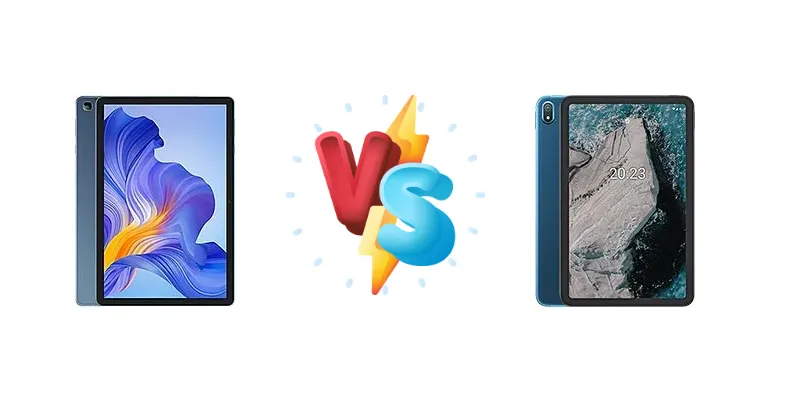
The budget tablet market is fiercely competitive, and the Honor Pad X8 and Nokia T20 represent compelling options for users seeking affordable Android slates. Both aim to deliver a functional tablet experience without breaking the bank, but they take different approaches to achieving this. This comparison dives deep into their specifications and performance to determine which tablet offers the best value.
🏆 Quick Verdict
For most users, the Honor Pad X8 emerges as the better choice. Its MediaTek MT8786 chipset, featuring slightly faster Cortex-A75 cores, provides a noticeable performance edge over the Nokia T20’s Unisoc T610, making it more responsive for everyday tasks and light gaming. While the Nokia T20 boasts a brighter display, the performance difference is more impactful for overall usability.
| Network |
|---|
| 2G bands | N/A | GSM 850 / 900 / 1800 / 1900 |
| 3G bands | N/A | HSDPA 850 / 900 / 1700(AWS) / 1900 / 2100 - US, LATAM |
| 4G bands | N/A | 1, 2, 3, 4, 5, 7, 8, 12, 13, 17, 20, 28, 40, 66 - US, LATAM |
| EDGE | No | - |
| GPRS | No | - |
| Speed | - | HSPA, LTE Cat4 150/50 Mbps - cellular model only |
| Technology | No cellular connectivity | GSM / HSPA / LTE |
| | - | 1, 3, 5, 7, 8, 20, 28, 38, 40, 41 - International |
| Launch |
|---|
| Announced | 2022, September 17 | 2021, October 06 |
| Status | Available. Released 2022, September 22 | Available. Released 2021, November 02 |
| Body |
|---|
| Build | - | Glass front, aluminum back |
| Dimensions | 240.2 x 159 x 7.6 mm (9.46 x 6.26 x 0.30 in) | 247.6 x 157.5 x 7.8 mm (9.75 x 6.20 x 0.31 in) |
| SIM | No | Nano-SIM (cellular model only) |
| Weight | 460 g (1.01 lb) | 465 g (Wi-Fi), 470 g (LTE) (1.03 lb) |
| | - | Splash resistant |
| Display |
|---|
| Protection | - | Scratch-resistant glass |
| Resolution | 1200 x 1920 pixels, 16:10 ratio (~224 ppi density) | 1200 x 2000 pixels, 5:3 ratio (~224 ppi density) |
| Size | 10.1 inches, 295.8 cm2 (~77.4% screen-to-body ratio) | 10.4 inches, 307.9 cm2 (~78.9% screen-to-body ratio) |
| Type | TFT LCD | IPS LCD, 400 nits (typ) |
| Platform |
|---|
| CPU | Octa-core (2x2.0 GHz Cortex-A75 & 6x1.8 GHz Cortex-A55) | Octa-core (2x1.8 GHz Cortex-A75 & 6x1.8 GHz Cortex-A55) |
| Chipset | MediaTek MT8786 | Unisoc T610 (12 nm) |
| GPU | Mali-G52 | Mali-G52 MP2 |
| OS | Android 10, Magic UI 4 | Android 11, upgradable to Android 13 |
| Memory |
|---|
| Card slot | microSDXC (dedicated slot) | microSDXC (dedicated slot) |
| Internal | 32GB 3GB RAM, 64GB 4GB RAM, 128GB 6GB RAM | 32GB 3GB RAM, 64GB 4GB RAM |
| | - | eMMC 5.1 |
| Main Camera |
|---|
| Features | - | LED flash |
| Single | 5 MP | 8 MP, AF |
| Video | 1080p@30fps | 1080p@30fps |
| Selfie camera |
|---|
| Single | 2 MP | 5 MP |
| Video | - | Yes |
| Sound |
|---|
| 3.5mm jack | No | Yes |
| 35mm jack | No | Yes |
| Loudspeaker | Yes, with stereo speakers | Yes, with stereo speakers |
| Comms |
|---|
| Bluetooth | 5.1, A2DP, LE | 5.0, A2DP, LE |
| NFC | No | No |
| Positioning | GPS, GLONASS, BDS | GPS - cellular model only |
| Radio | No | FM radio |
| USB | USB Type-C, OTG | USB Type-C 2.0 |
| WLAN | Wi-Fi 802.11 a/b/g/n/ac, dual-band | Wi-Fi 802.11 a/b/g/n/ac, dual-band |
| Features |
|---|
| Sensors | Accelerometer | Accelerometer |
| Battery |
|---|
| Charging | - | 15W wired |
| Type | Li-Po 5100 mAh | Li-Po 8200 mAh |
| Misc |
|---|
| Colors | Dark Blue, Light Blue | Deep Ocean |
| Models | AGM3-W09HN | TA-1397, TA-1394, TA-1392 |
| Price | About 190 EUR | About 200 EUR |
| SAR | - | 1.34 W/kg (body) |
| SAR EU | - | 1.35 W/kg (body) |
Honor Pad X8
- Slightly faster CPU performance due to higher clocked Cortex-A75 cores.
- Potentially better power efficiency with the MediaTek MT8786.
- Likely more responsive user experience for multitasking.
- Display specifications are unknown, potentially lacking brightness and contrast.
- Camera performance is likely basic, similar to the Nokia T20.
Nokia T20
- Brighter display (422 nits) for better visibility in bright environments.
- Higher contrast ratio (1786:1) for more vibrant visuals.
- Nokia’s reputation for software updates and a clean Android experience.
- Slightly slower CPU performance compared to the Honor Pad X8.
- 15W charging is relatively slow.
Display Comparison
The Nokia T20 distinguishes itself with a measured peak brightness of 422 nits and a 1786:1 contrast ratio, suggesting a more vibrant and visible display, especially in challenging lighting conditions. The Honor Pad X8’s display specifications are not provided, so we must assume a more standard IPS panel. However, without knowing the panel type or brightness, it’s difficult to assess its color accuracy or viewing angles. The Nokia T20’s higher contrast ratio will translate to deeper blacks and a more immersive viewing experience for video content. The absence of refresh rate information for both tablets suggests standard 60Hz panels, limiting smoothness in fast-paced content.
Camera Comparison
Neither tablet is positioned as a photography powerhouse, and detailed camera specifications are lacking. Given their price point, image quality will likely be adequate for casual snapshots and video calls, but not competitive with smartphones. Without sensor size or aperture information, it’s impossible to definitively assess camera performance. We can assume both tablets feature basic image processing algorithms, prioritizing simplicity over advanced features. The absence of OIS (Optical Image Stabilization) on either device suggests limited low-light performance.
Performance
The Honor Pad X8 utilizes the MediaTek MT8786, featuring a dual-core Cortex-A75 setup clocked at 2.0 GHz alongside a hexa-core Cortex-A55 cluster at 1.8 GHz. The Nokia T20, conversely, employs the Unisoc T610, also with a dual-core Cortex-A75 configuration, but clocked slightly lower at 1.8 GHz, paired with the same 1.8 GHz Cortex-A55 cores. While both utilize the same core architecture, the higher clock speed of the A75 cores in the MT8786 gives the Honor Pad X8 a slight edge in CPU-intensive tasks. Both tablets likely feature similar RAM configurations, but the MT8786’s more efficient architecture, built on a 12nm process, may offer better sustained performance under load. The Unisoc T610’s 12nm node is a factor, but the clock speed difference is more significant.
Battery Life
Battery capacity information is missing for the Honor Pad X8. The Nokia T20 features 15W wired charging. While 15W isn’t fast charging by modern standards, it’s sufficient for topping up the battery overnight. Without knowing the Honor Pad X8’s battery capacity, it’s difficult to compare endurance. However, the MediaTek MT8786’s potentially better power efficiency could offset a smaller battery capacity, resulting in comparable real-world battery life. The Nokia T20’s 15W charging will likely take several hours for a full charge.
Buying Guide
Buy the Honor Pad X8 if you prioritize responsiveness and smoother multitasking. Its chipset is better suited for users who frequently switch between apps, browse the web with multiple tabs open, or enjoy casual gaming. Buy the Nokia T20 if display brightness is paramount, particularly if you plan to use the tablet outdoors or in brightly lit environments, and if you value Nokia’s commitment to software updates and a cleaner Android experience.
Frequently Asked Questions
❓ Will the Unisoc T610 in the Nokia T20 struggle with demanding apps like video editors or graphically intensive games?
The Unisoc T610 is a capable processor for everyday tasks, but it will likely exhibit slowdowns and stuttering when running demanding applications. While it can handle light gaming, more graphically intensive titles will require reduced settings to maintain playable frame rates. The Honor Pad X8’s MT8786 offers a slight performance advantage, but neither tablet is designed for hardcore gaming.
❓ How does Nokia’s software update policy compare to Honor’s for these tablets?
Nokia is known for providing timely software updates and security patches, often guaranteeing several years of support for their devices. Honor’s update policy is less consistent, and updates may be slower to arrive. If long-term software support is a priority, the Nokia T20 is the better choice. However, both tablets run Android, so the core user experience is similar.
❓ Is the 15W charging on the Nokia T20 a significant drawback?
15W charging is relatively slow compared to the faster charging technologies found on more expensive tablets. It will take several hours to fully charge the Nokia T20 from 0%. However, for a tablet primarily used at home or in a stationary environment, this may not be a major inconvenience. Overnight charging is a viable solution.