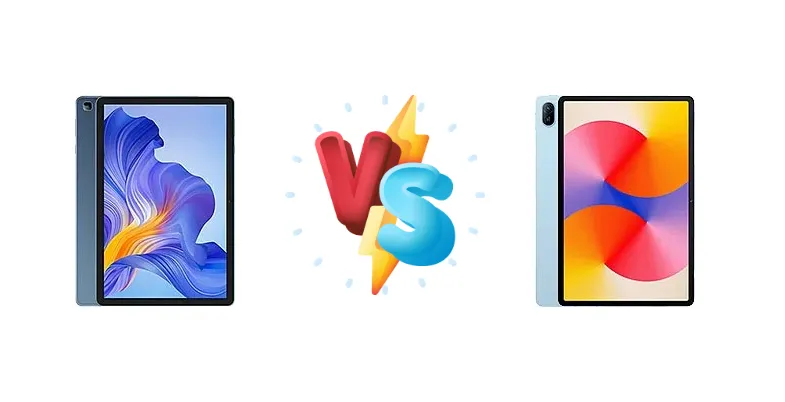
The budget tablet market is fiercely competitive, and the Honor Pad X8 and Huawei MatePad SE 11 are two contenders vying for your attention. While both aim to deliver an affordable tablet experience, they take different approaches. The Honor Pad X8 focuses on a balanced feature set powered by a MediaTek chipset, while the Huawei MatePad SE 11 emphasizes faster charging capabilities. This comparison will dissect their strengths and weaknesses to determine which tablet offers the best value.
🏆 Quick Verdict
For the average user prioritizing consistent performance for everyday tasks, the Honor Pad X8 emerges as the better choice. Its MediaTek MT8786 chipset, with its Cortex-A75 cores, provides a noticeable edge in responsiveness compared to the likely less powerful chipset in the MatePad SE 11 (spec not provided). While the MatePad SE 11’s 22.5W charging is a plus, it doesn’t compensate for a potential performance deficit.
| Network |
|---|
| 2G bands | N/A | N/A |
| 3G bands | N/A | N/A |
| 4G bands | N/A | N/A |
| EDGE | No | No |
| GPRS | No | No |
| Technology | No cellular connectivity | No cellular connectivity |
| Launch |
|---|
| Announced | 2022, September 17 | 2024, June 09 |
| Status | Available. Released 2022, September 22 | Available. Released 2024, June |
| Body |
|---|
| Build | - | Glass front, aluminum frame, aluminum back |
| Dimensions | 240.2 x 159 x 7.6 mm (9.46 x 6.26 x 0.30 in) | 252.3 x 163.8 x 6.9 mm (9.93 x 6.45 x 0.27 in) |
| SIM | No | No |
| Weight | 460 g (1.01 lb) | 475 g (1.05 lb) |
| Display |
|---|
| Resolution | 1200 x 1920 pixels, 16:10 ratio (~224 ppi density) | 1200 x 1920 pixels, 16:10 ratio (~206 ppi density) |
| Size | 10.1 inches, 295.8 cm2 (~77.4% screen-to-body ratio) | 11.0 inches, 350.9 cm2 (~84.9% screen-to-body ratio) |
| Type | TFT LCD | IPS LCD, 400 nits |
| Platform |
|---|
| CPU | Octa-core (2x2.0 GHz Cortex-A75 & 6x1.8 GHz Cortex-A55) | - |
| Chipset | MediaTek MT8786 | - |
| GPU | Mali-G52 | - |
| OS | Android 10, Magic UI 4 | HarmonyOS 2.0 |
| Memory |
|---|
| Card slot | microSDXC (dedicated slot) | microSDXC (dedicated slot) |
| Internal | 32GB 3GB RAM, 64GB 4GB RAM, 128GB 6GB RAM | 64GB 4GB RAM, 128GB 4GB RAM, 128GB 6GB RAM, 128GB 8GB RAM, 256GB 8GB RAM |
| Main Camera |
|---|
| Features | - | Panorama |
| Single | 5 MP | 8 MP, f/2.0, AF |
| Video | 1080p@30fps | 1080p@30fps |
| Selfie camera |
|---|
| Single | 2 MP | 5 MP, f/2.2 |
| Video | - | 720p@30fps |
| Sound |
|---|
| 3.5mm jack | No | - |
| 35mm jack | No | Unspecified |
| Loudspeaker | Yes, with stereo speakers | Yes, with stereo speakers (4 speakers) |
| Comms |
|---|
| Bluetooth | 5.1, A2DP, LE | 5.1, A2DP, LE |
| NFC | No | No |
| Positioning | GPS, GLONASS, BDS | No |
| Radio | No | No |
| USB | USB Type-C, OTG | USB Type-C 2.0, OTG |
| WLAN | Wi-Fi 802.11 a/b/g/n/ac, dual-band | Wi-Fi 802.11 a/b/g/n/ac, dual-band |
| Features |
|---|
| Sensors | Accelerometer | Accelerometer |
| Battery |
|---|
| Charging | - | 22.5W wired
5W reverse wired |
| Type | Li-Po 5100 mAh | 7700 mAh |
| Misc |
|---|
| Colors | Dark Blue, Light Blue | Nebula Gray, Crystal Blue |
| Models | AGM3-W09HN | - |
| Price | About 190 EUR | - |
Honor Pad X8
- Potentially stronger CPU performance with MediaTek MT8786
- Balanced feature set for everyday use
- Likely better value for the performance offered
- Charging speed likely slower than MatePad SE 11
- Display specifications unknown, potential for lower quality
Huawei MatePad SE 11
- Faster 22.5W wired charging
- 5W reverse wired charging for accessories
- Potentially more portable design (speculation)
- Likely weaker CPU performance compared to Honor Pad X8
- Chipset details missing, making performance prediction difficult
Display Comparison
Display specifications are absent for both devices, making a direct comparison difficult. However, given their price points, it’s reasonable to expect both utilize IPS LCD panels. The Honor Pad X8’s value proposition suggests a focus on screen size for media consumption, while the MatePad SE 11 may prioritize portability. Without knowing resolution, brightness (nits), and color gamut coverage, it’s impossible to definitively declare a winner. The absence of information regarding refresh rates (60Hz vs 90Hz) also hinders a complete assessment.
Camera Comparison
Camera performance is unlikely to be a key differentiator in this price segment. Both tablets likely feature basic camera setups suitable for casual snapshots and video calls. Without specific sensor details (megapixel count, aperture), it’s difficult to assess image quality. The inclusion of Optical Image Stabilization (OIS) on either device is improbable. Focusing on the primary camera sensor size would be more informative than simply listing megapixel counts, as larger sensors generally capture more light and produce better images.
Performance
The Honor Pad X8’s MediaTek MT8786 chipset, featuring a dual-cluster configuration of 2x2.0 GHz Cortex-A75 and 6x1.8 GHz Cortex-A55 cores, provides a solid foundation for everyday tasks. The Cortex-A75 cores offer a significant performance boost over the Cortex-A55 cores, ensuring smoother multitasking and app loading times. The Huawei MatePad SE 11’s chipset is unspecified, but given its positioning, it likely utilizes a less powerful MediaTek or Kirin processor. This difference in CPU architecture translates to a likely advantage for the Honor Pad X8 in demanding applications and gaming. RAM configurations are also unknown, but faster LPDDR4X or LPDDR5 RAM would further enhance the X8’s performance.
Battery Life
The Huawei MatePad SE 11’s 22.5W wired charging and 5W reverse wired charging are its standout features. This allows for significantly faster charging times compared to the likely slower charging speeds of the Honor Pad X8. However, battery capacity (mAh) is unknown for both devices. A larger battery capacity on the Honor Pad X8 could offset the MatePad SE 11’s faster charging, providing longer overall usage time. The 5W reverse wired charging on the MatePad SE 11 is a niche feature, allowing it to charge smaller accessories like earbuds, but its utility is limited.
Buying Guide
Buy the Honor Pad X8 if you need a tablet for general productivity, streaming video, and light gaming, and value a responsive user experience. It’s ideal for students or anyone needing a portable device for note-taking and web browsing. Buy the Huawei MatePad SE 11 if you prioritize quick top-ups and frequently find yourself needing to recharge your tablet on the go, and are willing to potentially compromise on raw processing power. It’s a good fit for users who primarily consume media and don’t engage in demanding tasks.
Frequently Asked Questions
❓ Is the MediaTek MT8786 in the Honor Pad X8 powerful enough for multitasking?
Yes, the MediaTek MT8786’s octa-core configuration, with its Cortex-A75 performance cores, is well-suited for multitasking between common apps like web browsers, email clients, and social media. While it won’t handle extremely demanding tasks like video editing, it provides a smooth and responsive experience for everyday use.
❓ Does the Huawei MatePad SE 11 support Huawei’s HarmonyOS, and does that impact app availability?
The Huawei MatePad SE 11 likely runs on HarmonyOS, Huawei’s proprietary operating system. This means it doesn’t have full access to the Google Play Store. Users rely on Huawei’s AppGallery and sideloading apps, which can limit app availability compared to tablets with full Google Play Store support. This is a significant consideration for users heavily invested in the Google ecosystem.
❓ What type of storage does each tablet use, and is it expandable?
Storage type (eMMC vs. UFS) and expandability (microSD card slot) are unknown for both devices. However, given the budget nature of these tablets, eMMC storage is more probable. The presence of a microSD card slot would be a significant advantage for users needing to store large files or media.