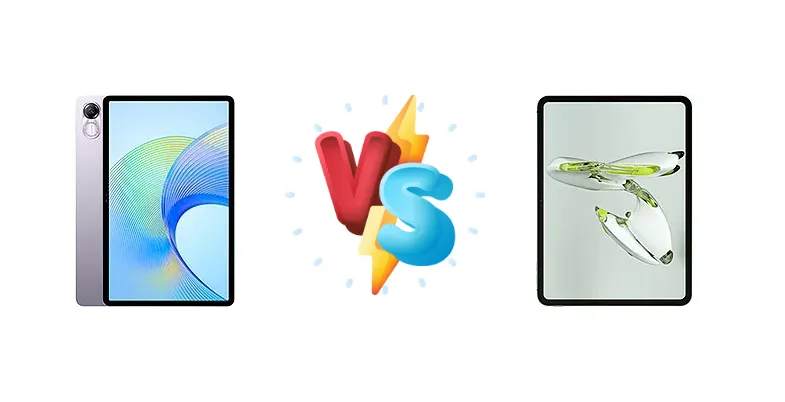
The budget tablet market is heating up, with the Honor Pad X8 Pro and OnePlus Pad Go vying for dominance. Both aim to deliver a compelling experience without breaking the bank, but they take different approaches. The Honor Pad X8 Pro leverages Qualcomm’s Snapdragon 685, while the OnePlus Pad Go opts for MediaTek’s Helio G99. This comparison dissects their strengths and weaknesses to determine which tablet offers the best value.
🏆 Quick Verdict
For the average user prioritizing sustained performance and a slightly more mature software experience, the Honor Pad X8 Pro emerges as the winner. While the OnePlus Pad Go’s 33W charging is a welcome addition, the Snapdragon 685’s Cortex-A73 cores provide a noticeable edge in CPU-intensive tasks, making it better suited for multitasking and demanding applications.
| Network |
|---|
| 2G bands | N/A | GSM 850 / 900 / 1800 / 1900 |
| 3G bands | N/A | HSDPA 850 / 900 / 2100 |
| 4G bands | N/A | LTE |
| EDGE | No | - |
| GPRS | No | - |
| Speed | - | HSPA, LTE - cellular model only |
| Technology | No cellular connectivity | GSM / HSPA / LTE |
| Launch |
|---|
| Announced | 2023, July 05 | 2023, October 06 |
| Status | Available. Released 2023, July 05 | Available. Released 2023, October 20 |
| Body |
|---|
| Build | Glass front, aluminum frame, aluminum back | - |
| Dimensions | 267.3 x 167.4 x 6.9 mm (10.52 x 6.59 x 0.27 in) | 255.1 x 188 x 6.9 mm (10.04 x 7.40 x 0.27 in) |
| SIM | No | Yes - cellular model only |
| Weight | 495 g (1.09 lb) | 532 g (1.17 lb) |
| Display |
|---|
| Resolution | 1200 x 2000 pixels, 5:3 ratio (~203 ppi density) | 1720 x 2408 pixels (~260 ppi density) |
| Size | 11.5 inches, 376.4 cm2 (~84.1% screen-to-body ratio) | 11.35 inches, 396.1 cm2 (~82.6% screen-to-body ratio) |
| Type | TFT LCD, 120Hz | IPS LCD, 90Hz, 400 nits (typ) |
| Platform |
|---|
| CPU | Octa-core (4x2.8 GHz Cortex-A73 & 4x1.9 GHz Cortex-A53) | Octa-core (2x2.2 GHz Cortex-A76 & 6x2.0 GHz Cortex-A55) |
| Chipset | Qualcomm SM6225 Snapdragon 685 (6 nm) | Mediatek Helio G99 (6 nm) |
| GPU | Adreno 610 | Mali-G57 MC2 |
| OS | Android 13, MagicOS 7.1 | Android 13, OxygenOS 13.2 |
| Memory |
|---|
| Card slot | No | microSDXC (dedicated slot) |
| Internal | 128GB 4GB RAM, 128GB 6GB RAM, 128GB 8GB RAM | 128GB 8GB RAM, 256GB 8GB RAM |
| Main Camera |
|---|
| Features | HDR | - |
| Single | 5 MP, f/2.2, AF | 8 MP |
| Video | 1080p@30fps | 1080p@30fps |
| Selfie camera |
|---|
| Single | 5 MP, f/2.2 | 8 MP |
| Video | 1080p@30fps | 1080p@30fps |
| Sound |
|---|
| 35mm jack | No | No |
| Loudspeaker | Yes, with stereo speakers (6 speakers) | Yes, with stereo speakers (4 speakers) |
| Comms |
|---|
| Bluetooth | 5.1, A2DP, LE | 5.2, A2DP, LE, aptX HD |
| NFC | No | No |
| Positioning | Unspecified | No |
| Radio | No | No |
| USB | USB Type-C, OTG | USB Type-C 2.0 |
| WLAN | Wi-Fi 802.11 a/b/g/n/ac, dual-band | Wi-Fi 802.11 a/b/g/n/ac, dual-band |
| Features |
|---|
| Sensors | Accelerometer | Accelerometer, proximity (accessories only), gyro, compass |
| Battery |
|---|
| Charging | - | 33W wired |
| Type | Li-Po 7250 mAh | Li-Po 8000 mAh |
| Misc |
|---|
| Colors | Gray, Purple, Mint | Twin Mint |
| Price | About 130 EUR | About 230 EUR |
Honor Pad X8 Pro
- Stronger CPU performance with Cortex-A73 cores
- Potentially better image processing due to Snapdragon ISP
- Mature software experience (Honor UI)
- Likely slower charging speeds
- Potentially less vibrant display
OnePlus Pad Go
- Faster 33W wired charging
- Slightly newer chipset (Helio G99)
- Modern design aesthetic
- Weaker CPU performance compared to Snapdragon 685
- Potential for more throttling under sustained load
Display Comparison
Neither Honor nor OnePlus provide detailed display specifications beyond the basic panel size. However, the choice of chipsets hints at potential differences. The Snapdragon 685 typically pairs with displays targeting efficient power consumption, suggesting the X8 Pro’s panel may prioritize battery life over peak brightness. The Helio G99, often found in gaming-focused devices, *could* indicate a slightly more vibrant display on the Pad Go, though this is speculative without further data. Both are likely to utilize IPS LCD technology given the price point, and bezel size will likely be comparable, impacting immersion.
Camera Comparison
Given the budget nature of both tablets, camera performance isn’t a primary focus. Detailed camera specs are unavailable, but it’s safe to assume both will feature basic camera setups suitable for casual snapshots and video calls. Expect similar limitations in low-light conditions. Focusing on the chipsets, the Snapdragon 685’s ISP (Image Signal Processor) is generally more capable than the Helio G99’s, potentially leading to slightly better image processing and dynamic range in the Honor Pad X8 Pro, though the difference will likely be minimal.
Performance
The core architectural difference is significant. The Honor Pad X8 Pro’s Snapdragon 685 features four Cortex-A73 cores clocked at 2.8 GHz, offering a substantial performance boost over the OnePlus Pad Go’s Helio G99’s two Cortex-A76 cores at 2.2 GHz. While the G99 has a higher core count (6x A55 vs 4x A53), the A73 cores in the Snapdragon 685 provide superior single-core performance, crucial for responsive UI and app loading. The 6nm process node is shared by both, but the Snapdragon’s architecture gives it an edge in sustained performance. The Pad Go’s G99 benefits from Mali-G57 MC2 GPU, while the Snapdragon 685 uses Adreno 610. While GPU benchmarks are needed for a definitive comparison, the Adreno typically holds an advantage in gaming.
Battery Life
Battery capacity is not specified for either device. However, the OnePlus Pad Go’s inclusion of 33W wired charging is a clear advantage. This will significantly reduce charging times compared to the likely 10-18W charging found on the Honor Pad X8 Pro. While the Snapdragon 685 is generally power-efficient, the faster charging of the Pad Go mitigates any potential battery life advantage the X8 Pro might have. Expect the Pad Go to reach a full charge considerably faster, a key convenience factor for many users.
Buying Guide
Buy the Honor Pad X8 Pro if you need a tablet capable of handling moderate multitasking, streaming, and light gaming without significant slowdowns. Its Snapdragon 685 chipset offers a more consistent experience under load. Buy the OnePlus Pad Go if you prioritize faster charging and a slightly newer design, and your usage primarily revolves around casual browsing, video playback, and less demanding apps. The Helio G99 is capable, but may exhibit more throttling during extended use.
Frequently Asked Questions
❓ Will the Helio G99 in the OnePlus Pad Go struggle with graphically demanding games like Genshin Impact?
While the Helio G99 is capable, Genshin Impact is a particularly demanding title. Expect to play at lower graphics settings and potentially experience frame drops during intense combat. The Snapdragon 685 in the Honor Pad X8 Pro will likely offer a slightly smoother experience, but neither tablet is a dedicated gaming device.
❓ How does the software experience differ between Honor UI and OxygenOS (OnePlus)?
Honor UI, based on Android, has matured over time and offers a generally stable experience. OxygenOS, while known for its clean interface, has undergone changes and may include more pre-installed apps than previous versions. Both offer customization options, but Honor UI tends to be more feature-rich out of the box.
❓ Is the lack of detailed display specs a concern when choosing between these tablets?
Yes, it is. Without knowing peak brightness, color accuracy, or screen resolution, it's difficult to assess the viewing experience. However, given the price point, both tablets likely utilize standard IPS LCD panels, so the differences are unlikely to be dramatic.