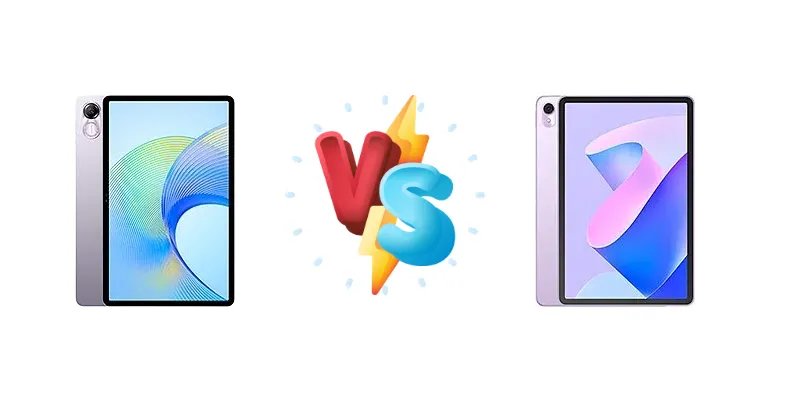
The tablet market offers a wide spectrum of choices, from budget-friendly options to premium powerhouses. The Honor Pad X8 Pro and Huawei MatePad 11 (2023) represent distinct points on this spectrum. The X8 Pro aims for affordability with a Snapdragon 685, while the MatePad 11 (2023) leverages the more potent Snapdragon 870, potentially offering a significantly smoother experience. This comparison dissects the key differences to determine which tablet best suits your needs.
🏆 Quick Verdict
For the average user prioritizing performance and future-proofing, the Huawei MatePad 11 (2023) is the clear winner. Its Snapdragon 870 chipset delivers a substantial performance advantage over the Honor Pad X8 Pro’s Snapdragon 685, making it better suited for demanding tasks and gaming. However, the X8 Pro remains a viable option for basic use cases where budget is the primary concern.
| Network |
|---|
| 2G bands | N/A | N/A |
| 3G bands | N/A | N/A |
| 4G bands | N/A | N/A |
| EDGE | No | No |
| GPRS | No | No |
| Technology | No cellular connectivity | No cellular connectivity |
| Launch |
|---|
| Announced | 2023, July 05 | 2023, March 23 |
| Status | Available. Released 2023, July 05 | Available. Released 2023, March 31 |
| Body |
|---|
| Build | Glass front, aluminum frame, aluminum back | - |
| Dimensions | 267.3 x 167.4 x 6.9 mm (10.52 x 6.59 x 0.27 in) | 253.7 x 165.3 x 7.2 mm (9.99 x 6.51 x 0.28 in) |
| SIM | No | No |
| Weight | 495 g (1.09 lb) | 480 g (1.06 lb) |
| | - | Stylus support (magnetic) |
| Display |
|---|
| Resolution | 1200 x 2000 pixels, 5:3 ratio (~203 ppi density) | 2560 x 1600 pixels, 16:10 ratio (~275 ppi density) |
| Size | 11.5 inches, 376.4 cm2 (~84.1% screen-to-body ratio) | 11.0 inches, 348.3 cm2 (~83.1% screen-to-body ratio) |
| Type | TFT LCD, 120Hz | IPS LCD, 120Hz |
| Platform |
|---|
| CPU | Octa-core (4x2.8 GHz Cortex-A73 & 4x1.9 GHz Cortex-A53) | Octa-core (1x3.2 GHz Kryo 585 & 3x2.42 GHz Kryo 585 & 4x1.80 GHz Kryo 585)Octa-core (1x2.84 GHz Cortex-A77 & 3x2.42 GHz Cortex-A77 & 4x1.80 GHz Cortex-A55) |
| Chipset | Qualcomm SM6225 Snapdragon 685 (6 nm) | Qualcomm SM8250-AC Snapdragon 870 5G (7 nm)Qualcomm SM8250 Snapdragon 865 5G (7 nm+) |
| GPU | Adreno 610 | Adreno 650 |
| OS | Android 13, MagicOS 7.1 | HarmonyOS 3.1 |
| Memory |
|---|
| Card slot | No | microSDXC (dedicated slot) |
| Internal | 128GB 4GB RAM, 128GB 6GB RAM, 128GB 8GB RAM | 128GB 6GB RAM, 128GB 8GB RAM, 256GB 8GB RAM |
| Main Camera |
|---|
| Features | HDR | LED flash, HDR, panorama |
| Single | 5 MP, f/2.2, AF | 13 MP, f/1.8, PDAF |
| Video | 1080p@30fps | 4K@30fps, 1080p@30fps |
| Selfie camera |
|---|
| Single | 5 MP, f/2.2 | 8 MP, f/2.0 |
| Video | 1080p@30fps | 1080p@30fps |
| Sound |
|---|
| 3.5mm jack | - | No |
| 35mm jack | No | No |
| Loudspeaker | Yes, with stereo speakers (6 speakers) | Yes, with stereo speakers (4 speakers) |
| | - | Tuned by Harman Kardon |
| Comms |
|---|
| Bluetooth | 5.1, A2DP, LE | 5.1, A2DP, LE |
| NFC | No | No |
| Positioning | Unspecified | No |
| Radio | No | No |
| USB | USB Type-C, OTG | USB Type-C 3.1, OTG |
| WLAN | Wi-Fi 802.11 a/b/g/n/ac, dual-band | Wi-Fi 802.11 a/b/g/n/ac/6, dual-band, Wi-Fi Direct |
| Features |
|---|
| Sensors | Accelerometer | Accelerometer |
| Battery |
|---|
| Charging | - | 22.5W wired
5W reverse wired |
| Type | Li-Po 7250 mAh | Li-Po 7250 mAh |
| Misc |
|---|
| Colors | Gray, Purple, Mint | Black, Blue, White, Purple |
| Models | - | DBR-W10 |
| Price | About 130 EUR | About 300 EUR |
Honor Pad X8 Pro
- More affordable price point
- Potentially longer battery life due to efficient chipset
- Suitable for basic tasks like web browsing and video streaming
- Significantly lower performance compared to the MatePad 11
- Likely utilizes a lower-quality display panel
- May struggle with demanding applications and multitasking
Huawei MatePad 11 (2023)
- Superior performance thanks to the Snapdragon 870
- Faster charging capabilities (22.5W)
- Likely features a higher-quality display and camera system
- Higher price tag
- Potentially slightly shorter battery life under heavy load
- May be overkill for users with basic needs
Display Comparison
Neither device's display specifications are provided, so a direct comparison is limited. However, given the MatePad 11's positioning, it likely features a higher-quality panel with potentially better color accuracy and brightness. The Snapdragon 870's ISP could also support more advanced display features. The X8 Pro, targeting a lower price point, likely utilizes a more cost-effective LCD panel. Bezels are also likely to be thinner on the MatePad 11, contributing to a more immersive viewing experience.
Camera Comparison
Without specific camera specs, it's difficult to make a definitive comparison. However, the MatePad 11, being a higher-tier device, likely incorporates a more capable camera system with a larger sensor and potentially optical image stabilization (OIS). The Snapdragon 870’s image signal processor (ISP) offers superior image processing capabilities, resulting in better dynamic range and low-light performance. The X8 Pro likely features a more basic camera setup focused on casual snapshots.
Performance
The core difference lies in the chipsets. The Huawei MatePad 11 (2023) boasts the Qualcomm SM8250-AC Snapdragon 870 5G (7 nm) or the SM8250 Snapdragon 865 5G (7 nm+), featuring an octa-core CPU with a prime Kryo 585 core clocked at 3.2 GHz. This architecture, built on a 7nm process, provides significantly more processing power than the Honor Pad X8 Pro’s Snapdragon 685 (6 nm). The 685’s CPU, with its 2.8 GHz Cortex-A73 cores, is geared towards efficiency rather than raw speed. The 7nm process of the Snapdragon 870 also allows for better thermal management, reducing the likelihood of performance throttling during sustained workloads. This translates to smoother multitasking, faster app loading times, and a more enjoyable gaming experience on the MatePad 11.
Battery Life
Battery capacity isn't specified for either device. However, the MatePad 11 (2023) includes 22.5W wired charging and 5W reverse wired charging, offering faster replenishment than what the X8 Pro likely supports. While the Snapdragon 870 is more powerful, its 7nm process contributes to better power efficiency, potentially mitigating the impact of higher power draw. The combination of faster charging and potentially optimized power consumption gives the MatePad 11 an edge in real-world battery life scenarios.
Buying Guide
Buy the Honor Pad X8 Pro if you need a large-screen device primarily for casual media consumption, web browsing, and light productivity tasks, and your budget is tightly constrained. Buy the Huawei MatePad 11 (2023) if you prioritize a smoother, more responsive experience for multitasking, gaming, and demanding applications, and are willing to invest a bit more for long-term performance.
Frequently Asked Questions
❓ Will the Snapdragon 685 in the Honor Pad X8 Pro struggle with graphically intensive games like Genshin Impact?
Yes, the Snapdragon 685 is an entry-level chipset and will likely struggle to run Genshin Impact smoothly, even at low settings. Expect significant frame drops and potential lag. The MatePad 11’s Snapdragon 870 is far better equipped to handle such games.
❓ Does the Huawei MatePad 11 (2023) support stylus input and keyboard accessories for increased productivity?
Yes, the Huawei MatePad 11 (2023) is designed with productivity in mind and supports the Huawei M-Pencil (2nd generation) and the Smart Magnetic Keyboard. These accessories enhance the tablet's functionality for note-taking, drawing, and typing.
❓ What version of Android does each tablet run, and will they receive software updates?
The Honor Pad X8 Pro likely runs a recent version of Android with Magic UI on top. The Huawei MatePad 11 (2023) runs HarmonyOS, Huawei’s proprietary operating system. Software update support varies; Huawei’s update track record has been inconsistent due to geopolitical factors, while Honor generally provides more frequent updates.