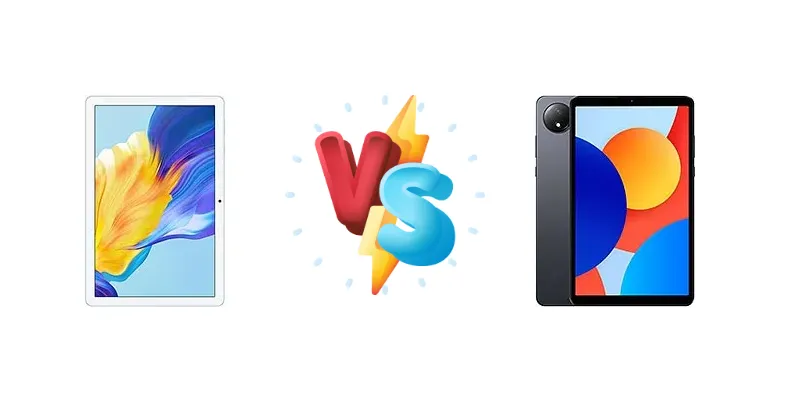
The sub-$200 tablet market is heating up, with the Honor Pad X8 Lite and Xiaomi Redmi Pad SE 8.7 vying for dominance. Both aim to deliver a capable Android experience without breaking the bank, but they take slightly different approaches. This comparison dives deep into their specifications to determine which tablet offers the best value for your money.
🏆 Quick Verdict
For most users, the Xiaomi Redmi Pad SE 8.7 emerges as the slightly better choice. While both tablets share the same CPU architecture, the Redmi Pad SE 8.7’s 18W (International) or 10W (India) charging capability provides a tangible advantage in usability, offsetting any minor performance differences.
| Network |
|---|
| 2G bands | N/A | GSM 850 / 900 / 1800 / 1900 |
| 3G bands | N/A | HSDPA 800 / 850 / 900 / 1700(AWS) / 1900 / 2100 |
| 4G bands | N/A | 1, 2, 3, 4, 5, 7, 8, 13, 18, 19, 20, 26, 28, 38, 40, 41, 66 |
| EDGE | No | - |
| GPRS | No | - |
| Speed | - | HSPA, LTE - cellular model only |
| Technology | No cellular connectivity | GSM / HSPA / LTE |
| Launch |
|---|
| Announced | 2022, September 15 | 2024, July 29 |
| Status | Available. Released 2022, November | Available. Released 2024, August 08 |
| Body |
|---|
| Build | - | Glass front (Gorilla Glass 3) |
| Dimensions | 240.2 x 159 x 7.6 mm (9.46 x 6.26 x 0.30 in) | 211.6 x 125.5 x 8.8 mm (8.33 x 4.94 x 0.35 in) |
| SIM | Nano-SIM | Nano-SIM + Nano-SIM (cellular model only) |
| Weight | 460 g (1.01 lb) | 370 / 373 / 375 g (13.05 oz) |
| Display |
|---|
| Protection | - | Corning Gorilla Glass 3 |
| Resolution | 800 x 1280 pixels, 16:10 ratio (~156 ppi density) | 800 x 1340 pixels, 5:3 ratio (~179 ppi density) |
| Size | 9.7 inches, 272.8 cm2 (~71.4% screen-to-body ratio) | 8.7 inches, 214.9 cm2 (~80.9% screen-to-body ratio) |
| Type | IPS LCD | IPS LCD, 1B colors, 90Hz, 600 nits (HBM) |
| Platform |
|---|
| CPU | Octa-core (2x2.0 GHz Cortex-A75 & 6x1.8 GHz Cortex-A55) | Octa-core (2x2.0 GHz Cortex-A75 & 6x1.8 GHz Cortex-A55) |
| Chipset | Mediatek MT8786 | Mediatek Helio G85 (12 nm) |
| GPU | - | Mali-G52 MC2 |
| OS | Android 12, Magic UI 6.1 | Android 14, HyperOS |
| Memory |
|---|
| Card slot | Unspecified | microSDXC (dedicated slot) |
| Internal | 32GB | 64GB 4GB RAM, 128GB 4GB RAM, 128GB 6GB RAM |
| Main Camera |
|---|
| Features | - | LED flash |
| Single | 5 MP | 8 MP, f/2.0, (wide), 1/4.0", 1.12µm |
| Video | 1080p@30fps | 1080p@30fps |
| Selfie camera |
|---|
| Single | 2 MP | 5 MP, f/2.2, (wide), 1/5.0", 1.12µm |
| Video | 720p@30fps | 1080p@30fps |
| Sound |
|---|
| 3.5mm jack | No | - |
| 35mm jack | No | Yes |
| Loudspeaker | Yes, with stereo speakers | Yes, with stereo speakers |
| Comms |
|---|
| Bluetooth | 5.1, A2DP, LE | 5.3, A2DP, LE |
| Infrared port | - | Yes |
| NFC | No | No |
| Positioning | No | GPS, GALILEO, GLONASS, BDS - cellular model only |
| Radio | No | FM radio |
| USB | USB Type-C, OTG | USB Type-C 2.0 |
| WLAN | Wi-Fi 802.11 a/b/g/n/ac, dual-band | Wi-Fi 802.11 a/b/g/n/ac, dual-band |
| Features |
|---|
| Sensors | Accelerometer | Accelerometer, proximity (accessories only), compass |
| Battery |
|---|
| Charging | - | 18W wired (Int'l)
10W wired (India) |
| Type | Li-Po 5100 mAh | 6650 mAh |
| Misc |
|---|
| Colors | Mint Blue | Aurora Green (Forest Green), Sky Blue (Ocean Blue), Graphite Gray (Urban Grey) |
| Models | - | 220233L2G |
| Price | - | About 120 EUR |
| SAR | - | 0.90 W/kg (head) 0.65 W/kg (body) |
| SAR EU | - | 0.40 W/kg (head) 0.99 W/kg (body) |
Honor Pad X8 Lite
- Potentially lower initial purchase price.
- Competent CPU for basic tasks.
- Suitable for light usage scenarios.
- Lacks fast charging support.
- Limited information on display quality.
- Unspecified battery capacity.
Xiaomi Redmi Pad SE 8.7
- Faster charging (18W International/10W India).
- Potentially better power efficiency with Helio G85.
- Slightly more compact 8.7-inch screen.
- May be slightly more expensive than the X8 Lite.
- Limited information on display quality.
- Unspecified battery capacity.
Display Comparison
Neither Honor nor Xiaomi provide detailed display specifications beyond screen size. Both tablets likely utilize IPS LCD panels, common in this price bracket. Without knowing peak brightness, color gamut coverage, or resolution, it’s difficult to declare a clear winner. However, the Redmi Pad SE 8.7’s slightly smaller 8.7-inch screen may result in a marginally higher pixel density, potentially offering a sharper image. Bezels are expected to be substantial on both devices, reflecting their budget positioning.
Camera Comparison
Camera performance is unlikely to be a key differentiator in this segment. Detailed camera specs are unavailable, but both tablets likely feature basic rear and front-facing cameras suitable for video calls and casual snapshots. Without information on sensor size, aperture, or image processing capabilities, it’s impossible to assess image quality. Focusing on camera capabilities for these devices would be a misdirection of expectations.
Performance
Both the Honor Pad X8 Lite and the Xiaomi Redmi Pad SE 8.7 are powered by an octa-core CPU featuring the same core configuration: 2x2.0 GHz Cortex-A75 and 6x1.8 GHz Cortex-A55. However, the Redmi Pad SE 8.7 utilizes the Mediatek Helio G85 (12nm), while the X8 Lite uses the Mediatek MT8786. The Helio G85, being a 12nm chip, *may* offer slightly improved power efficiency and potentially higher sustained performance due to better thermal headroom, though the difference is likely minimal in real-world usage. Both will handle everyday tasks like web browsing, video streaming, and social media without issue, but demanding games will require reduced settings.
Battery Life
Battery capacity is not specified for either device. However, the Redmi Pad SE 8.7’s charging capabilities are a significant advantage. Offering 18W wired charging (International) or 10W (India), it can replenish the battery much faster than the Honor Pad X8 Lite, which lacks any specified fast charging support. This difference in charging speed translates to less downtime and greater convenience for users who rely on their tablets throughout the day.
Buying Guide
Buy the Honor Pad X8 Lite if you prioritize a potentially lower initial cost and are comfortable with slower charging speeds. It’s a solid option for basic tasks like reading and light browsing. Buy the Xiaomi Redmi Pad SE 8.7 if you value faster charging, even if it means a slightly higher price tag. This makes it ideal for users who need a tablet they can quickly top up between uses, such as students or travelers.
Frequently Asked Questions
❓ Does the Xiaomi Redmi Pad SE 8.7 support reverse charging, allowing me to charge other devices?
No, the Xiaomi Redmi Pad SE 8.7 does not offer reverse charging functionality. It is designed primarily for receiving power via the USB-C port, not for outputting it.
❓ What type of storage does the Honor Pad X8 Lite use, and is it expandable via microSD card?
While the exact storage type isn't specified, budget tablets like the Honor Pad X8 Lite typically utilize eMMC storage. It's highly likely to include a microSD card slot for storage expansion, but this should be verified before purchase.
❓ Will the Redmi Pad SE 8.7 run demanding games like Genshin Impact smoothly?
While the Helio G85 can handle some gaming, Genshin Impact will likely require significant graphical settings reductions to achieve playable frame rates. Expect to play at low settings and potentially with frame rate limitations.
❓ Which tablet is better suited for reading e-books for extended periods?
Both tablets are suitable for reading, but the Redmi Pad SE 8.7’s slightly smaller screen size (8.7 inches) might be more comfortable for prolonged reading sessions. However, without knowing the screen's blue light filter capabilities, it's difficult to definitively say which is better for eye strain.