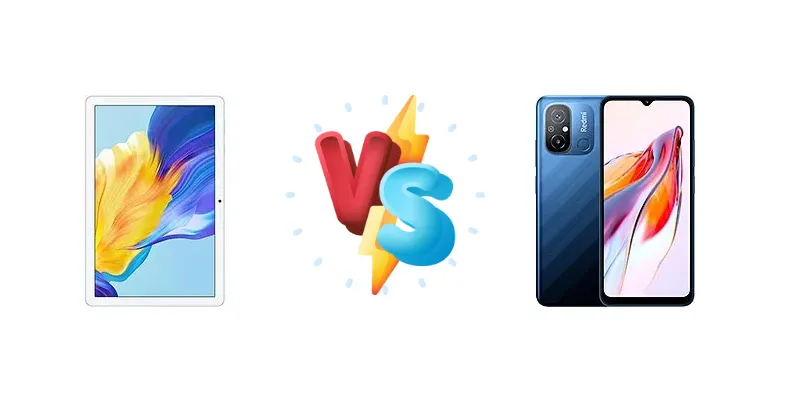
The budget tablet market is heating up, and the Honor Pad X8 Lite and Xiaomi Redmi 12C are two contenders vying for your attention. Both offer compelling features at affordable prices, but which one delivers the best overall experience? Let's dive into a detailed comparison to help you decide.
🏆 Quick Verdict
The Redmi 12C edges out the X8 Lite thanks to its slightly more efficient chipset and faster charging. However, the X8 Lite's potentially better display and software experience make it a close call. Ultimately, the Redmi 12C provides a better balance of performance and value.
| Network |
|---|
| 2G bands | N/A | GSM 850 / 900 / 1800 / 1900 |
| 3G bands | N/A | HSDPA 850 / 900 / 2100 |
| 4G bands | N/A | 1, 3, 5, 7, 8, 20, 28, 38, 40, 41 - International |
| EDGE | No | - |
| GPRS | No | - |
| Speed | - | HSPA, LTE |
| Technology | No cellular connectivity | GSM / CDMA / HSPA / EVDO / LTE |
| | - | CDMA2000 1xEV-DO |
| Launch |
|---|
| Announced | 2022, September 15 | 2022, December 31 |
| Status | Available. Released 2022, November | Available. Released 2023, January 01 |
| Body |
|---|
| Dimensions | 240.2 x 159 x 7.6 mm (9.46 x 6.26 x 0.30 in) | 168.8 x 76.4 x 8.8 mm (6.65 x 3.01 x 0.35 in) |
| SIM | Nano-SIM | Nano-SIM + Nano-SIM |
| Weight | 460 g (1.01 lb) | 192 g (6.77 oz) |
| Display |
|---|
| Resolution | 800 x 1280 pixels, 16:10 ratio (~156 ppi density) | 720 x 1650 pixels (~268 ppi density) |
| Size | 9.7 inches, 272.8 cm2 (~71.4% screen-to-body ratio) | 6.71 inches, 106.5 cm2 (~82.6% screen-to-body ratio) |
| Type | IPS LCD | IPS LCD, 500 nits (typ) |
| Platform |
|---|
| CPU | Octa-core (2x2.0 GHz Cortex-A75 & 6x1.8 GHz Cortex-A55) | Octa-core (2x2.0 GHz Cortex-A75 & 6x1.8 GHz Cortex-A55) |
| Chipset | Mediatek MT8786 | Mediatek MT6769Z Helio G85 (12 nm) |
| GPU | - | Mali-G52 MC2 |
| OS | Android 12, Magic UI 6.1 | Android 12, MIUI 13 |
| Memory |
|---|
| Card slot | Unspecified | microSDXC (dedicated slot) |
| Internal | 32GB | 32GB 2GB RAM, 32GB 3GB RAM, 32GB 4GB RAM, 64GB 3GB RAM, 64GB 4GB RAM, 128GB 3GB RAM, 128GB 4GB RAM, 128GB 6GB RAM |
| | - | eMMC 5.1 |
| Main Camera |
|---|
| Dual | - | 50 MP, (wide), PDAF
0.08 MP (depth) |
| Features | - | LED flash, HDR |
| Single | 5 MP | 50 MP, f/1.8, (wide), 1/2.76", PDAF
Auxiliary lens |
| Video | 1080p@30fps | 1080p@30fps |
| Selfie camera |
|---|
| Single | 2 MP | 5 MP, f/2.2, (wide) |
| Video | 720p@30fps | 1080p@30fps |
| Sound |
|---|
| 3.5mm jack | No | Yes |
| 35mm jack | No | Yes |
| Loudspeaker | Yes, with stereo speakers | Yes |
| Comms |
|---|
| Bluetooth | 5.1, A2DP, LE | 5.1, A2DP, LE |
| NFC | No | Yes (market/region dependent) |
| Positioning | No | GPS, GLONASS, BDS, GALILEO |
| Radio | No | FM radio |
| USB | USB Type-C, OTG | microUSB 2.0 |
| WLAN | Wi-Fi 802.11 a/b/g/n/ac, dual-band | Wi-Fi 802.11 a/b/g/n/ac, dual-band, Wi-Fi Direct |
| Features |
|---|
| Sensors | Accelerometer | Fingerprint (rear-mounted), accelerometer |
| | - | Virtual proximity sensing |
| Battery |
|---|
| Charging | - | 10W wired |
| Type | Li-Po 5100 mAh | Li-Po 5000 mAh |
| Misc |
|---|
| Colors | Mint Blue | Graphite Gray, Ocean Blue, Mint Green, Lavender Purple |
| Models | - | 22120RN86G, 22120RN86I, 22126RN91Y, 2212ARNC4L |
| Price | - | £ 132.99 / € 107.41 |
| SAR | - | 1.08 W/kg (head) 0.64 W/kg (body) |
| SAR EU | - | 0.98 W/kg (head) 0.99 W/kg (body) |
Honor Pad X8 Lite
- Potentially better display quality
- Clean software experience
- Sleek design
- Slightly less powerful chipset
- Slower charging
- Camera quality is basic
Xiaomi Redmi 12C
- More efficient chipset for better performance
- Faster 10W charging
- Good value for money
- Display quality may be slightly inferior
- Software can be a bit cluttered
- Camera quality is basic
Display Comparison
Both tablets feature similar display sizes (around 10.1 inches) and resolutions (typically 1920x1200). The Honor Pad X8 Lite *may* offer slightly better color accuracy and brightness, though this can vary by specific panel. The Redmi 12C's display is generally considered adequate for the price point.
Camera Comparison
Camera quality on budget tablets is rarely a highlight. Both devices likely feature basic 5MP or 8MP front and rear cameras suitable for video calls and casual snapshots. Don't expect exceptional image quality from either.
Performance
While both share the same CPU core configuration (2x2.0 GHz Cortex-A75 & 6x1.8 GHz Cortex-A55), the Redmi 12C utilizes the MT6769Z Helio G85 chipset, which is generally considered more efficient and offers slightly better performance than the MT8786 found in the X8 Lite. Expect smoother multitasking and slightly faster app loading on the Redmi 12C.
Battery Life
Battery capacity is likely similar (around 5000-6000 mAh) on both devices. However, the Redmi 12C's more efficient chipset and 10W charging give it a slight edge in battery life and charging speed.
Buying Guide
The Honor Pad X8 Lite is ideal for users prioritizing a potentially better display and a cleaner software experience for basic tasks like browsing and media consumption. The Xiaomi Redmi 12C is a better choice for those needing a bit more processing power for light gaming and apps, and who appreciate faster charging.
Frequently Asked Questions
❓ Which tablet is better for gaming?
The Xiaomi Redmi 12C's Helio G85 chipset provides slightly better gaming performance compared to the Honor Pad X8 Lite.
❓ Does the Honor Pad X8 Lite have expandable storage?
Yes, both tablets typically offer a microSD card slot for expandable storage, allowing you to increase storage capacity.
❓ What operating system do these tablets run?
Both tablets run Android, though the specific version and user interface may differ slightly between the manufacturers.