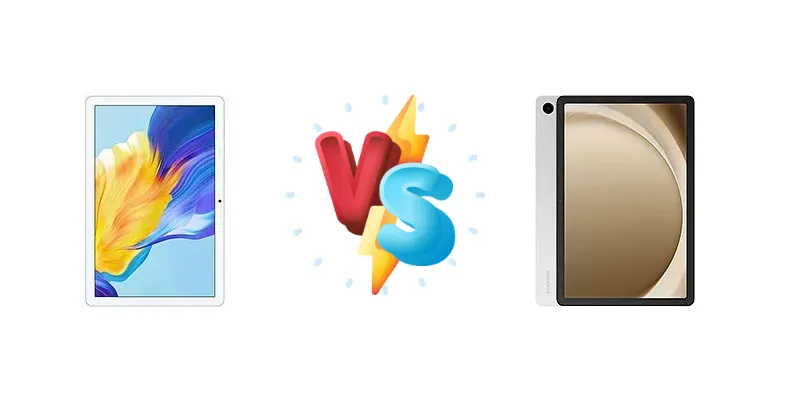
The budget tablet market is heating up, with the Honor Pad X8 Lite and Samsung Galaxy Tab A9+ vying for dominance. Both aim to deliver a capable Android experience without breaking the bank, but they take different approaches. The Honor Pad X8 Lite relies on a Mediatek chipset, while the Samsung Tab A9+ opts for Qualcomm's Snapdragon 695 5G. This comparison dives deep into the specifics to determine which tablet offers the best value.
🏆 Quick Verdict
For most users, the Samsung Galaxy Tab A9+ emerges as the stronger choice. Its Snapdragon 695 chipset, built on a more efficient 6nm process, provides a noticeable performance advantage and 5G connectivity. While the Honor Pad X8 Lite is a viable option, the A9+'s superior processing power and future-proofing make it the better investment.
| Network |
|---|
| 2G bands | N/A | GSM 850 / 900 / 1800 / 1900 |
| 3G bands | N/A | HSDPA 850 / 900 / 1700(AWS) / 1900 / 2100 |
| 4G bands | N/A | 1, 2, 3, 4, 5, 7, 8, 12, 13, 17, 20, 26, 28, 38, 40, 41, 66 |
| 5G bands | - | 1, 3, 5, 7, 8, 20, 28, 38, 40, 41, 66, 77, 78 SA/NSA/Sub6 |
| EDGE | No | - |
| GPRS | No | - |
| Speed | - | HSPA, LTE, 5G - cellular model only |
| Technology | No cellular connectivity | GSM / HSPA / LTE / 5G |
| Launch |
|---|
| Announced | 2022, September 15 | 2023, October 05 |
| Status | Available. Released 2022, November | Available. Released 2023, October 17 |
| Body |
|---|
| Dimensions | 240.2 x 159 x 7.6 mm (9.46 x 6.26 x 0.30 in) | 257.1 x 168.7 x 6.9 mm (10.12 x 6.64 x 0.27 in) |
| SIM | Nano-SIM | Nano-SIM + eSIM (cellular model only) |
| Weight | 460 g (1.01 lb) | 480 g or 492 g (1.06 lb) |
| Display |
|---|
| Resolution | 800 x 1280 pixels, 16:10 ratio (~156 ppi density) | 1200 x 1920 pixels, 16:10 ratio (~206 ppi density) |
| Size | 9.7 inches, 272.8 cm2 (~71.4% screen-to-body ratio) | 11.0 inches, 350.9 cm2 (~80.9% screen-to-body ratio) |
| Type | IPS LCD | TFT LCD, 90Hz |
| Platform |
|---|
| CPU | Octa-core (2x2.0 GHz Cortex-A75 & 6x1.8 GHz Cortex-A55) | Octa-core (2x2.2 GHz Kryo 660 Gold & 6x1.8 GHz Kryo 660 Silver) |
| Chipset | Mediatek MT8786 | Qualcomm SM6375 Snapdragon 695 5G (6 nm) |
| GPU | - | Adreno 619 |
| OS | Android 12, Magic UI 6.1 | Android 13, upgradable to Android 15, One UI 7 |
| Memory |
|---|
| Card slot | Unspecified | microSDXC (dedicated slot) |
| Internal | 32GB | 64GB 4GB RAM, 128GB 4GB RAM, 128GB 8GB RAM, 256GB 8GB RAM |
| Main Camera |
|---|
| Single | 5 MP | 8 MP, AF |
| Video | 1080p@30fps | 1080p@30fps |
| Selfie camera |
|---|
| Single | 2 MP | 5 MP |
| Video | 720p@30fps | 1080p@30fps |
| Sound |
|---|
| 3.5mm jack | No | - |
| 35mm jack | No | Yes |
| Loudspeaker | Yes, with stereo speakers | Yes, with stereo speakers (4 speakers) |
| Comms |
|---|
| Bluetooth | 5.1, A2DP, LE | 5.1, A2DP, LE |
| NFC | No | No |
| Positioning | No | GPS, GLONASS, GALILEO, BDS, QZSS - cellular model only |
| Radio | No | No |
| USB | USB Type-C, OTG | USB Type-C 2.0 |
| WLAN | Wi-Fi 802.11 a/b/g/n/ac, dual-band | Wi-Fi 802.11 a/b/g/n/ac, dual-band, Wi-Fi Direct |
| Features |
|---|
| Sensors | Accelerometer | Accelerometer, gyro, proximity (accessories only), compass |
| Battery |
|---|
| Charging | - | 15W wired |
| Type | Li-Po 5100 mAh | Li-Po 7040 mAh |
| Misc |
|---|
| Colors | Mint Blue | Graphite, Silver, Navy |
| Models | - | SM-X210, SM-X215, SM-X216B |
| Price | - | $ 199.99 |
| SAR | - | 0.42 W/kg (body) |
| SAR EU | - | 1.19 W/kg (body) |
Honor Pad X8 Lite
- Potentially lower price point
- Decent performance for basic tasks
- Large 10.1-inch display
- Older Mediatek chipset
- Less efficient power consumption
- No 5G connectivity
Samsung Galaxy Tab A9+
- More powerful Snapdragon 695 chipset
- 6nm process for better efficiency
- 5G connectivity for on-the-go access
- 15W charging is relatively slow
- Potentially higher price
- Standard LCD display
Display Comparison
Neither device boasts a particularly high-end display. Details regarding panel type (IPS, TFT) and resolution are missing for the Honor Pad X8 Lite, suggesting a standard LCD experience. The Samsung Galaxy Tab A9+ also utilizes a standard LCD, but its larger screen size (11 inches vs. the X8 Lite’s 10.1 inches) offers a more immersive viewing experience. Both are likely to have similar color accuracy, but the A9+'s larger size is a clear advantage for media consumption. Brightness levels are not specified, but given the price points, neither is expected to excel in direct sunlight.
Camera Comparison
Camera performance is unlikely to be a deciding factor for either tablet. Both are positioned as budget devices, and camera quality typically takes a backseat. Details regarding sensor sizes and apertures are unavailable for both, but it’s safe to assume they feature basic camera setups suitable for casual snapshots. The focus should be on video conferencing and quick scans rather than photography. The presence of a 2MP macro camera on either device is largely inconsequential due to its limited resolution and image quality.
Performance
The core difference lies in the chipsets. The Samsung Galaxy Tab A9+’s Qualcomm Snapdragon 695 (6nm) significantly outperforms the Honor Pad X8 Lite’s Mediatek MT8786. The 6nm fabrication process of the Snapdragon 695 translates to better power efficiency and reduced thermal throttling, crucial for sustained performance. While both CPUs feature an octa-core configuration with similar clock speeds for the efficiency cores (1.8 GHz), the Snapdragon 695’s Kryo 660 Gold cores (2x2.2 GHz) offer a performance edge over the Cortex-A75 cores (2x2.0 GHz) in the Mediatek chip. This means faster app loading times, smoother multitasking, and a more responsive user experience on the Samsung device. The A9+ also benefits from potential software optimizations from Samsung.
Battery Life
Battery capacity details are missing for the Honor Pad X8 Lite. The Samsung Galaxy Tab A9+ features a 7,040mAh battery coupled with 15W wired charging. While 15W isn’t particularly fast, it’s adequate for a tablet of this size and usage profile. The Snapdragon 695’s power efficiency should contribute to longer battery life on the A9+ compared to the X8 Lite, even if the latter has a slightly larger battery capacity. The 6nm process allows the A9+ to extract more usage from each mAh.
Buying Guide
Buy the Honor Pad X8 Lite if you prioritize a lower upfront cost and primarily need a tablet for basic tasks like web browsing, video playback, and light productivity. It's a good fit for casual users who don't demand high performance. Buy the Samsung Galaxy Tab A9+ if you value smoother multitasking, occasional gaming, and the convenience of 5G connectivity. It’s ideal for students, travelers, or anyone who wants a tablet that can handle a wider range of tasks without slowdowns.
Frequently Asked Questions
❓ Will the Snapdragon 695 in the Tab A9+ handle demanding games like Genshin Impact?
While the Snapdragon 695 isn't a gaming powerhouse, it can run Genshin Impact at lower settings (medium or low) with acceptable frame rates. Expect some occasional stuttering during intense scenes. The Honor Pad X8 Lite's Mediatek MT8786 will struggle significantly more with this title.
❓ Does the Samsung Galaxy Tab A9+ support Samsung DeX for a desktop-like experience?
No, the Samsung Galaxy Tab A9+ does not support Samsung DeX. This feature is typically reserved for higher-end Samsung tablets like the Tab S series. However, it does offer multi-window support for basic multitasking.
❓ How much storage does each tablet offer, and is it expandable?
Storage configurations vary by region. The Samsung Galaxy Tab A9+ is commonly available with 64GB or 128GB of internal storage, expandable via microSD card. Details for the Honor Pad X8 Lite are less consistent, but it typically offers 64GB or 128GB with microSD expansion as well. Always check the specific model before purchasing.
❓ What Android version do these tablets ship with, and what is the guaranteed update support?
The Samsung Galaxy Tab A9+ ships with Android 13 and is expected to receive at least one major Android OS update and several years of security patches. Honor's update policy for the Pad X8 Lite is less clear, typically offering fewer updates than Samsung. This is a key consideration for long-term software support and security.