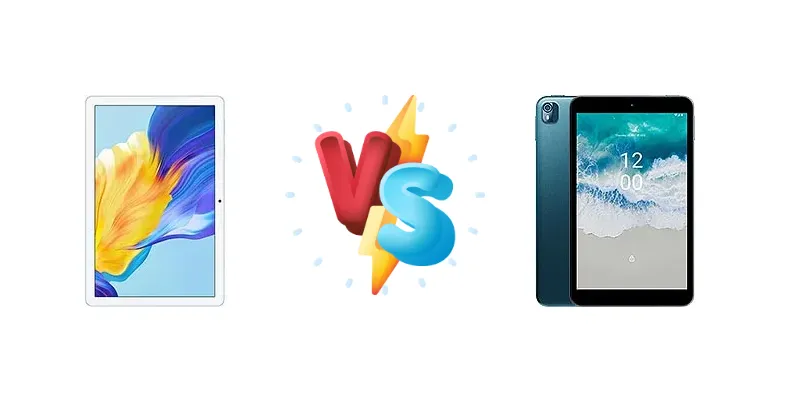
The Honor Pad X8 Lite and Nokia T10 represent the entry-level end of the Android tablet market, targeting users who need a larger screen for media consumption, light productivity, and casual gaming without breaking the bank. Both devices aim to deliver a functional experience at an affordable price, but they take different approaches to achieving this, primarily in their chipset choices and overall feature sets.
🏆 Quick Verdict
For most users, the Honor Pad X8 Lite offers a more compelling experience. Its Mediatek MT8786 chipset, with its faster Cortex-A75 cores, provides a noticeable performance edge over the Nokia T10’s Unisoc T606, making it better suited for multitasking and demanding applications. While the Nokia T10 benefits from a slightly more efficient manufacturing process, the performance difference is more impactful for everyday use.
| Network |
|---|
| 2G bands | N/A | GSM 850 / 900 / 1800 / 1900 |
| 3G bands | N/A | HSDPA 850 / 900 / 2100 |
| 4G bands | N/A | 1, 3, 5, 7, 8, 20, 28, 38, 40, 41 |
| EDGE | No | - |
| GPRS | No | - |
| Speed | - | HSPA 42.2/5.76 Mbps, LTE Cat4 150/50 Mbps |
| Technology | No cellular connectivity | GSM / HSPA / LTE |
| Launch |
|---|
| Announced | 2022, September 15 | 2022, July 12 |
| Status | Available. Released 2022, November | Available. Released 2022, August 20 |
| Body |
|---|
| Build | - | Glass front, plastic back, plastic frame |
| Dimensions | 240.2 x 159 x 7.6 mm (9.46 x 6.26 x 0.30 in) | 208 x 123.2 x 9 mm (8.19 x 4.85 x 0.35 in) |
| SIM | Nano-SIM | Nano-SIM |
| Weight | 460 g (1.01 lb) | 375 g (13.23 oz) |
| | - | Splash resistant |
| Display |
|---|
| Resolution | 800 x 1280 pixels, 16:10 ratio (~156 ppi density) | 800 x 1280 pixels, 16:10 ratio (~189 ppi density) |
| Size | 9.7 inches, 272.8 cm2 (~71.4% screen-to-body ratio) | 8.0 inches, 185.6 cm2 (~72.4% screen-to-body ratio) |
| Type | IPS LCD | IPS LCD, 360 nits (typ), 450 nits (peak) |
| Platform |
|---|
| CPU | Octa-core (2x2.0 GHz Cortex-A75 & 6x1.8 GHz Cortex-A55) | Octa-core (2x1.6 GHz Cortex-A75 & 6x1.6 GHz Cortex-A55) |
| Chipset | Mediatek MT8786 | Unisoc T606 (12 nm) |
| GPU | - | Mali-G57 MP1 |
| OS | Android 12, Magic UI 6.1 | Android 12, upgradable to Android 13 |
| Memory |
|---|
| Card slot | Unspecified | microSDXC |
| Internal | 32GB | 32GB 3GB RAM, 64GB 4GB RAM |
| Main Camera |
|---|
| Features | - | LED flash |
| Single | 5 MP | 8 MP, 1/4.0", 1.12µm, AF |
| Video | 1080p@30fps | 1080p |
| Selfie camera |
|---|
| Single | 2 MP | 2 MP, 1/5.0", 1.65µm |
| Video | 720p@30fps | 720p |
| Sound |
|---|
| 3.5mm jack | No | Yes |
| 35mm jack | No | Yes |
| Loudspeaker | Yes, with stereo speakers | Yes, with stereo speakers |
| Comms |
|---|
| Bluetooth | 5.1, A2DP, LE | 5.0, A2DP, LE |
| NFC | No | No |
| Positioning | No | GPS, GLONASS, GALILEO |
| Radio | No | No |
| USB | USB Type-C, OTG | USB Type-C 2.0, OTG |
| WLAN | Wi-Fi 802.11 a/b/g/n/ac, dual-band | Wi-Fi 802.11 a/b/g/n/ac, dual-band |
| Features |
|---|
| Sensors | Accelerometer | Accelerometer, proximity |
| Battery |
|---|
| Charging | - | 10W wired |
| Type | Li-Po 5100 mAh | Li-Po 5250 mAh |
| Misc |
|---|
| Colors | Mint Blue | Ocean Blue |
| Models | - | TA-1503, TA-1472, TA-1462, TA-1457 |
| Price | - | About 160 EUR |
| SAR | - | 1.19 W/kg (body) |
| SAR EU | - | 0.27 W/kg (head) 1.57 W/kg (body) |
Honor Pad X8 Lite
- More powerful Mediatek MT8786 chipset for smoother performance
- Faster CPU clock speeds for quicker app loading
- Potentially better image processing capabilities
- Likely less battery efficient under heavy load
- Charging speed not specified, potentially slower than competitors
Nokia T10
- Potentially better battery life due to the 12nm Unisoc T606
- Clean Android experience (typical of Nokia)
- 10W charging included
- Slower Unisoc T606 chipset limits performance
- Lower CPU clock speeds result in slower app loading
Display Comparison
Neither Honor nor Nokia provide detailed display specifications beyond screen size. However, given the price points, both likely utilize IPS LCD panels. The key difference lies in the processing power driving them. While both will be adequate for media consumption, the Honor Pad X8 Lite’s more capable chipset will contribute to smoother animations and faster response times when interacting with the UI. Expect similar color accuracy and viewing angles on both devices, but the X8 Lite’s processor may allow for more effective image processing.
Camera Comparison
Camera performance is unlikely to be a deciding factor for buyers in this segment. Both tablets likely feature basic camera setups geared towards casual snapshots. Without specific sensor details, it’s safe to assume image quality will be similar – adequate for video calls and quick photos in good lighting conditions, but lacking in detail and dynamic range. Focusing on the chipset’s image signal processor (ISP) capabilities, the Mediatek MT8786 likely offers slightly better image processing than the Unisoc T606, potentially resulting in marginally better photos.
Performance
The core of the difference between these tablets lies in their chipsets. The Honor Pad X8 Lite’s Mediatek MT8786 features two Cortex-A75 cores clocked at 2.0 GHz, paired with six Cortex-A55 cores at 1.8 GHz. This configuration provides a significant performance boost over the Nokia T10’s Unisoc T606, which has two Cortex-A75 cores clocked lower at 1.6 GHz and six Cortex-A55 cores also at 1.6 GHz. The higher clock speeds on the X8 Lite’s A75 cores translate to faster app loading times and smoother multitasking. The Unisoc T606, built on a 12nm process, aims for efficiency, but the performance gap is noticeable. While neither tablet is a gaming powerhouse, the X8 Lite will handle less demanding titles with greater ease.
Battery Life
The Nokia T10 includes 10W wired charging, a relatively slow charging speed in today’s market. While battery capacity isn’t specified in the provided data, the Unisoc T606’s 12nm process *could* translate to slightly better power efficiency. However, the Honor Pad X8 Lite’s more powerful processor may offset this advantage during intensive tasks. Expect both tablets to offer all-day battery life with moderate usage, but the Nokia T10 might edge out the X8 Lite in scenarios involving prolonged video playback or light web browsing. The slower charging speed of the Nokia T10 will require more patience to reach a full charge.
Buying Guide
Buy the Honor Pad X8 Lite if you prioritize performance for multitasking, streaming, and light gaming. Its more powerful processor will handle demanding apps and provide a smoother user experience. Buy the Nokia T10 if battery life and a clean Android experience are paramount, and your usage is primarily focused on basic tasks like web browsing and video playback. The Nokia T10’s simpler software and potentially lower power consumption may appeal to those seeking a straightforward tablet experience.
Frequently Asked Questions
❓ Will the Unisoc T606 in the Nokia T10 struggle with multiple apps open simultaneously?
Yes, the Unisoc T606 is a relatively low-powered chipset. While it can handle basic multitasking, opening several apps or switching between them frequently will likely result in noticeable lag and slowdowns. The Honor Pad X8 Lite’s Mediatek MT8786 is better equipped to handle heavier multitasking workloads.
❓ Is the 10W charging on the Nokia T10 significantly slower than other tablets?
Yes, 10W charging is quite slow by modern standards. Expect it to take several hours to fully charge the Nokia T10 from 0%. While not a dealbreaker for casual users, those who frequently use their tablet throughout the day may find the slow charging speed inconvenient. The Honor Pad X8 Lite’s charging speed is not specified, but it’s likely to be similar or slightly faster.
❓ Can either of these tablets handle popular mobile games like PUBG Mobile or Call of Duty Mobile?
Both tablets will struggle with demanding games like PUBG Mobile or Call of Duty Mobile. While you might be able to run them at the lowest settings with reduced frame rates, expect significant lag and stuttering. These tablets are better suited for less graphically intensive games.
❓ Which tablet is better for streaming video content from services like Netflix or YouTube?
Both tablets are capable of streaming video content, but the Honor Pad X8 Lite’s more powerful processor will provide a smoother playback experience, especially with higher resolution videos. The X8 Lite will also handle background tasks while streaming without as much performance degradation.