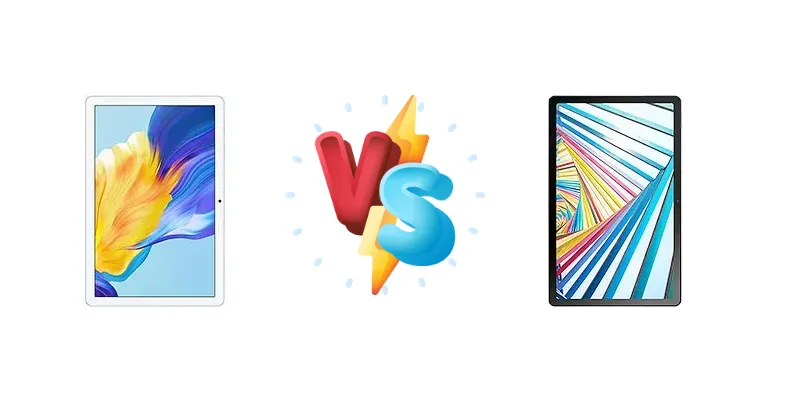
The budget tablet market is fiercely competitive, and the Honor Pad X8 Lite and Lenovo Tab M10 Plus (3rd Gen) are two strong contenders. Both aim to deliver a functional tablet experience without breaking the bank, but they take different approaches to achieving this. The Honor Pad X8 Lite relies on a Mediatek chipset, while the Lenovo Tab M10 Plus offers a choice between Qualcomm Snapdragon and Mediatek Helio, impacting performance and efficiency.
🏆 Quick Verdict
For most users, the Lenovo Tab M10 Plus (3rd Gen) with the Snapdragon 680 chipset offers a more compelling experience. Its 6nm process node and generally faster CPU cores provide a noticeable performance edge, especially for multitasking and demanding applications. While the Honor Pad X8 Lite is a capable device, the Lenovo’s superior processing power justifies the potential price difference.
| Network |
|---|
| 2G bands | N/A | GSM 850 / 900 / 1800 / 1900 |
| 3G bands | N/A | HSDPA 800 / 850 / 900 / 1900 / 2100 |
| 4G bands | N/A | 1, 2, 3, 4, 5, 7, 8, 19, 20, 26, 28, 28, 38, 40, 41 |
| EDGE | No | - |
| GPRS | No | - |
| Speed | - | HSPA 42.2/5.76 Mbps, LTE Cat13 390/75 Mbps - cellular model only |
| Technology | No cellular connectivity | GSM / HSPA / LTE |
| Launch |
|---|
| Announced | 2022, September 15 | 2022, May |
| Status | Available. Released 2022, November | Available. Released 2022, May |
| Body |
|---|
| Dimensions | 240.2 x 159 x 7.6 mm (9.46 x 6.26 x 0.30 in) | 251.2 x 158.8 x 7.5 mm (9.89 x 6.25 x 0.30 in) |
| SIM | Nano-SIM | Nano-SIM (cellular model only) |
| Weight | 460 g (1.01 lb) | 465 g (1.03 lb) |
| | - | Stylus support |
| Display |
|---|
| Resolution | 800 x 1280 pixels, 16:10 ratio (~156 ppi density) | 1200 x 2000 pixels, 5:3 ratio (~220 ppi density) |
| Size | 9.7 inches, 272.8 cm2 (~71.4% screen-to-body ratio) | 10.61 inches, 320.4 cm2 (~80.3% screen-to-body ratio) |
| Type | IPS LCD | IPS LCD, 400 nits (typ) |
| Platform |
|---|
| CPU | Octa-core (2x2.0 GHz Cortex-A75 & 6x1.8 GHz Cortex-A55) | Octa-core (4x2.4 GHz Kryo 265 Gold & 4x1.9 GHz Kryo 265 Silver) - LTE model Octa-core (2x2.0 GHz Cortex-A75 & 6x1.8 GHz Cortex-A55) - Wi-Fi only model |
| Chipset | Mediatek MT8786 | Qualcomm SM6225 Snapdragon 680 4G (6 nm) - LTE model Mediatek MT6769V/CU Helio G80 (12 nm) - Wi-Fi only model |
| GPU | - | Adreno 610 - LTE model Mali-G52 MC2 - Wi-Fi only model |
| OS | Android 12, Magic UI 6.1 | Android 12 |
| Memory |
|---|
| Card slot | Unspecified | microSDXC (dedicated slot) |
| Internal | 32GB | 32GB 3GB RAM, 64GB 4GB RAM, 128GB 4GB RAM, 128GB 6GB RAM |
| | - | eMCP/uMCP |
| Main Camera |
|---|
| Single | 5 MP | 8 MP, AF |
| Video | 1080p@30fps | 1080p |
| Selfie camera |
|---|
| Single | 2 MP | 8 MP |
| Video | 720p@30fps | - |
| Sound |
|---|
| 3.5mm jack | No | Yes |
| 35mm jack | No | Yes |
| Loudspeaker | Yes, with stereo speakers | Yes, with stereo speakers (4 speakers) |
| Comms |
|---|
| Bluetooth | 5.1, A2DP, LE | 5.0, A2DP, LE |
| NFC | No | No |
| Positioning | No | GPS, GLONASS, BDS - cellular model only |
| Radio | No | FM Radio |
| USB | USB Type-C, OTG | USB Type-C 2.0 |
| WLAN | Wi-Fi 802.11 a/b/g/n/ac, dual-band | Wi-Fi 802.11 a/b/g/n/ac, dual-band, Wi-Fi Direct |
| Features |
|---|
| Sensors | Accelerometer | Accelerometer, proximity, gyro |
| Battery |
|---|
| Charging | - | 20W wired |
| Type | Li-Po 5100 mAh | Li-Po 7700 mAh |
| Misc |
|---|
| Colors | Mint Blue | Storm Grey, Frost Blue |
| Price | - | About 260 EUR |
Honor Pad X8 Lite
- Potentially lower price point
- Compact 8-inch form factor for portability
- Adequate for basic tasks like browsing and video
- Less powerful Mediatek MT8786 chipset
- Likely slower app loading and multitasking
- Charging speed not specified
Lenovo Tab M10 Plus (3rd Gen)
- Faster Snapdragon 680 (6nm) chipset (LTE model)
- Larger 10.61-inch display for immersive viewing
- 20W fast charging
- Potentially higher price
- Wi-Fi only model uses less efficient Helio G80
- Larger size may be less portable
Display Comparison
Neither device boasts a particularly standout display. Both are likely to feature IPS LCD panels, common in this price bracket. However, detailed specs like resolution and peak brightness are missing. The Lenovo Tab M10 Plus benefits from a slightly larger 10.61-inch screen compared to the Honor Pad X8 Lite’s 8-inch display, potentially offering a more immersive viewing experience. Without knowing the exact nit ratings, it’s difficult to assess outdoor visibility, but larger screens generally allow for higher peak brightness. Bezels are expected to be noticeable on both devices, typical of budget tablets.
Camera Comparison
Camera performance is unlikely to be a deciding factor for either tablet. Both will likely feature basic camera setups suitable for casual snapshots and video calls. Details on sensor sizes and apertures are unavailable, but it’s safe to assume they won’t compete with smartphone cameras. Focusing on the primary sensor is key; any secondary sensors (like the often-present 2MP macro) are unlikely to deliver meaningful results. The Lenovo Tab M10 Plus may have a slight edge if it incorporates better image processing algorithms, but this is speculative without further testing.
Performance
This is where the Lenovo Tab M10 Plus (3rd Gen) pulls ahead, *depending on the configuration*. The Snapdragon 680 (6nm) variant offers a significant advantage over the Honor Pad X8 Lite’s Mediatek MT8786. The Snapdragon’s Kryo 265 Gold cores, clocked at 2.4 GHz, outperform the Cortex-A75 cores in the MT8786 (2.0 GHz). The 6nm process also translates to better power efficiency and potentially less thermal throttling during sustained workloads. The Wi-Fi only version of the Lenovo Tab M10 Plus uses the Helio G80, which has a similar CPU configuration to the Honor Pad X8 Lite, but the Snapdragon version is the clear winner. Both tablets likely feature similar RAM configurations, but the Snapdragon’s superior architecture will provide a smoother overall experience.
Battery Life
Battery life will depend heavily on usage patterns. The Lenovo Tab M10 Plus includes 20W wired charging, a welcome addition that will reduce charging times compared to the Honor Pad X8 Lite, which lacks specified charging speeds. While the exact battery capacities are unknown, the Snapdragon 680’s improved power efficiency could offset a potentially smaller battery size in the Lenovo Tab M10 Plus, resulting in comparable or even better real-world battery life. The 20W charging on the Lenovo will provide a faster top-up when needed.
Buying Guide
Buy the Honor Pad X8 Lite if you prioritize a lower upfront cost and primarily need a tablet for basic tasks like web browsing, video playback, and light social media. It’s a solid choice for casual users who don’t demand high performance. Buy the Lenovo Tab M10 Plus (3rd Gen) if you value smoother multitasking, faster app loading times, and the potential for 4G connectivity (LTE model). It’s better suited for students, professionals, or anyone who wants a more responsive and versatile tablet experience.
Frequently Asked Questions
❓ Does the Snapdragon 680 in the Lenovo Tab M10 Plus handle multitasking well?
Yes, the Snapdragon 680, built on a 6nm process, is significantly better at multitasking than the Mediatek MT8786 in the Honor Pad X8 Lite. Its more efficient architecture and faster cores allow for smoother switching between apps and handling multiple tasks simultaneously without noticeable slowdown.
❓ Which tablet is better for streaming video?
The Lenovo Tab M10 Plus (3rd Gen) is better suited for streaming video due to its larger 10.61-inch display and the potential for a brighter screen. The Snapdragon 680 also ensures smoother playback and less buffering, especially with higher-resolution content.
❓ Is the Wi-Fi only version of the Lenovo Tab M10 Plus a good option if I don't need cellular connectivity?
The Wi-Fi only version is a viable option if you primarily use your tablet at home or in locations with reliable Wi-Fi. However, it's important to note that it uses the Mediatek Helio G80 chipset, which is less powerful than the Snapdragon 680 found in the LTE model. If performance is a priority, the LTE version is worth the extra cost.