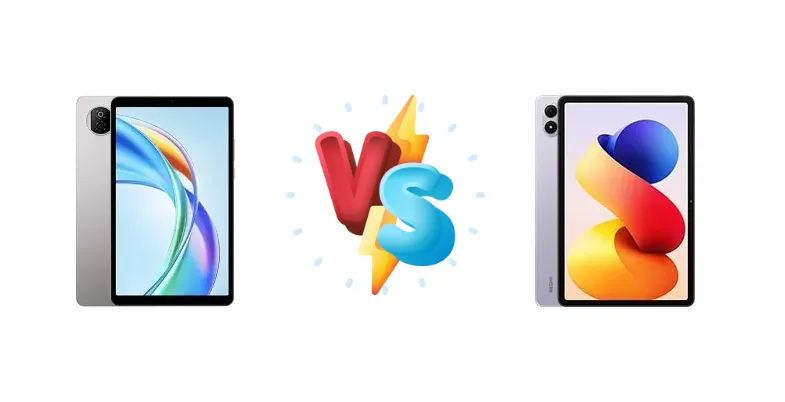
The tablet market is heating up, with both Xiaomi and Honor offering compelling options in the affordable segment. We’re pitting the Xiaomi Redmi Pad 2 Pro, boasting the newer Snapdragon 7s Gen 4, against the Honor Pad X7, powered by the Snapdragon 680, to determine which delivers the best balance of performance, battery life, and value.
🏆 Quick Verdict
For most users, the Xiaomi Redmi Pad 2 Pro is the superior choice. Its significantly more powerful Snapdragon 7s Gen 4 chipset, coupled with 33W fast charging, provides a smoother experience and quicker top-ups, justifying the likely price premium. However, the Honor Pad X7 remains a viable option for those on a very tight budget.
| Network |
|---|
| 2G bands | N/A | N/A |
| 3G bands | N/A | N/A |
| 4G bands | N/A | - |
| EDGE | No | N/A |
| GPRS | No | N/A |
| Technology | No cellular connectivity | No cellular connectivity |
| Launch |
|---|
| Announced | 2025, July 24 | 2025, September 24 |
| Status | Available. Released 2025, July 24 | Available. Released 2025, September 24 |
| Body |
|---|
| Build | Glass front, aluminum frame, aluminum back | Glass front, aluminum frame, aluminum back |
| Dimensions | 211.8 x 124.8 x 8 mm (8.34 x 4.91 x 0.31 in) | 279.8 x 181.7 x 7.5 mm (11.02 x 7.15 x 0.30 in) |
| SIM | No | No |
| Weight | 365 g (12.87 oz) | 610 g (1.34 lb) |
| Display |
|---|
| Protection | - | Mohs level 6 |
| Resolution | 800 x 1340 pixels, 5:3 ratio (~179 ppi density) | 1600 x 2560 pixels, 16:10 ratio (~249 ppi density) |
| Size | 8.7 inches, 214.9 cm2 (~81.3% screen-to-body ratio) | 12.1 inches, 424.5 cm2 (~83.5% screen-to-body ratio) |
| Type | IPS LCD, 90Hz, 500 nits (typ), 625 nits (HBM) | IPS LCD, 1B colors, 120Hz, Dolby Vision, 600 nits (HBM) |
| Platform |
|---|
| CPU | Octa-core (4x2.4 GHz Kryo 265 Gold & 4x1.9 GHz Kryo 265 Silver) | Octa-core (1x2.7 GHz Cortex-A720 & 3x2.4 GHz Cortex-A720 & 4x1.8 GHz Cortex-A520) |
| Chipset | Qualcomm SM6225 Snapdragon 680 (6 nm) | Qualcomm SM7635-AC Snapdragon 7s Gen 4 (4 nm) |
| GPU | Adreno 610 | Adreno 810 |
| OS | Android 15, MagicOS 9 | Android 15, HyperOS 2 |
| Memory |
|---|
| Card slot | microSDXC | microSDXC (dedicated slot) |
| Internal | 128GB 4GB RAM | 128GB 6GB RAM, 256GB 8GB RAM |
| Main Camera |
|---|
| Features | HDR | Color spectrum sensor, LED flash, HDR |
| Single | 8 MP, f/2.0, AF | 8 MP, f/2.0, (wide), 1/4.0", 1.12µm |
| Video | 1080p@30fps | 1080p@30fps |
| Selfie camera |
|---|
| Single | 5 MP, f/2.2 | 8 MP, f/2.3, (wide), 1/4.0", 1.12µm |
| Video | 1080p@30fps | 1080p@30fps |
| Sound |
|---|
| 35mm jack | No | Yes |
| Loudspeaker | Yes, with stereo speakers | Yes, with stereo speakers, Dolby Atmos (4 speakers) |
| Comms |
|---|
| Bluetooth | 5.0, A2DP, LE | 5.4, A2DP, LE, aptX HD, aptX Adaptive |
| NFC | No | No |
| Positioning | No | No |
| Radio | No | No |
| USB | USB Type-C, OTG | USB Type-C 2.0, OTG |
| WLAN | Wi-Fi 802.11 a/b/g/n/ac, dual-band | Wi-Fi 802.11 a/b/g/n/a/6, dual-band, Wi-Fi Direct |
| Features |
|---|
| Sensors | Accelerometer | Accelerometer, gyro, proximity (accessories only), compass |
| Battery |
|---|
| Charging | 10W wired | 33W wired, PD3.0, QC3+
27W reverse wired |
| Type | Li-Ion 7020 mAh | 12000 mAh |
| Misc |
|---|
| Colors | Gray | Graphite Gray, Silver, Lavender Purple, Matte Glass Version |
| Models | - | 25099RP13G |
| Price | About 150 EUR | About 300 EUR |
| EU LABEL |
|---|
| Battery | - | 103:18h endurance, 1000 cycles |
| Energy | - | Class G |
| Free fall | - | Class A (208 falls) |
| Repairability | - | Class C |
Honor Pad X7
- Extremely Affordable
- Decent Performance for Basic Tasks
- Acceptable Battery Life
- Slow 10W Charging
- Outdated Snapdragon 680 Chipset
Xiaomi Redmi Pad 2 Pro
- Powerful Snapdragon 7s Gen 4
- Fast 33W Charging with PD3.0/QC3+
- Excellent Battery Endurance
- Likely Higher Price
- May be overkill for basic users
Display Comparison
While both tablets likely feature LCD panels (data not provided), the core difference lies in the processing power driving them. Display quality details like resolution and refresh rate are missing, but the chipset's ability to efficiently render graphics will impact perceived smoothness. The Redmi Pad 2 Pro’s Snapdragon 7s Gen 4 will handle demanding visual tasks with greater ease, potentially offering a more fluid experience in games and video playback. Bezels and color accuracy are unknown, but the chipset difference suggests the Redmi Pad 2 Pro will be more capable of driving a higher-quality display if equipped.
Camera Comparison
Camera specifications are not provided for either device. Given the budget nature of both tablets, expectations should be tempered. Image quality will likely be adequate for casual snapshots and video calls, but neither device is expected to compete with flagship smartphones. The absence of detailed camera specs makes a direct comparison impossible, but the Redmi Pad 2 Pro’s more powerful ISP (Image Signal Processor) within the Snapdragon 7s Gen 4 could potentially offer slightly better image processing.
Performance
The Xiaomi Redmi Pad 2 Pro’s Snapdragon 7s Gen 4 (4nm) represents a substantial leap over the Honor Pad X7’s Snapdragon 680 (6nm). The 7s Gen 4 features a more modern CPU architecture – a 1x2.7 GHz Cortex-A720 prime core alongside 3x2.4 GHz Cortex-A720 cores and 4x1.8 GHz Cortex-A520 efficiency cores – compared to the 680’s 4x2.4 GHz Kryo 265 Gold and 4x1.9 GHz Kryo 265 Silver configuration. This translates to significantly faster processing speeds and improved multitasking capabilities. The 4nm process node further enhances efficiency, leading to better thermal management and sustained performance. Gamers and users running demanding applications will see a noticeable difference.
Battery Life
The Redmi Pad 2 Pro boasts impressive battery endurance, with a reported 103:18h endurance and 12:55h active use score. While the Honor Pad X7’s battery capacity is unknown, its Snapdragon 680 chipset is less power-hungry. However, the Redmi Pad 2 Pro’s 33W wired charging (with PD3.0 and QC3+ support) is a game-changer. This allows for significantly faster charging times compared to the Honor Pad X7’s slow 10W charging. The Redmi Pad 2 Pro also offers 27W reverse wired charging, a feature absent on the X7, allowing it to charge other devices.
Buying Guide
Buy the Honor Pad X7 if you prioritize extreme affordability and only need a tablet for basic tasks like web browsing, video streaming, and light productivity. It’s ideal for users who aren’t demanding gamers or power users. Buy the Xiaomi Redmi Pad 2 Pro if you value performance, faster charging, and a more future-proof experience. This tablet is better suited for multitasking, gaming, and users who want a device that will remain responsive for years to come.
Frequently Asked Questions
❓ Will the Snapdragon 680 in the Honor Pad X7 struggle with demanding games like Genshin Impact?
Yes, the Snapdragon 680 is a budget-oriented chipset and will likely struggle to run graphically intensive games like Genshin Impact smoothly, even at low settings. Expect significant frame rate drops and potential stuttering. The Redmi Pad 2 Pro’s Snapdragon 7s Gen 4 is far better equipped for gaming.
❓ How long will it take to fully charge the Xiaomi Redmi Pad 2 Pro from 0% to 100%?
With 33W fast charging, the Redmi Pad 2 Pro should fully charge from 0% to 100% in approximately 1 hour and 45 minutes to 2 hours, depending on usage during charging. This is a significant improvement over the Honor Pad X7’s much slower 10W charging, which could take upwards of 4-5 hours.
❓ Does the Redmi Pad 2 Pro support video playback in HDR formats?
While not explicitly stated, the Snapdragon 7s Gen 4 supports HDR10+ and HLG playback. This suggests the Redmi Pad 2 Pro is likely capable of displaying HDR content, offering a wider color gamut and improved contrast for compatible videos. The Honor Pad X7's capabilities are unknown.