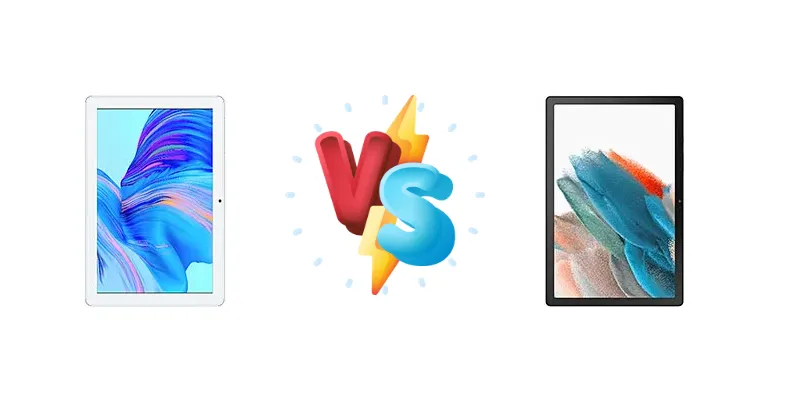
The sub-$200 tablet market is fiercely competitive, and the Honor Pad X6 and Samsung Galaxy Tab A8 10.5 (2021) are two of the leading contenders. Both aim to deliver a functional Android experience without breaking the bank, but they take different approaches to achieving that goal. This comparison dives deep into their specifications and performance to determine which tablet offers the best value for your money.
🏆 Quick Verdict
For most users, the Samsung Galaxy Tab A8 10.5 (2021) is the better choice. While the Honor Pad X6 is a capable device, the Tab A8’s more modern Unisoc Tiger T618 chipset and faster 15W charging provide a noticeably smoother experience and quicker power-ups, justifying its slightly higher price.
| Network |
|---|
| 2G bands | GSM 850 / 900 / 1800 / 1900 | GSM 850 / 900 / 1800 / 1900 |
| 3G bands | HSDPA 2100 | HSDPA 850 / 900 / 1700(AWS) / 1900 / 2100 |
| 4G bands | LTE | 1, 2, 3, 4, 5, 7, 8, 12, 17, 20, 28, 38, 40, 41, 66 |
| Speed | HSPA, LTE - cellular model only | HSPA, LTE - cellular model only |
| Technology | GSM / HSPA / LTE | GSM / HSPA / LTE |
| Launch |
|---|
| Announced | 2020, July 17. Released 2020, July 28 | 2021, December 15 |
| Status | Discontinued | Available. Released 2022, January 17 |
| Body |
|---|
| Build | Glass front, aluminum frame, aluminum back | - |
| Dimensions | 240.2 x 159 x 7.6 mm (9.46 x 6.26 x 0.30 in) | 246.8 x 161.9 x 6.9 mm (9.72 x 6.37 x 0.27 in) |
| SIM | Nano-SIM (cellular model only) | Nano-SIM (cellular model only) |
| Weight | 460 g (1.01 lb) | 508 g (1.12 lb) |
| | Stylus support | - |
| Display |
|---|
| Resolution | 800 x 1280 pixels, 16:10 ratio (~156 ppi density) | 1200 x 1920 pixels, 16:10 ratio (~216 ppi density) |
| Size | 9.7 inches, 272.8 cm2 (~71.4% screen-to-body ratio) | 10.5 inches, 319.7 cm2 (~80.0% screen-to-body ratio) |
| Type | IPS LCD | TFT LCD |
| Platform |
|---|
| CPU | Octa-core (4x2.0 GHz Cortex-A73 & 4x1.7 GHz Cortex-A53) | Octa-core (2x2.0 GHz Cortex-A75 & 6x2.0 GHz Cortex-A55) |
| Chipset | Kirin 710A (14 nm) | Unisoc Tiger T618 (12 nm) |
| GPU | Mali-G51 MP4 | Mali G52 MP2 |
| OS | Android 10, Magic UI 3.1, no Google Play Services | Android 11, upgradable to Android 14, One UI 6 |
| Memory |
|---|
| Card slot | Unspecified | microSDXC (dedicated slot) |
| Internal | 32GB 3GB RAM, 64GB 4GB RAM | 32GB 2GB RAM, 32GB 3GB RAM, 64GB 2GB RAM, 64GB 3GB RAM, 64GB 4GB RAM, 128GB 3GB RAM, 128GB 4GB RAM |
| | eMMC 5.1 | - |
| Main Camera |
|---|
| Features | HDR, panorama | - |
| Single | 5 MP, f/2.2 | 8 MP, AF |
| Video | 1080p@30fps | 1080p@30fps |
| Selfie camera |
|---|
| Single | 2 MP, f/2.4 | 5 MP |
| Video | - | 1080p@30fps |
| Sound |
|---|
| 3.5mm jack | Yes | Yes |
| 35mm jack | Yes | Yes |
| Loudspeaker | Yes, with dual speakers | Yes, with stereo speakers (4 speakers) |
| Comms |
|---|
| Bluetooth | 5.1, A2DP, LE | 5.0, A2DP, LE |
| NFC | No | No |
| Positioning | GPS - cellular model only | GPS, GLONASS, BDS, GALILEO, QZSS - cellular model only |
| Radio | No | No |
| USB | USB Type-C 2.0 | USB Type-C 2.0 |
| WLAN | Wi-Fi 802.11 a/b/g/n/ac, dual-band, Wi-Fi Direct | Wi-Fi 802.11 a/b/g/n/ac, dual-band, Wi-Fi Direct |
| Features |
|---|
| Sensors | Accelerometer | Accelerometer, gyro, proximity, compass |
| Battery |
|---|
| Charging | 10W wired | 15W wired |
| Type | Li-Po 5100 mAh | Li-Po 7040 mAh |
| Misc |
|---|
| Colors | Neo Mint | Gray, Silver, Pink Gold |
| Models | AGR-W09, AGR-AL09 | SM-X200, SM-X205 |
| Price | - | About 230 EUR |
| SAR EU | - | 0.92 W/kg (body) |
Honor Pad X6
- Potentially lower price point
- Acceptable performance for basic tasks
- Honor’s Magic UI offers customization options
- Older Kirin 710A chipset
- Slower 10W charging
- Likely less responsive user experience
Samsung Galaxy Tab A8 10.5 (2021)
- More modern Unisoc Tiger T618 chipset
- Faster 15W charging
- Slightly larger 10.5-inch display
- May be slightly more expensive
- Samsung’s One UI can be resource-intensive
- Build quality may not be premium
Display Comparison
Neither tablet boasts a particularly impressive display. Both are likely to utilize IPS LCD panels, common in this price bracket. However, details like peak brightness and color gamut coverage are missing. The Tab A8’s 10.5-inch screen size is slightly larger than the X6’s, potentially offering a more immersive viewing experience. Bezels are expected to be substantial on both, as manufacturers cut costs here. Without specific display specs, it’s difficult to declare a clear winner, but the larger screen of the Tab A8 gives it a slight edge.
Camera Comparison
Camera quality is unlikely to be a deciding factor for buyers in this segment. Both tablets likely feature basic camera setups. Given the lack of detailed specifications, it’s safe to assume both will struggle in low-light conditions. Focusing on the primary sensor, the Tab A8 likely has a slight advantage due to Samsung’s image processing expertise, but the difference will be minimal. Any 2MP auxiliary cameras on either device are largely irrelevant.
Performance
The core difference lies in the chipsets. The Samsung Galaxy Tab A8’s Unisoc Tiger T618, fabricated on a 12nm process, represents a more modern architecture than the Honor Pad X6’s Kirin 710A (14nm). The T618’s CPU configuration – 2x2.0 GHz Cortex-A75 & 6x2.0 GHz Cortex-A55 – is a step up from the X6’s 4x2.0 GHz Cortex-A73 & 4x1.7 GHz Cortex-A53. The Cortex-A75 cores in the Tab A8 offer significantly better single-core performance, crucial for app responsiveness. While both have octa-core CPUs, the architectural improvements in the T618 translate to a smoother user experience, particularly when multitasking. The Tab A8 is likely to handle demanding apps and games with fewer stutters.
Battery Life
Battery capacity is not specified for either device, making a direct comparison difficult. However, the Samsung Galaxy Tab A8’s 15W wired charging is a clear advantage over the Honor Pad X6’s 10W charging. This means the Tab A8 will reach a full charge significantly faster, reducing downtime. While a larger battery capacity on the X6 could offset the slower charging, the faster charging speed of the Tab A8 is a more immediately noticeable benefit for most users.
Buying Guide
Buy the Honor Pad X6 if you prioritize absolute affordability and are primarily using the tablet for very basic tasks like reading ebooks or light web browsing. Its Kirin 710A is sufficient for these workloads. Buy the Samsung Galaxy Tab A8 10.5 (2021) if you want a more responsive and versatile tablet experience, especially for multitasking, streaming video, and casual gaming. The Unisoc T618 offers a tangible performance advantage and the faster charging is a significant convenience.
Frequently Asked Questions
❓ Will the Unisoc Tiger T618 in the Tab A8 struggle with demanding games like PUBG?
While the Unisoc Tiger T618 isn't a gaming powerhouse, it's capable of running PUBG Mobile at medium settings with acceptable frame rates. Expect some occasional frame drops during intense action. The Kirin 710A in the Honor Pad X6 will likely require even lower settings and may exhibit more noticeable lag.
❓ Is the 10W charging on the Honor Pad X6 noticeably slow in everyday use?
Yes, 10W charging is significantly slower than the 15W charging on the Tab A8. Expect it to take considerably longer to fully charge the Honor Pad X6, potentially requiring overnight charging to ensure it's ready for the day. This is a key convenience factor where the Tab A8 excels.
❓ How does the software experience differ between Honor’s Magic UI and Samsung’s One UI?
Honor’s Magic UI is based on Android and offers a degree of customization. Samsung’s One UI is also Android-based but is known for its feature-richness and sometimes, pre-installed bloatware. One UI can also be more resource-intensive, potentially impacting performance on a budget device like the Tab A8, though the T618 chipset mitigates this somewhat.