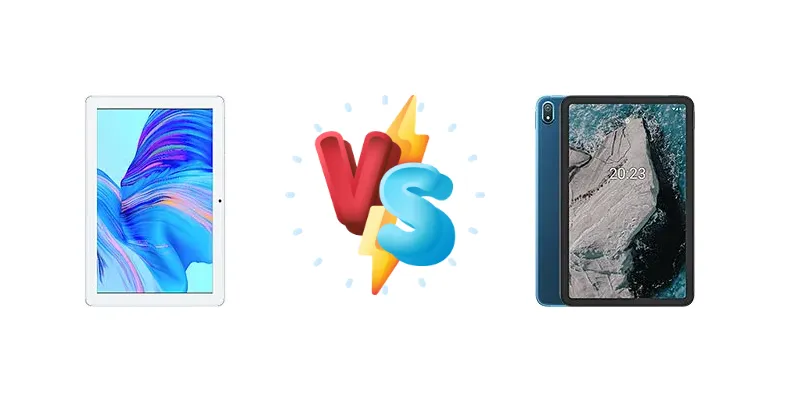
The budget tablet market is fiercely competitive, and the Honor Pad X6 and Nokia T20 represent compelling options for users seeking affordable Android experiences. While both aim to deliver value, they take different approaches to chipset selection and feature sets. This comparison dissects their strengths and weaknesses to determine which tablet best suits your needs.
🏆 Quick Verdict
For most users, the Nokia T20 emerges as the better choice. Its Unisoc T610, fabricated on a more efficient 12nm process, coupled with a brighter 422 nit display, provides a smoother and more visually pleasing experience than the Honor Pad X6’s older Kirin 710A and lack of detailed display specs.
| Network |
|---|
| 2G bands | GSM 850 / 900 / 1800 / 1900 | GSM 850 / 900 / 1800 / 1900 |
| 3G bands | HSDPA 2100 | HSDPA 850 / 900 / 1700(AWS) / 1900 / 2100 - US, LATAM |
| 4G bands | LTE | 1, 2, 3, 4, 5, 7, 8, 12, 13, 17, 20, 28, 40, 66 - US, LATAM |
| Speed | HSPA, LTE - cellular model only | HSPA, LTE Cat4 150/50 Mbps - cellular model only |
| Technology | GSM / HSPA / LTE | GSM / HSPA / LTE |
| | - | 1, 3, 5, 7, 8, 20, 28, 38, 40, 41 - International |
| Launch |
|---|
| Announced | 2020, July 17. Released 2020, July 28 | 2021, October 06 |
| Status | Discontinued | Available. Released 2021, November 02 |
| Body |
|---|
| Build | Glass front, aluminum frame, aluminum back | Glass front, aluminum back |
| Dimensions | 240.2 x 159 x 7.6 mm (9.46 x 6.26 x 0.30 in) | 247.6 x 157.5 x 7.8 mm (9.75 x 6.20 x 0.31 in) |
| SIM | Nano-SIM (cellular model only) | Nano-SIM (cellular model only) |
| Weight | 460 g (1.01 lb) | 465 g (Wi-Fi), 470 g (LTE) (1.03 lb) |
| | Stylus support | Splash resistant |
| Display |
|---|
| Protection | - | Scratch-resistant glass |
| Resolution | 800 x 1280 pixels, 16:10 ratio (~156 ppi density) | 1200 x 2000 pixels, 5:3 ratio (~224 ppi density) |
| Size | 9.7 inches, 272.8 cm2 (~71.4% screen-to-body ratio) | 10.4 inches, 307.9 cm2 (~78.9% screen-to-body ratio) |
| Type | IPS LCD | IPS LCD, 400 nits (typ) |
| Platform |
|---|
| CPU | Octa-core (4x2.0 GHz Cortex-A73 & 4x1.7 GHz Cortex-A53) | Octa-core (2x1.8 GHz Cortex-A75 & 6x1.8 GHz Cortex-A55) |
| Chipset | Kirin 710A (14 nm) | Unisoc T610 (12 nm) |
| GPU | Mali-G51 MP4 | Mali-G52 MP2 |
| OS | Android 10, Magic UI 3.1, no Google Play Services | Android 11, upgradable to Android 13 |
| Memory |
|---|
| Card slot | Unspecified | microSDXC (dedicated slot) |
| Internal | 32GB 3GB RAM, 64GB 4GB RAM | 32GB 3GB RAM, 64GB 4GB RAM |
| | eMMC 5.1 | eMMC 5.1 |
| Main Camera |
|---|
| Features | HDR, panorama | LED flash |
| Single | 5 MP, f/2.2 | 8 MP, AF |
| Video | 1080p@30fps | 1080p@30fps |
| Selfie camera |
|---|
| Single | 2 MP, f/2.4 | 5 MP |
| Video | - | Yes |
| Sound |
|---|
| 3.5mm jack | Yes | Yes |
| 35mm jack | Yes | Yes |
| Loudspeaker | Yes, with dual speakers | Yes, with stereo speakers |
| Comms |
|---|
| Bluetooth | 5.1, A2DP, LE | 5.0, A2DP, LE |
| NFC | No | No |
| Positioning | GPS - cellular model only | GPS - cellular model only |
| Radio | No | FM radio |
| USB | USB Type-C 2.0 | USB Type-C 2.0 |
| WLAN | Wi-Fi 802.11 a/b/g/n/ac, dual-band, Wi-Fi Direct | Wi-Fi 802.11 a/b/g/n/ac, dual-band |
| Features |
|---|
| Sensors | Accelerometer | Accelerometer |
| Battery |
|---|
| Charging | 10W wired | 15W wired |
| Type | Li-Po 5100 mAh | Li-Po 8200 mAh |
| Misc |
|---|
| Colors | Neo Mint | Deep Ocean |
| Models | AGR-W09, AGR-AL09 | TA-1397, TA-1394, TA-1392 |
| Price | - | About 200 EUR |
| SAR | - | 1.34 W/kg (body) |
| SAR EU | - | 1.35 W/kg (body) |
Honor Pad X6
- Potentially lower price point
- Familiar Android interface
- Lightweight design (assumed based on market segment)
- Older Kirin 710A chipset
- Slower 10W charging
- Display specifications are unknown, likely lower quality
Nokia T20
- Brighter 422 nit display
- More efficient Unisoc T610 chipset
- Faster 15W charging
- May be slightly more expensive
- Unisoc chipset may have limited software support (potential concern)
- Build quality may not be premium
Display Comparison
The Nokia T20 boasts a significant advantage in display quality, achieving a measured peak brightness of 422 nits and a 1786:1 contrast ratio. While the Honor Pad X6’s display specifications are absent, the Nokia’s brightness level ensures comfortable viewing in well-lit environments. The lack of detailed specs for the Honor Pad X6 suggests a potentially lower-quality panel, impacting color accuracy and outdoor visibility. This makes the Nokia T20 the clear winner for users who consume a lot of video or work outdoors.
Camera Comparison
Neither tablet is positioned as a photography powerhouse, and detailed camera specifications are unavailable for either. Given the budget nature of both devices, image quality is likely to be similar – adequate for casual snapshots but not competitive with smartphones. Without specific sensor details, it’s difficult to declare a winner, but the absence of any marketing around the Honor Pad X6’s camera suggests it’s not a key selling point.
Performance
The Nokia T20’s Unisoc T610 (12nm) and its CPU configuration of 2x1.8 GHz Cortex-A75 and 6x1.8 GHz Cortex-A55 cores offer a more modern architecture than the Honor Pad X6’s Kirin 710A (14nm). The Cortex-A75 cores in the T20 provide a noticeable performance uplift in single-core tasks, while the 12nm process generally translates to better power efficiency. Although both are octa-core CPUs, the Kirin 710A’s older Cortex-A73 cores are less efficient. This difference in architecture means the Nokia T20 will likely handle multitasking and demanding apps more smoothly.
Battery Life
While battery capacity isn’t specified for either device, the Nokia T20’s 15W wired charging is a clear advantage over the Honor Pad X6’s slower 10W charging. Faster charging reduces downtime and allows for quicker top-ups, which is particularly beneficial for tablets used on the go. The more efficient Unisoc T610 in the Nokia T20 may also contribute to slightly longer battery life, offsetting any potential capacity differences.
Buying Guide
Buy the Honor Pad X6 if you prioritize a potentially lower price point and are primarily focused on very basic tasks like reading and light web browsing. Buy the Nokia T20 if you value a more responsive user experience, a brighter and more usable display for media consumption, and faster charging capabilities, even if it means spending slightly more.
Frequently Asked Questions
❓ Is the Unisoc T610 in the Nokia T20 powerful enough for gaming?
The Unisoc T610 is capable of handling casual gaming, but it’s not designed for demanding titles at high settings. Expect playable frame rates in less graphically intensive games, but you may need to lower settings for more demanding games. The Kirin 710A in the Honor Pad X6 will likely offer a similar gaming experience.
❓ How does the 12nm process of the Unisoc T610 affect battery life compared to the 14nm Kirin 710A?
A smaller process node (12nm vs 14nm) generally indicates greater power efficiency. The Unisoc T610 should consume less power than the Kirin 710A for the same workload, potentially resulting in longer battery life on the Nokia T20, even with similar battery capacities.
❓ Will the Nokia T20 receive long-term software updates?
Nokia has a relatively good track record for providing software updates, even for their budget devices. However, Unisoc chipsets sometimes receive less frequent updates compared to Qualcomm or MediaTek. It's advisable to check Nokia's official update policy for the T20 to confirm the expected update schedule.