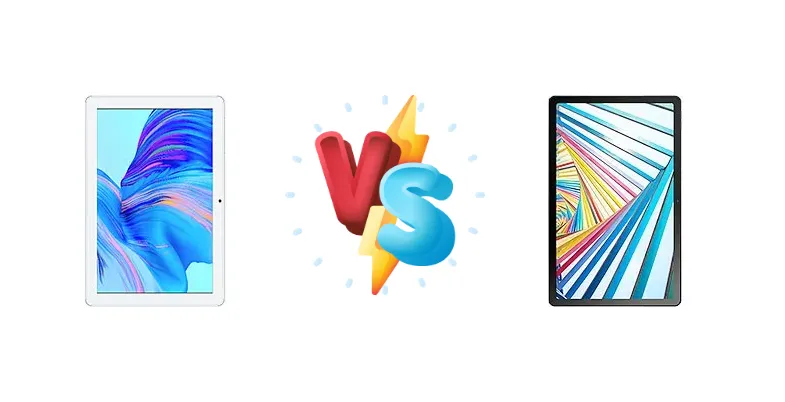
The budget tablet market is fiercely competitive, and the Honor Pad X6 and Lenovo Tab M10 Plus (3rd Gen) represent compelling options for users seeking affordable entertainment and productivity. This comparison dives deep into their specifications, focusing on the core differences in chipset architecture, charging capabilities, and overall performance to determine which tablet delivers the most value.
🏆 Quick Verdict
For the average user prioritizing responsiveness and faster charging, the Lenovo Tab M10 Plus (3rd Gen) with the Snapdragon 680 chipset is the better choice. While the Honor Pad X6 offers a functional experience, the Lenovo’s more modern 6nm process and faster CPU cores provide a noticeable performance edge.
| Network |
|---|
| 2G bands | GSM 850 / 900 / 1800 / 1900 | GSM 850 / 900 / 1800 / 1900 |
| 3G bands | HSDPA 2100 | HSDPA 800 / 850 / 900 / 1900 / 2100 |
| 4G bands | LTE | 1, 2, 3, 4, 5, 7, 8, 19, 20, 26, 28, 28, 38, 40, 41 |
| Speed | HSPA, LTE - cellular model only | HSPA 42.2/5.76 Mbps, LTE Cat13 390/75 Mbps - cellular model only |
| Technology | GSM / HSPA / LTE | GSM / HSPA / LTE |
| Launch |
|---|
| Announced | 2020, July 17. Released 2020, July 28 | 2022, May |
| Status | Discontinued | Available. Released 2022, May |
| Body |
|---|
| Build | Glass front, aluminum frame, aluminum back | - |
| Dimensions | 240.2 x 159 x 7.6 mm (9.46 x 6.26 x 0.30 in) | 251.2 x 158.8 x 7.5 mm (9.89 x 6.25 x 0.30 in) |
| SIM | Nano-SIM (cellular model only) | Nano-SIM (cellular model only) |
| Weight | 460 g (1.01 lb) | 465 g (1.03 lb) |
| | Stylus support | Stylus support |
| Display |
|---|
| Resolution | 800 x 1280 pixels, 16:10 ratio (~156 ppi density) | 1200 x 2000 pixels, 5:3 ratio (~220 ppi density) |
| Size | 9.7 inches, 272.8 cm2 (~71.4% screen-to-body ratio) | 10.61 inches, 320.4 cm2 (~80.3% screen-to-body ratio) |
| Type | IPS LCD | IPS LCD, 400 nits (typ) |
| Platform |
|---|
| CPU | Octa-core (4x2.0 GHz Cortex-A73 & 4x1.7 GHz Cortex-A53) | Octa-core (4x2.4 GHz Kryo 265 Gold & 4x1.9 GHz Kryo 265 Silver) - LTE model Octa-core (2x2.0 GHz Cortex-A75 & 6x1.8 GHz Cortex-A55) - Wi-Fi only model |
| Chipset | Kirin 710A (14 nm) | Qualcomm SM6225 Snapdragon 680 4G (6 nm) - LTE model Mediatek MT6769V/CU Helio G80 (12 nm) - Wi-Fi only model |
| GPU | Mali-G51 MP4 | Adreno 610 - LTE model Mali-G52 MC2 - Wi-Fi only model |
| OS | Android 10, Magic UI 3.1, no Google Play Services | Android 12 |
| Memory |
|---|
| Card slot | Unspecified | microSDXC (dedicated slot) |
| Internal | 32GB 3GB RAM, 64GB 4GB RAM | 32GB 3GB RAM, 64GB 4GB RAM, 128GB 4GB RAM, 128GB 6GB RAM |
| | eMMC 5.1 | eMCP/uMCP |
| Main Camera |
|---|
| Features | HDR, panorama | - |
| Single | 5 MP, f/2.2 | 8 MP, AF |
| Video | 1080p@30fps | 1080p |
| Selfie camera |
|---|
| Single | 2 MP, f/2.4 | 8 MP |
| Sound |
|---|
| 3.5mm jack | Yes | Yes |
| 35mm jack | Yes | Yes |
| Loudspeaker | Yes, with dual speakers | Yes, with stereo speakers (4 speakers) |
| Comms |
|---|
| Bluetooth | 5.1, A2DP, LE | 5.0, A2DP, LE |
| NFC | No | No |
| Positioning | GPS - cellular model only | GPS, GLONASS, BDS - cellular model only |
| Radio | No | FM Radio |
| USB | USB Type-C 2.0 | USB Type-C 2.0 |
| WLAN | Wi-Fi 802.11 a/b/g/n/ac, dual-band, Wi-Fi Direct | Wi-Fi 802.11 a/b/g/n/ac, dual-band, Wi-Fi Direct |
| Features |
|---|
| Sensors | Accelerometer | Accelerometer, proximity, gyro |
| Battery |
|---|
| Charging | 10W wired | 20W wired |
| Type | Li-Po 5100 mAh | Li-Po 7700 mAh |
| Misc |
|---|
| Colors | Neo Mint | Storm Grey, Frost Blue |
| Models | AGR-W09, AGR-AL09 | - |
| Price | - | About 260 EUR |
Honor Pad X6
- Potentially lower price point.
- Functional for basic tasks.
- Honor’s brand recognition.
- Older, less efficient Kirin 710A chipset.
- Slower 10W charging.
- Likely limited multitasking capabilities.
Lenovo Tab M10 Plus (3rd Gen)
- Faster Snapdragon 680 (LTE model) or Helio G80 (Wi-Fi model) chipset.
- Faster 20W charging.
- More responsive user experience.
- May be slightly more expensive.
- Performance varies between LTE and Wi-Fi models.
- Build quality may be similar to the Honor Pad X6.
Display Comparison
Neither device boasts a standout display. Both likely utilize IPS LCD panels, common in this price bracket. However, detailed display specs like resolution, brightness, and color gamut are missing. The Lenovo Tab M10 Plus’s potential for a higher resolution panel (depending on the specific variant) could offer a slightly sharper image. Bezels are expected to be substantial on both, impacting immersion. Without specific data, it’s difficult to declare a clear winner; the display experience will likely be similar.
Camera Comparison
Camera performance is unlikely to be a deciding factor for either tablet. Both are likely equipped with basic camera setups geared towards video calls rather than photography. Detailed sensor information is unavailable, but given the price point, expecting high-quality images is unrealistic. The focus should be on video call clarity, and both should suffice for that purpose. Any claims of advanced camera features should be viewed with skepticism.
Performance
The Lenovo Tab M10 Plus (3rd Gen) offers a significant performance advantage, *depending on the model*. The LTE variant features the Qualcomm Snapdragon 680 (6nm), built on a more efficient process than the Honor Pad X6’s Kirin 710A (14nm). This 6nm process translates to better thermal efficiency and sustained performance under load. The Snapdragon 680’s Kryo 265 Gold cores, clocked at 2.4 GHz, outperform the Kirin 710A’s Cortex-A73 cores at 2.0 GHz. The Wi-Fi only model of the Lenovo Tab M10 Plus uses the Mediatek Helio G80 (12nm), which is still a capable chip, but less efficient than the Snapdragon 680. The Kirin 710A, while adequate for basic tasks, will struggle with demanding applications and multitasking. The Lenovo’s potential for smoother operation is a key differentiator.
Battery Life
Battery capacity is not specified for either device, making a direct comparison difficult. However, the Lenovo Tab M10 Plus (3rd Gen) has a clear advantage in charging speed with 20W wired charging, compared to the Honor Pad X6’s slower 10W charging. This means the Lenovo can be topped up significantly faster, reducing downtime. While a larger battery capacity on the Honor Pad X6 might offer longer overall runtime, the convenience of faster charging on the Lenovo is a significant benefit for users who rely on their tablet throughout the day.
Buying Guide
Buy the Honor Pad X6 if you need a basic tablet for light tasks like reading ebooks, browsing the web, and occasional video calls, and are on a very tight budget. Buy the Lenovo Tab M10 Plus (3rd Gen) if you prefer a more responsive experience for multitasking, streaming, and light gaming, and value faster charging speeds for extended use.
Frequently Asked Questions
❓ Does the Lenovo Tab M10 Plus (3rd Gen) Snapdragon 680 model get hot during extended gaming sessions?
The Snapdragon 680’s 6nm process is relatively efficient, meaning it generates less heat than the Kirin 710A. While it will warm up during prolonged gaming, it’s unlikely to experience significant throttling, providing a more consistent gaming experience than the Honor Pad X6.
❓ Is the Wi-Fi only version of the Lenovo Tab M10 Plus (3rd Gen) a significant downgrade in performance compared to the LTE model?
Yes, the Wi-Fi only version uses the Mediatek Helio G80, which is a capable chip but less powerful and efficient than the Snapdragon 680 found in the LTE model. Users prioritizing performance should opt for the LTE version if cellular connectivity isn't a primary concern.
❓ Can either tablet be used for taking notes with a stylus?
Neither tablet officially supports a stylus out of the box. While capacitive styluses may work, the experience won't be optimized, and pressure sensitivity or palm rejection are unlikely to function correctly. These tablets are not designed for serious note-taking.