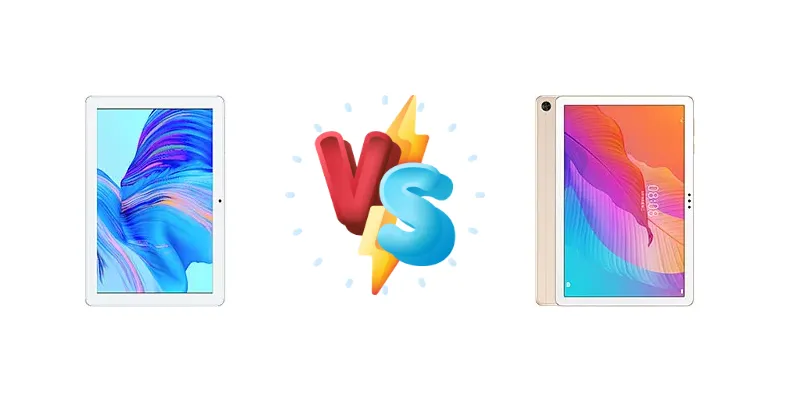
The Honor Pad X6 and Huawei MatePad T 10s present a curious case: two tablets built around the exact same Kirin 710A chipset. This comparison isn't about raw power, but rather the subtle differences in software experience, brand ecosystem, and potential long-term support that separate these nearly identical devices. Both target the budget-conscious user, but cater to slightly different needs.
🏆 Quick Verdict
For the average user prioritizing app compatibility and a more straightforward Android experience, the Honor Pad X6 emerges as the slightly better choice. While both tablets deliver similar performance thanks to the Kirin 710A, Honor's commitment to Google Mobile Services (GMS) provides a smoother, more familiar user experience out of the box.
| Network |
|---|
| 2G bands | GSM 850 / 900 / 1800 / 1900 | GSM 850 / 900 / 1800 / 1900 |
| 3G bands | HSDPA 2100 | HSDPA 850 / 900 / 1700(AWS) / 1900 / 2100 |
| 4G bands | LTE | 1, 3, 5, 7, 8, 18, 19, 20, 26, 28, 38, 40, 41 |
| Speed | HSPA, LTE - cellular model only | HSPA, LTE - cellular model only |
| Technology | GSM / HSPA / LTE | GSM / HSPA / LTE |
| Launch |
|---|
| Announced | 2020, July 17. Released 2020, July 28 | 2020, September 09. Released 2020, September 09 |
| Status | Discontinued | Discontinued |
| Body |
|---|
| Build | Glass front, aluminum frame, aluminum back | - |
| Dimensions | 240.2 x 159 x 7.6 mm (9.46 x 6.26 x 0.30 in) | 240.2 x 159 x 7.9 mm (9.46 x 6.26 x 0.31 in) |
| SIM | Nano-SIM (cellular model only) | Nano-SIM (cellular model only) |
| Weight | 460 g (1.01 lb) | 450 g (0.99 lb) |
| | Stylus support | Stylus support |
| Display |
|---|
| Resolution | 800 x 1280 pixels, 16:10 ratio (~156 ppi density) | 1200 x 1920 pixels, 16:10 ratio (~224 ppi density) |
| Size | 9.7 inches, 272.8 cm2 (~71.4% screen-to-body ratio) | 10.1 inches, 295.8 cm2 (~77.4% screen-to-body ratio) |
| Type | IPS LCD | IPS LCD |
| Platform |
|---|
| CPU | Octa-core (4x2.0 GHz Cortex-A73 & 4x1.7 GHz Cortex-A53) | Octa-core (4x2.0 GHz Cortex-A73 & 4x1.7 GHz Cortex-A53) |
| Chipset | Kirin 710A (14 nm) | Kirin 710A (14 nm) |
| GPU | Mali-G51 MP4 | Mali-G51 MP4 |
| OS | Android 10, Magic UI 3.1, no Google Play Services | Android 10, EMUI 10.1, no Google Play Services |
| Memory |
|---|
| Card slot | Unspecified | microSDXC |
| Internal | 32GB 3GB RAM, 64GB 4GB RAM | 16GB 2GB RAM, 32GB 2GB RAM, 64GB 3GB RAM, 64GB 4GB RAM, 128GB 4GB RAM |
| | eMMC 5.1 | eMMC 5.1 |
| Main Camera |
|---|
| Features | HDR, panorama | HDR, panorama |
| Single | 5 MP, f/2.2 | 5 MP, f/2.2, PDAF |
| Video | 1080p@30fps | 1080p@30fps |
| Selfie camera |
|---|
| Single | 2 MP, f/2.4 | 2 MP, f/2.4 |
| Sound |
|---|
| 3.5mm jack | Yes | Yes |
| 35mm jack | Yes | Yes |
| Loudspeaker | Yes, with dual speakers | Yes, with stereo speakers |
| | - | Tuned by Harman Kardon |
| Comms |
|---|
| Bluetooth | 5.1, A2DP, LE | 5.0, A2DP, LE |
| NFC | No | No |
| Positioning | GPS - cellular model only | GPS, GLONASS, BDS - cellular model only |
| Radio | No | No |
| USB | USB Type-C 2.0 | USB Type-C 2.0, OTG |
| WLAN | Wi-Fi 802.11 a/b/g/n/ac, dual-band, Wi-Fi Direct | Wi-Fi 802.11 a/b/g/n/ac, dual-band, Wi-Fi Direct |
| Features |
|---|
| Sensors | Accelerometer | Accelerometer, proximity |
| Battery |
|---|
| Charging | 10W wired | 10W wired |
| Type | Li-Po 5100 mAh | Li-Po 5100 mAh |
| Misc |
|---|
| Colors | Neo Mint | Gold, Deepsea Blue |
| Models | AGR-W09, AGR-AL09 | AGS3-L09, AGS3-W09, AGS3K-W09 |
| Price | - | About 200 EUR |
Honor Pad X6
- Guaranteed Google Mobile Services (GMS) access
- Potentially faster software updates and support
- Wider app compatibility out of the box
- Brand perception may be less established than Huawei
- May lack some of Huawei’s exclusive software features
Huawei MatePad T 10s
- Strong brand recognition and established ecosystem
- Huawei’s EMUI offers unique software features
- Potentially better integration with other Huawei devices
- Reliance on AppGallery and potential app compatibility issues
- Requires workarounds for Google apps
- Software updates may be less frequent
Display Comparison
Both the Honor Pad X6 and Huawei MatePad T 10s are expected to feature LCD panels, typical for this price bracket. Given the lack of specific display specs, we can assume similar characteristics: moderate brightness levels suitable for indoor use, and standard color accuracy. The absence of high refresh rate technology (like 90Hz or 120Hz) is expected, focusing on power efficiency. The user experience will likely be comparable, with the quality dictated more by panel calibration than inherent technology.
Camera Comparison
Camera performance is unlikely to be a deciding factor for either tablet. Both are expected to feature basic camera setups geared towards video calls and casual snapshots. Without specific sensor details, it’s safe to assume similar image quality. The focus should be on functionality rather than photographic excellence. Expect adequate performance in well-lit conditions, but struggles in low light.
Performance
The core of both tablets is the Kirin 710A (14 nm) chipset, featuring an octa-core CPU configuration (4x2.0 GHz Cortex-A73 & 4x1.7 GHz Cortex-A53). This means identical CPU performance for tasks like web browsing, document editing, and light multitasking. The GPU performance will also be virtually indistinguishable. However, the key differentiator lies in software optimization. Honor’s Magic UI, built on Android, generally offers a more streamlined experience with GMS support, while Huawei’s EMUI, also based on Android, requires navigating the AppGallery and potential workarounds for Google apps. Thermal management will likely be similar, with the 14nm process node potentially leading to some throttling under sustained heavy loads.
Battery Life
Both tablets utilize 10W wired charging, indicating a focus on cost-effectiveness over rapid charging speeds. Battery capacity is not specified, but given the target market, we can anticipate capacities around 5100mAh. A full charge will likely take over 3 hours. The real-world battery life will depend heavily on usage patterns, but both tablets should comfortably handle a day of moderate use – primarily web browsing, video streaming, and light gaming.
Buying Guide
Buy the Honor Pad X6 if you need seamless access to the Google Play Store and a wider range of apps without workarounds. It’s ideal for users heavily invested in the Google ecosystem. Buy the Huawei MatePad T 10s if you prefer Huawei’s EMUI software and are comfortable navigating the AppGallery and potential sideloading of apps, or if you are already deeply integrated into the Huawei ecosystem.
Frequently Asked Questions
❓ Will I be able to use all my favorite apps on the Huawei MatePad T 10s without workarounds?
The Huawei MatePad T 10s does not come with Google Mobile Services (GMS) pre-installed. While the AppGallery offers a growing selection of apps, you may need to sideload some apps or use workarounds to access popular Google services like Gmail, YouTube, and Google Maps. This process can be less straightforward for less tech-savvy users.
❓ How does the Kirin 710A handle multitasking and demanding apps on these tablets?
The Kirin 710A is a capable chipset for everyday tasks like web browsing, video streaming, and light gaming. However, it's not designed for intensive multitasking or graphically demanding games. Expect some slowdowns when running multiple apps simultaneously or playing high-end games at maximum settings. Both tablets will perform similarly in these scenarios.
❓ Is the 10W charging speed sufficient for daily use?
10W charging is relatively slow by modern standards. Expect a full charge to take over 3 hours. This is a trade-off to keep the cost of the tablets down. If fast charging is a priority, you'll need to consider more expensive tablet options.
❓ What is the long-term software support like for both the Honor Pad X6 and Huawei MatePad T 10s?
Historically, Honor has been quicker to adopt newer Android versions after separating from Huawei. Huawei's EMUI updates have been less frequent. While both manufacturers provide security updates, the Honor Pad X6 is likely to receive longer-term software support and potentially more frequent updates.