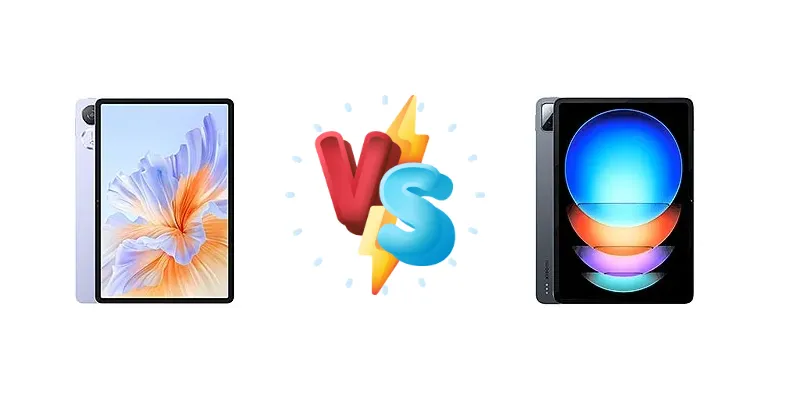
The large-screen Android tablet market is heating up, with Honor and Xiaomi delivering compelling options. The Honor Pad V9 focuses on a balance of power and fast charging, while the Xiaomi Pad 6S Pro 12.4 aims for top-tier performance with the Snapdragon 8 Gen 2. This comparison dissects the key differences to determine which tablet best suits your needs.
🏆 Quick Verdict
For users prioritizing raw processing power and demanding applications, the Xiaomi Pad 6S Pro 12.4 is the clear winner thanks to its Snapdragon 8 Gen 2 chipset. However, the Honor Pad V9 offers a compelling alternative with its potentially faster 66W charging (China variant) and a more balanced approach, making it ideal for everyday users.
| Network |
|---|
| 2G bands | N/A | N/A |
| 3G bands | N/A | N/A |
| 4G bands | N/A | - |
| EDGE | N/A | N/A |
| GPRS | N/A | N/A |
| Technology | No cellular connectivity | No cellular connectivity |
| Launch |
|---|
| Announced | 2024, December 17 | 2024, February 22 |
| Status | Available. Released 2024, December 23 | Available. Released 2024, February 22 |
| Body |
|---|
| Build | - | Glass front (Gorilla Glass 5), aluminum frame, aluminum back |
| Dimensions | 259.1 x 176.1 x 6.1 mm (10.20 x 6.93 x 0.24 in) | 278.7 x 191.6 x 6.3 mm (10.97 x 7.54 x 0.25 in) |
| SIM | No | No |
| Weight | 475 g (1.05 lb) | 590 g (1.30 lb) |
| Display |
|---|
| Protection | - | Corning Gorilla Glass 5 |
| Resolution | 2800 x 1840 pixels, 3:2 ratio (~291 ppi density) | 2032 x 3048 pixels, 3:2 ratio (~295 ppi density) |
| Size | 11.5 inches, 391.6 cm2 (~85.8% screen-to-body ratio) | 12.4 inches, 457.8 cm2 (~85.7% screen-to-body ratio) |
| Type | IPS LCD, 1B colors, 144Hz, HDR, 500 nits (typ) | IPS LCD, 68B colors, 144Hz, HDR10, Dolby Vision, 900 nits (peak) |
| Platform |
|---|
| CPU | Octa-core (1x3.35 GHz Cortex-A715 & 3x3.20 GHz Cortex-A715 & 4x2.20 GHz Cortex-A510) | Octa-core (1x3.2 GHz Cortex-X3 & 2x2.8 GHz Cortex-A715 & 2x2.8 GHz Cortex-A710 & 3x2.0 GHz Cortex-A510) |
| Chipset | Mediatek Dimensity 8350 (4 nm) | Qualcomm SM8550-AB Snapdragon 8 Gen 2 (4 nm) |
| GPU | Mali G615-MC6 | Adreno 740 |
| OS | Android 15, MagicOS 9 | Android 14, up to 3 major Android upgrades, HyperOS |
| Memory |
|---|
| Card slot | No | No |
| Internal | 128GB 8GB RAM, 256GB 8GB RAM, 256GB 12GB RAM, 512GB 12GB RAM | 256GB 8GB RAM, 256GB 12GB RAM, 512GB 12GB RAM, 1TB 16GB RAM |
| Main Camera |
|---|
| Dual | - | 50 MP, f/1.8, (wide), 1/2.76", 0.64µm, PDAF
Auxiliary lens |
| Features | LED flash | LED flash, HDR, panorama |
| Single | 13 MP, f/2.0, (wide), AF | - |
| Video | 4K@30fps, 1080p@30fps | 4K@30/60fps, 1080p@30/60fps |
| Selfie camera |
|---|
| Single | 8 MP, f/2.0, (wide) | 32 MP, f/2.2, (wide), 1/3.6", 0.61µm |
| Video | 1080p@30fps | 1080p@30fps |
| Sound |
|---|
| 35mm jack | No | No |
| Loudspeaker | Yes, with stereo speakers (8 speakers) | Yes, with stereo speakers (6 speakers) |
| Comms |
|---|
| Bluetooth | 5.2, A2DP, LE, aptX HD | 5.3, A2DP, LE, LHDC |
| NFC | No | Yes (file transfer only) |
| Positioning | No | No |
| Radio | No | No |
| USB | USB Type-C 2.0, magnetic connector | USB Type-C 3.2, accessory connector |
| WLAN | Wi-Fi 802.11 a/b/g/n/ac/6, dual-band, Wi-Fi Direct | Wi-Fi 802.11 a/b/g/n/a/6/7, dual-band, Wi-Fi Direct |
| Features |
|---|
| Sensors | Accelerometer, proximity (accessories only), gyro | Fingerprint (side-mounted), accelerometer, gyro, proximity (accessories only), compass |
| Battery |
|---|
| Charging | 35W wired - Global
66W wired - China | 120W wired, PD3.0, QC4, 45% in 10 min, 100% in 35 min |
| Type | Si/C Li-Ion 10100 mAh | 10000 mAh |
| Misc |
|---|
| Colors | Violet, Gray, White | Black, Blue, Green |
| Models | ROL-W00 | 24018RPACG |
| Price | About 350 EUR | About 700 EUR |
| SAR EU | - | 0.99 W/kg (body) |
Honor Pad V9
- Potentially faster 66W charging (China variant)
- Balanced performance for everyday tasks
- Competitive price point (likely)
- Less powerful chipset than the Xiaomi
- Unspecified display brightness and quality
Xiaomi Pad 6S Pro 12.4
- Snapdragon 8 Gen 2 delivers top-tier performance
- Brighter and higher contrast display
- Ultra-fast 120W charging
- Higher price tag
- Performance may lead to increased heat generation
Display Comparison
The Xiaomi Pad 6S Pro 12.4 boasts a brighter display, reaching a measured 848 nits, compared to an unlisted value for the Honor Pad V9. This higher brightness translates to better visibility in outdoor conditions. Furthermore, the 1378:1 contrast ratio on the Xiaomi suggests deeper blacks and more vibrant colors. While both likely utilize IPS LCD technology, the Xiaomi’s superior specifications indicate a more visually immersive experience. The larger screen size of the Xiaomi (12.4 inches vs. unspecified for the Honor) also contributes to a more expansive viewing area.
Camera Comparison
Neither tablet is positioned as a photography powerhouse, but the Xiaomi Pad 6S Pro 12.4 likely has an advantage due to its higher-end chipset’s image signal processor (ISP). Without specific camera specs for the Honor Pad V9, it’s difficult to make a direct comparison. We can assume both will feature capable main sensors for video conferencing and casual snapshots, but the Xiaomi’s ISP will likely deliver better image processing and low-light performance. Any included secondary cameras are likely to be of limited utility on both devices.
Performance
The core difference lies in the chipsets. The Xiaomi Pad 6S Pro 12.4 is equipped with the Qualcomm Snapdragon 8 Gen 2 (4nm), featuring a prime Cortex-X3 core clocked at 3.2 GHz. This architecture is designed for peak performance. The Honor Pad V9 utilizes the MediaTek Dimensity 8350 (4nm), with a different core configuration – a Cortex-A715 prime core at 3.35 GHz, alongside additional A715 cores. While the Dimensity 8350 is a capable chip, the Snapdragon 8 Gen 2’s Cortex-X3 core provides a significant performance advantage in CPU-intensive tasks. The Xiaomi’s likely faster LPDDR5x RAM further enhances its performance edge. Thermal management will be crucial; the 4nm process on both chips aids efficiency, but the Snapdragon’s higher peak performance may generate more heat.
Battery Life
The Xiaomi Pad 6S Pro 12.4 demonstrates impressive battery life, achieving 11:14 hours of active use. While the Honor Pad V9’s battery capacity is unlisted, the Xiaomi’s endurance sets a high bar. Crucially, the Xiaomi supports 120W wired charging, achieving 45% charge in 10 minutes and 100% in 35 minutes. The Honor Pad V9 offers 35W charging globally and 66W in China. The faster charging speeds of the Xiaomi significantly reduce downtime, making it more convenient for users who need to quickly top up their battery. The difference in charging speed is a major differentiator.
Buying Guide
Buy the Honor Pad V9 if you need a versatile tablet with a focus on efficient power management and potentially faster charging speeds, especially if you're in China where the 66W charging is available. It’s a great all-rounder for media consumption, productivity, and light gaming. Buy the Xiaomi Pad 6S Pro 12.4 if you prioritize uncompromising performance for demanding tasks like video editing, high-end gaming, or running multiple intensive applications simultaneously. Its superior chipset and display make it a powerhouse for power users.
Frequently Asked Questions
❓ Does the Snapdragon 8 Gen 2 in the Xiaomi Pad 6S Pro 12.4 generate significant heat during prolonged gaming sessions?
While the Snapdragon 8 Gen 2 is incredibly powerful, it can generate heat under sustained load. Xiaomi likely employs advanced thermal management solutions, such as vapor chamber cooling, to mitigate throttling. However, users engaging in extended gaming sessions may experience some performance reduction over time. The 4nm process helps, but it's not a complete solution.
❓ Is the 35W charging on the global Honor Pad V9 sufficient for most users, or is the 66W China variant a significant upgrade?
35W charging is adequate for overnight charging and moderate use. However, the 66W charging (available in China) offers a substantial speed increase, reducing full charge times considerably. If fast charging is a priority, and you have access to the China variant, it's a worthwhile upgrade.
❓ What type of stylus support do these tablets offer, and are styluses sold separately?
Both tablets support stylus input, but the specific stylus compatibility and features differ. The Xiaomi Pad 6S Pro 12.4 is compatible with the Xiaomi Smart Pen (sold separately), offering 4096 levels of pressure sensitivity. The Honor Pad V9 also supports a stylus (sold separately), but details on its features are currently limited. Check the official websites for compatibility and specifications.