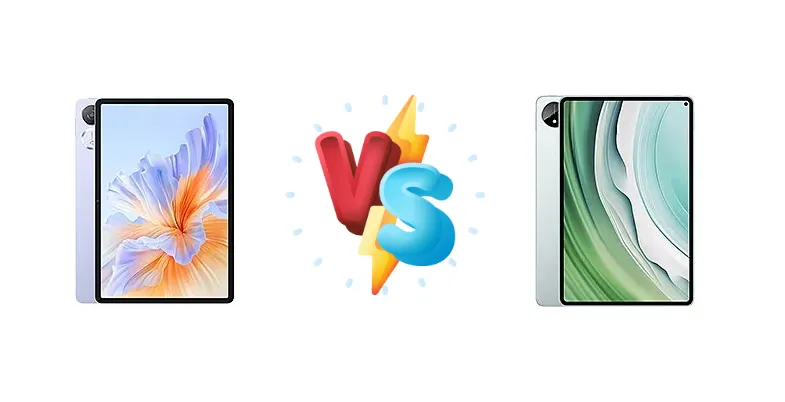
The Honor Pad V9 and the Huawei MatePad Pro 11 (2024) represent compelling options in the Android tablet space, but cater to slightly different priorities. The Honor Pad V9 leverages the newer, 4nm Mediatek Dimensity 8350, while Huawei opts for its in-house Kirin 9000S, fabricated on a 7nm process. This comparison dissects the implications of these chipset choices, alongside differences in charging and overall user experience.
🏆 Quick Verdict
For the average user prioritizing raw performance and potentially longer sustained workloads, the Honor Pad V9 emerges as the winner. Its Dimensity 8350, built on a 4nm process, offers a more efficient architecture, translating to better thermal management and potentially higher peak performance. However, the MatePad Pro 11's 66W charging and reverse charging capabilities are significant advantages.
| Network |
|---|
| 2G bands | N/A | N/A |
| 3G bands | N/A | N/A |
| 4G bands | N/A | N/A |
| EDGE | N/A | No |
| GPRS | N/A | No |
| Technology | No cellular connectivity | No cellular connectivity |
| Launch |
|---|
| Announced | 2024, December 17 | 2023, November 28 |
| Status | Available. Released 2024, December 23 | Available. Released 2023, December 18 |
| Body |
|---|
| Dimensions | 259.1 x 176.1 x 6.1 mm (10.20 x 6.93 x 0.24 in) | 249.2 x 160.4 x 5.9 mm (9.81 x 6.31 x 0.23 in) |
| SIM | No | No |
| Weight | 475 g (1.05 lb) | 449 g g cellular model) (15.84 oz) |
| Display |
|---|
| Resolution | 2800 x 1840 pixels, 3:2 ratio (~291 ppi density) | 2560 x 1600 pixels, 16:10 ratio (~274 ppi density) |
| Size | 11.5 inches, 391.6 cm2 (~85.8% screen-to-body ratio) | 11.0 inches, 350.9 cm2 (~87.8% screen-to-body ratio) |
| Type | IPS LCD, 1B colors, 144Hz, HDR, 500 nits (typ) | OLED, 1B colors, 120Hz, 600 nits (typ) |
| Platform |
|---|
| CPU | Octa-core (1x3.35 GHz Cortex-A715 & 3x3.20 GHz Cortex-A715 & 4x2.20 GHz Cortex-A510) | Octa-core (1x2.49 GHz Taishan Big & 3x2.15 GHz Taishan Mid & 4x1.53GHz Cortex-A510) |
| Chipset | Mediatek Dimensity 8350 (4 nm) | Kirin 9000S (7 nm) |
| GPU | Mali G615-MC6 | Maleoon 910 MP4 |
| OS | Android 15, MagicOS 9 | HarmonyOS 4.0 |
| Memory |
|---|
| Card slot | No | No |
| Internal | 128GB 8GB RAM, 256GB 8GB RAM, 256GB 12GB RAM, 512GB 12GB RAM | 128GB 8GB RAM, 256GB 8GB RAM, 256GB 12GB RAM, 512GB 12GB RAM |
| Main Camera |
|---|
| Dual | - | 13 MP, f/1.8, (wide), PDAF
8 MP, f/2.2, (ultrawide) |
| Features | LED flash | LED flash, HDR, panorama |
| Single | 13 MP, f/2.0, (wide), AF | - |
| Video | 4K@30fps, 1080p@30fps | 4K@30fps, 1080p@30fps |
| Selfie camera |
|---|
| Single | 8 MP, f/2.0, (wide) | 16 MP, f/2.2 |
| Video | 1080p@30fps | 1080p@30fps |
| Sound |
|---|
| 35mm jack | No | No |
| Loudspeaker | Yes, with stereo speakers (8 speakers) | Yes, with stereo speakers (6 speakers) |
| Comms |
|---|
| Bluetooth | 5.2, A2DP, LE, aptX HD | 5.2, A2DP, LE |
| NFC | No | No |
| Positioning | No | GPS, GLONASS, BDS, GALILEO, QZSS |
| Radio | No | No |
| USB | USB Type-C 2.0, magnetic connector | USB Type-C 3.1, OTG |
| WLAN | Wi-Fi 802.11 a/b/g/n/ac/6, dual-band, Wi-Fi Direct | Wi-Fi 802.11 a/b/g/n/ac, dual-band |
| Features |
|---|
| Sensors | Accelerometer, proximity (accessories only), gyro | Accelerometer, gyro, proximity (accessories only), compass |
| Battery |
|---|
| Charging | 35W wired - Global
66W wired - China | 66W wired
5W reverse wired |
| Type | Si/C Li-Ion 10100 mAh | Li-Po 8300 mAh |
| Misc |
|---|
| Colors | Violet, Gray, White | Gray, Blue, White, Black |
| Models | ROL-W00 | XYAO-W00 |
| Price | About 350 EUR | About 540 EUR |
Honor Pad V9
- More efficient 4nm Dimensity 8350 chipset
- Potentially better sustained performance
- Modern CPU architecture
- Slower charging speed (35W Global)
- No reverse charging
Huawei MatePad Pro 11 (2024)
- Faster 66W wired charging
- Convenient 5W reverse wired charging
- Huawei ecosystem integration
- Less efficient 7nm Kirin 9000S chipset
- Older CPU architecture
Display Comparison
While both tablets likely feature high-quality LCD panels (specific panel details are missing), the comparison hinges on other factors. We anticipate both will offer similar color accuracy and viewing angles. The absence of LTPO technology in either device suggests standard refresh rate panels, impacting power consumption during dynamic content. Bezels are likely comparable, given both target a premium aesthetic. Without specific brightness data, it's difficult to declare a clear winner, but Huawei's history suggests a focus on vibrant displays.
Camera Comparison
Given the tablet form factor, camera performance isn't a primary concern. However, any differences in sensor size or image processing could be noteworthy. Without specific details, it's reasonable to assume both tablets will offer adequate cameras for casual photography and video calls. The absence of information regarding OIS or lens apertures makes a detailed comparison impossible. We can expect Huawei to lean on its established image processing algorithms, potentially offering more refined results, but the impact will be minimal for typical tablet use cases.
Performance
The core of the difference lies in the chipsets. The Honor Pad V9’s Mediatek Dimensity 8350 (4nm) boasts a more modern architecture than the Huawei MatePad Pro 11’s Kirin 9000S (7nm). The Dimensity 8350’s Cortex-A715 cores, running at up to 3.35 GHz, are designed for higher efficiency and performance compared to the Kirin 9000S’s Taishan cores at 2.49 GHz. The 4nm fabrication process further enhances the Dimensity 8350’s thermal efficiency, reducing the likelihood of throttling during extended gaming sessions. While the Kirin 9000S benefits from Huawei’s optimization, the architectural advantage leans towards the Honor Pad V9. Both utilize LPDDR5x RAM, minimizing memory-related bottlenecks.
Battery Life
The Huawei MatePad Pro 11 (2024) takes a clear lead in charging speed with its 66W wired charging, significantly faster than the Honor Pad V9’s 35W (Global) or 66W (China) option. This translates to substantially quicker top-ups. The addition of 5W reverse wired charging on the Huawei model is a unique convenience, allowing it to charge other devices. While battery capacity isn't specified, the faster charging of the MatePad Pro 11 mitigates any potential disadvantage from a slightly smaller battery. The Dimensity 8350’s efficiency in the Honor Pad V9 could offset the charging speed difference in real-world usage, but the Huawei offers a more immediate solution for power users.
Buying Guide
Buy the Honor Pad V9 if you need a tablet focused on sustained performance for gaming or demanding applications, and value the efficiency of a 4nm chipset. Buy the Huawei MatePad Pro 11 (2024) if you prioritize faster charging speeds, the convenience of reverse wireless charging, and are invested in the Huawei ecosystem, potentially benefiting from seamless integration with other Huawei devices.
Frequently Asked Questions
❓ Will the Kirin 9000S throttle under heavy gaming loads on the Huawei MatePad Pro 11 (2024)?
The Kirin 9000S, being fabricated on a 7nm process, is more susceptible to thermal throttling compared to the Honor Pad V9’s 4nm Dimensity 8350. While Huawei’s software optimizations can mitigate this, expect potential performance dips during prolonged, demanding gaming sessions. The Honor Pad V9 is likely to maintain higher sustained performance.
❓ Does the Honor Pad V9 support fast charging outside of China? I see conflicting reports about 35W vs 66W.
The Honor Pad V9 supports 66W charging in China, but the global version is limited to 35W. This significantly impacts charging times, with the 35W version taking considerably longer to reach a full charge. This is a key consideration for users outside of China.
❓ How does the Huawei MatePad Pro 11 (2024)'s reverse charging feature work, and is it useful?
The Huawei MatePad Pro 11 (2024) offers 5W reverse wired charging, allowing you to use it as a power bank for other devices like smartphones or earbuds. While 5W is relatively slow, it can be a lifesaver in emergencies or when access to a power outlet is limited. It's a convenient feature for users who frequently travel or rely on multiple devices.