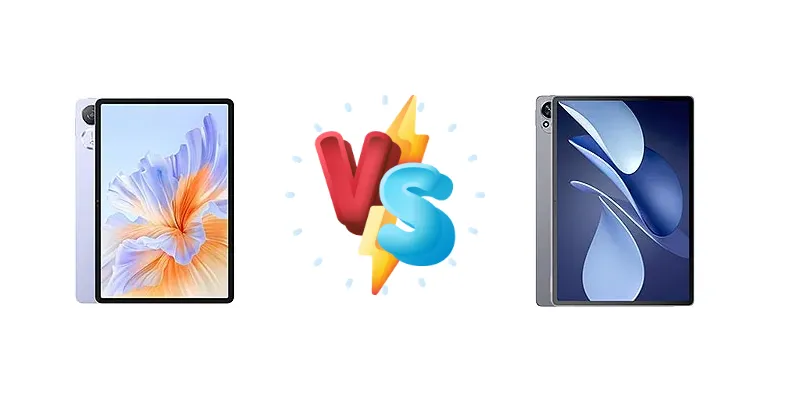
The Android tablet market is heating up, with Honor and Huawei both offering compelling options. The Honor Pad V9, featuring the Mediatek Dimensity 8350, aims for a balance of power and affordability. Meanwhile, the Huawei MatePad Air (2025) focuses on rapid charging with its 66W UFCS implementation. This comparison dissects the key differences to help you determine which tablet best suits your needs.
🏆 Quick Verdict
For the average user prioritizing sustained performance and potentially lower cost (depending on regional pricing), the Honor Pad V9 emerges as the winner. Its Dimensity 8350 chipset offers a robust processing foundation, while the MatePad Air (2025) primarily distinguishes itself with faster charging.
| Network |
|---|
| 2G bands | N/A | N/A |
| 3G bands | N/A | N/A |
| 4G bands | N/A | N/A |
| EDGE | N/A | No |
| GPRS | N/A | No |
| Technology | No cellular connectivity | No cellular connectivity |
| Launch |
|---|
| Announced | 2024, December 17 | 2025, August 15 |
| Status | Available. Released 2024, December 23 | Available. Released 2025, August 21 |
| Body |
|---|
| Build | - | Glass front, aluminum frame, aluminum back |
| Dimensions | 259.1 x 176.1 x 6.1 mm (10.20 x 6.93 x 0.24 in) | 270 x 183 x 5.9 mm (10.63 x 7.20 x 0.23 in) |
| SIM | No | No |
| Weight | 475 g (1.05 lb) | 555 g (1.22 lb) |
| Display |
|---|
| Resolution | 2800 x 1840 pixels, 3:2 ratio (~291 ppi density) | 2800 x 1840 pixels, 3:2 ratio (~279 ppi density) |
| Size | 11.5 inches, 391.6 cm2 (~85.8% screen-to-body ratio) | 12.0 inches, 426.4 cm2 (~86.3% screen-to-body ratio) |
| Type | IPS LCD, 1B colors, 144Hz, HDR, 500 nits (typ) | IPS LCD, 144Hz, 1000 nits (peak), HDR Vivid |
| Platform |
|---|
| CPU | Octa-core (1x3.35 GHz Cortex-A715 & 3x3.20 GHz Cortex-A715 & 4x2.20 GHz Cortex-A510) | - |
| Chipset | Mediatek Dimensity 8350 (4 nm) | - |
| GPU | Mali G615-MC6 | - |
| OS | Android 15, MagicOS 9 | HarmonyOS 5.0 |
| Memory |
|---|
| Card slot | No | No |
| Internal | 128GB 8GB RAM, 256GB 8GB RAM, 256GB 12GB RAM, 512GB 12GB RAM | 256GB 12GB RAM, 512GB 12GB RAM |
| Main Camera |
|---|
| Dual | - | 50 MP, f/1.8, (wide), PDAF
8 MP, f/2.2, (ultrawide) |
| Features | LED flash | LED flash |
| Single | 13 MP, f/2.0, (wide), AF | - |
| Video | 4K@30fps, 1080p@30fps | 4K@30fps, 1080p@30fps |
| Selfie camera |
|---|
| Single | 8 MP, f/2.0, (wide) | 8 MP, f/2.2 |
| Video | 1080p@30fps | 1080p@30fps |
| Sound |
|---|
| 35mm jack | No | No |
| Loudspeaker | Yes, with stereo speakers (8 speakers) | Yes, with stereo speakers (6 speakers) |
| Comms |
|---|
| Bluetooth | 5.2, A2DP, LE, aptX HD | 5.2, A2DP, LE, L2HC |
| NFC | No | No |
| Positioning | No | No |
| Radio | No | No |
| USB | USB Type-C 2.0, magnetic connector | USB Type-C 3.1, OTG, magnetic accessory connector |
| WLAN | Wi-Fi 802.11 a/b/g/n/ac/6, dual-band, Wi-Fi Direct | Wi-Fi 802.11 a/b/g/n/ac/6/7, dual-band |
| Features |
|---|
| Sensors | Accelerometer, proximity (accessories only), gyro | Accelerometer, gyro, proximity (accessories only) |
| Battery |
|---|
| Charging | 35W wired - Global
66W wired - China | 66W wired, UFCS, 100% in 85 min |
| Type | Si/C Li-Ion 10100 mAh | Li-Po 10100 mAh |
| Misc |
|---|
| Colors | Violet, Gray, White | Pink, Green, White, Gray |
| Models | ROL-W00 | LRT-W20, LRT-W30 |
| Price | About 350 EUR | About 360 EUR |
Honor Pad V9
- Powerful Mediatek Dimensity 8350 chipset
- Potentially more affordable (depending on region)
- Efficient 4nm process node for sustained performance
- Slower 35W charging (globally)
- Regional charging disparity (66W in China only)
Huawei MatePad Air (2025)
- Ultra-fast 66W UFCS charging (85 min 0-100%)
- Likely optimized power efficiency (Huawei's strength)
- Potential for advanced display technology
- Chipset performance currently unknown
- May command a higher price point
Display Comparison
Display specifications are currently unavailable for the Huawei MatePad Air (2025). However, the Honor Pad V9’s display quality will be a key differentiator. Without knowing the MatePad Air’s panel type, resolution, or refresh rate, it’s difficult to make a direct comparison. The V9’s display will likely target a balance between color accuracy and power efficiency, crucial for tablet use. We anticipate the MatePad Air will aim for a similar balance, potentially leveraging Huawei’s display technology expertise.
Camera Comparison
Camera details are absent for both devices. Given the tablet form factor, camera quality is typically less of a priority than on smartphones. We expect both tablets to feature a basic rear camera setup suitable for document scanning and casual photography. Without sensor size or aperture information, a meaningful comparison is impossible. The inclusion of OIS (Optical Image Stabilization) would be a notable advantage for either device, but is unlikely at this price point.
Performance
The Honor Pad V9’s Mediatek Dimensity 8350 (4nm) chipset is the performance centerpiece. Its octa-core configuration – 1x3.35 GHz Cortex-A715, 3x3.20 GHz Cortex-A715, and 4x2.20 GHz Cortex-A510 – promises strong multi-core performance. The 4nm process node is critical, offering improved thermal efficiency compared to older, larger nodes, which translates to less throttling during prolonged gaming or video rendering. The Huawei MatePad Air (2025) lacks chipset details, but Huawei historically prioritizes efficient performance. The Dimensity 8350’s raw power likely gives the V9 an edge in demanding applications, assuming comparable RAM configurations (LPDDR5x is expected on both).
Battery Life
The Huawei MatePad Air (2025) shines with its 66W wired charging, utilizing UFCS (Universal Fast Charging Standard) technology, promising a full charge in just 85 minutes. The Honor Pad V9 offers a more variable charging experience: 35W globally and 66W in China. This regional difference is significant; Chinese users benefit from substantially faster charging speeds. While battery capacity remains unknown for both devices, the MatePad Air’s 66W charging provides a clear advantage in terms of convenience, allowing for quicker top-ups. The Honor Pad V9’s 35W charging, while still respectable, will take considerably longer to reach 100%.
Buying Guide
Buy the Honor Pad V9 if you need a tablet capable of handling demanding tasks like gaming and video editing, and value raw processing power. It’s ideal for users who spend extended periods using resource-intensive applications. Buy the Huawei MatePad Air (2025) if you prioritize minimizing downtime and require the convenience of extremely fast charging, especially if you frequently find yourself needing to top up your tablet quickly throughout the day.
Frequently Asked Questions
❓ Does the Honor Pad V9's Dimensity 8350 chipset get hot during extended gaming sessions?
The Dimensity 8350's 4nm process node is designed for improved thermal efficiency. While some heat generation is inevitable during demanding tasks, the 4nm node should mitigate throttling better than older chipsets. However, sustained peak performance will still generate heat, and the tablet's cooling solution will play a crucial role in maintaining stable frame rates.
❓ Is the 66W UFCS charging on the Huawei MatePad Air (2025) compatible with standard USB-PD chargers?
UFCS is designed to be backward compatible with USB-PD, but full 66W speeds require a charger that specifically supports UFCS. Using a standard USB-PD charger will likely result in slower charging speeds, though it will still charge the device.
❓ What are the implications of the Honor Pad V9 having different charging speeds in China versus globally?
The difference in charging speeds highlights regional market strategies. Offering 66W charging in China caters to the demand for faster charging in that market, while the 35W global version likely aims to balance cost and charging speed for wider international appeal. This means Chinese consumers get a significant convenience advantage.