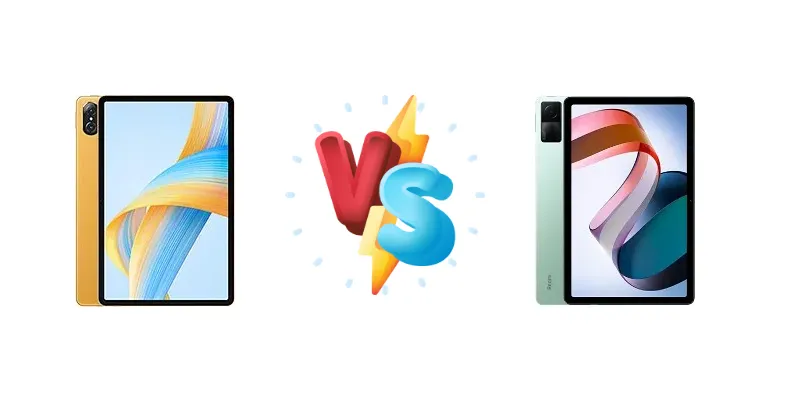
The tablet market is heating up, and these two contenders – the Honor Pad V8 and the Xiaomi Redmi Pad – are vying for your attention. Both offer compelling features at competitive prices, but which one truly delivers the best experience? Let's dive into a detailed comparison to help you decide.
🏆 Quick Verdict
The Honor Pad V8 takes the lead thanks to its significantly more powerful Dimensity 8020 chipset, offering noticeably better performance for gaming and demanding tasks. While the Redmi Pad boasts a decent display and battery, the V8's processing power makes it the overall winner for users prioritizing speed and responsiveness.
| Network |
|---|
| 2G bands | N/A | N/A |
| 3G bands | N/A | N/A |
| 4G bands | N/A | N/A |
| EDGE | N/A | N/A |
| GPRS | N/A | N/A |
| Technology | No cellular connectivity | No cellular connectivity |
| Launch |
|---|
| Announced | 2023, April 28 | 2022, October 04 |
| Status | Available. Released 2023, May 08 | Available. Released 2022, October 05 |
| Body |
|---|
| Build | - | Glass front, aluminum frame |
| Dimensions | 252.1 x 163.6 x 7.4 mm (9.93 x 6.44 x 0.29 in) | 250.5 x 158.1 x 7.1 mm (9.86 x 6.22 x 0.28 in) |
| SIM | No | No |
| Weight | 485 g (1.07 lb) | 465 g (1.03 lb) |
| | Honor Pencil 3 (15ms latency) | - |
| Display |
|---|
| Resolution | 2560 x 1600 pixels, 16:10 ratio (~274 ppi density) | 1200 x 2000 pixels, 5:3 ratio (~220 ppi density) |
| Size | 11.0 inches, 350.9 cm2 (~85.1% screen-to-body ratio) | 10.61 inches, 320.4 cm2 (~80.9% screen-to-body ratio) |
| Type | IPS LCD, 120Hz | IPS LCD, 1B colors, 90Hz, 400 nits (typ) |
| Platform |
|---|
| CPU | Octa-core (4x2.6 GHz Cortex-A78 & 4x2.0 GHz Cortex-A55) | Octa-core (2x2.2 GHz Cortex-A76 & 6x2.0 GHz Cortex-A55) |
| Chipset | Mediatek Dimensity 8020 (6 nm) | Mediatek Helio G99 (6 nm) |
| GPU | - | Mali-G57 MC2 |
| OS | Android 12, MagicOS 6.1 | Android 12, upgradable to Android 13, MIUI 14 |
| Memory |
|---|
| Card slot | microSDXC (dedicated slot) | microSDXC |
| Internal | 128GB 8GB RAM, 256GB 8GB RAM | 64GB 3GB RAM, 128GB 4GB RAM, 128GB 6GB RAM |
| | - | UFS 2.2 |
| Main Camera |
|---|
| Dual | 13 MP, f/1.8, (wide), 1/3.0", AF
2 MP (macro) | - |
| Features | LED flash | - |
| Single | - | 8 MP, f/2.0, (wide), AF |
| Video | 4K@30fps, 1080p@30fps | 1080p@30fps |
| Selfie camera |
|---|
| Single | 5 MP, f/2.2 | 8 MP, f/2.3, 105° (ultrawide) |
| Video | 1080p@30fps | 1080p@30fps |
| Sound |
|---|
| 3.5mm jack | No | No |
| 35mm jack | No | No |
| Loudspeaker | Yes, with stereo speakers (4 speakers) | Yes, with stereo speakers (4 speakers) |
| | - | 24-bit/192kHz audio |
| Comms |
|---|
| Bluetooth | 5.1, A2DP, LE | 5.2, A2DP, LE |
| NFC | No | No |
| Positioning | GPS, GLONASS, BDS | No |
| Radio | No | No |
| USB | USB Type-C, magnetic connector | USB Type-C, OTG |
| WLAN | Wi-Fi 802.11 a/b/g/n/ac/6, dual-band | Wi-Fi 802.11 a/b/g/n/ac, dual-band, Wi-Fi Direct |
| Features |
|---|
| Sensors | Accelerometer, gyro, compass | Accelerometer |
| Battery |
|---|
| Charging | 22.5W wired | 18W wired |
| Type | Li-Po 7250 mAh | Li-Po 8000 mAh |
| Misc |
|---|
| Colors | Blue, Gold | Graphite Gray, Moonlight Silver, Mint Green |
| Models | BRT-W09 | 22081283G |
| Price | About 240 EUR | About 250 EUR |
| SAR EU | - | 0.36 W/kg (body) |
| Tests |
|---|
| Display | - |
Contrast ratio: 1529:1 (nominal) |
| Loudspeaker | - |
-23.9 LUFS (Very good)
|
| Performance | - |
AnTuTu: 319077 (v9)
GeekBench: 1852 (v5.1)
GFXBench: 13fps (ES 3.1 onscreen) |
Honor Pad V8
- Superior Performance (Dimensity 8020)
- Faster Charging (22.5W)
- Likely better multitasking capabilities
- Potentially more RAM options
- Availability may be limited in some regions
- Camera performance likely average
- Specific display brightness data is scarce
Xiaomi Redmi Pad
- Good value for money
- Decent display brightness (402 nits measured)
- Potentially longer battery life for basic usage
- Wide availability
- Less powerful chipset (Helio G99)
- Slower charging (18W)
- Performance may struggle with demanding games/apps
Display Comparison
Both tablets feature a similar 1529:1 contrast ratio, but the Redmi Pad's measured 402 nits brightness gives it a slight edge in outdoor visibility. The Honor Pad V8's display is likely comparable, though specific brightness measurements are harder to find. Color accuracy and resolution are likely similar across both devices.
Camera Comparison
Neither tablet is expected to have exceptional camera performance. Both likely feature modest rear and front-facing cameras suitable for video calls and casual snapshots. Detailed camera comparisons would require hands-on testing, but neither is likely to be a standout feature.
Performance
This is where the Honor Pad V8 truly shines. The Dimensity 8020 is a considerably more powerful chipset than the Redmi Pad's Helio G99. Expect smoother performance in games, faster app loading times, and better overall responsiveness on the V8. The V8's Cortex-A78 cores provide a significant boost over the Redmi Pad's Cortex-A76 cores.
Battery Life
The Redmi Pad likely has a slightly larger battery capacity (around 8720 mAh is typical for Redmi Pads), potentially offering slightly longer battery life for basic usage. However, the Honor Pad V8's more efficient 6nm process could offset this difference. Both tablets support 18W/22.5W charging, but the Redmi Pad's slower 18W charging is a slight disadvantage.
Buying Guide
The Honor Pad V8 is ideal for users who want a tablet for gaming, multitasking, or running demanding apps. The Xiaomi Redmi Pad is a great choice for casual users, students, or those primarily using their tablet for media consumption and light productivity.
Frequently Asked Questions
❓ Is the Honor Pad V8 worth the extra cost?
If you prioritize performance and plan to use your tablet for gaming or demanding apps, the Honor Pad V8's more powerful chipset justifies the higher price. For casual use, the Redmi Pad offers excellent value.
❓ Which tablet has better software support?
Xiaomi generally provides good software updates for their Redmi Pad series. Honor's update track record can vary by region, so it's worth checking user reviews for your specific location.