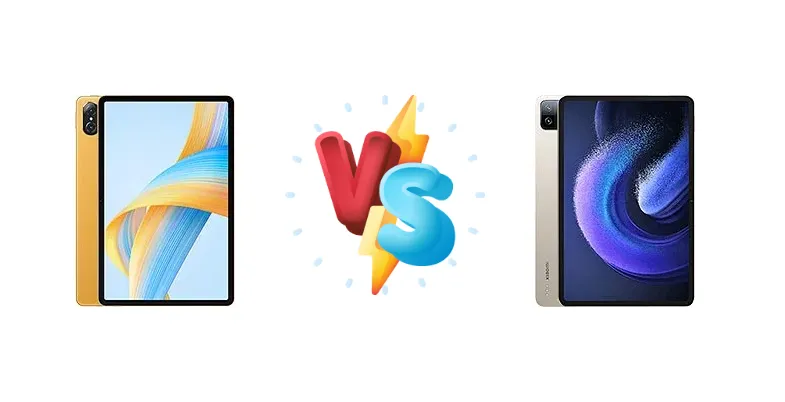
The tablet market is heating up, and two contenders are vying for your attention: the Honor Pad V8 and the Xiaomi Pad 6 Pro. Both offer compelling features, but cater to slightly different needs. Let's dive into a detailed comparison to help you decide which one deserves a spot in your tech arsenal.
🏆 Quick Verdict
The Xiaomi Pad 6 Pro decisively wins thanks to its significantly faster Snapdragon 8+ Gen 1 chipset, blazing-fast 67W charging, and generally superior display. While the Honor Pad V8 offers a more budget-friendly option, the Xiaomi Pad 6 Pro delivers a premium experience.
| Network |
|---|
| 2G bands | N/A | N/A |
| 3G bands | N/A | N/A |
| 4G bands | N/A | - |
| EDGE | N/A | N/A |
| GPRS | N/A | N/A |
| Technology | No cellular connectivity | No cellular connectivity |
| Launch |
|---|
| Announced | 2023, April 28 | 2023, April 18 |
| Status | Available. Released 2023, May 08 | Available. Released 2023, April 30 |
| Body |
|---|
| Build | - | Glass front (Gorilla Glass 3), aluminum frame, aluminum back |
| Dimensions | 252.1 x 163.6 x 7.4 mm (9.93 x 6.44 x 0.29 in) | 254 x 165.2 x 6.5 mm (10.0 x 6.50 x 0.26 in) |
| SIM | No | No |
| Weight | 485 g (1.07 lb) | 490 g (1.08 lb) |
| | Honor Pencil 3 (15ms latency) | Stylus support (magnetic) |
| Display |
|---|
| Protection | - | Corning Gorilla Glass 3 |
| Resolution | 2560 x 1600 pixels, 16:10 ratio (~274 ppi density) | 1800 x 2880 pixels, 16:10 ratio (~309 ppi density) |
| Size | 11.0 inches, 350.9 cm2 (~85.1% screen-to-body ratio) | 11.0 inches, 350.9 cm2 (~83.6% screen-to-body ratio) |
| Type | IPS LCD, 120Hz | IPS LCD, 1B colors, 144Hz, HDR10, Dolby Vision, 550 nits |
| Platform |
|---|
| CPU | Octa-core (4x2.6 GHz Cortex-A78 & 4x2.0 GHz Cortex-A55) | Octa-core (1x3.19 GHz Cortex-X2 & 3x2.75 GHz Cortex-A710 & 4x1.80 GHz Cortex-A510) |
| Chipset | Mediatek Dimensity 8020 (6 nm) | Qualcomm SM8475 Snapdragon 8+ Gen 1 (4 nm) |
| GPU | - | Adreno 730 |
| OS | Android 12, MagicOS 6.1 | Android 13, MIUI 14 |
| Memory |
|---|
| Card slot | microSDXC (dedicated slot) | No |
| Internal | 128GB 8GB RAM, 256GB 8GB RAM | 128GB 8GB RAM, 256GB 8GB RAM, 256GB 12GB RAM, 512GB 12GB RAM |
| | - | UFS 3.1 |
| Main Camera |
|---|
| Dual | 13 MP, f/1.8, (wide), 1/3.0", AF
2 MP (macro) | 50 MP, f/1.8, (wide), 1/2.76", 0.64µm, PDAF
Auxiliary lens |
| Features | LED flash | Dual-LED flash, HDR, panorama |
| Video | 4K@30fps, 1080p@30fps | 4K@30/60fps, 1080p@30/60fps |
| Selfie camera |
|---|
| Single | 5 MP, f/2.2 | 20 MP, f/2.2, (wide), 1/3.4", 0.8µm |
| Video | 1080p@30fps | 1080p@30/60fps |
| Sound |
|---|
| 3.5mm jack | No | No |
| 35mm jack | No | No |
| Loudspeaker | Yes, with stereo speakers (4 speakers) | Yes, with stereo speakers (4 speakers) |
| | - | 24-bit/192kHz audio |
| Comms |
|---|
| Bluetooth | 5.1, A2DP, LE | 5.3, A2DP, LE |
| NFC | No | No |
| Positioning | GPS, GLONASS, BDS | No |
| Radio | No | No |
| USB | USB Type-C, magnetic connector | USB Type-C 3.2, accessory connector |
| WLAN | Wi-Fi 802.11 a/b/g/n/ac/6, dual-band | Wi-Fi 802.11 a/b/g/n/a/6e, dual-band, Wi-Fi Direct |
| Features |
|---|
| Sensors | Accelerometer, gyro, compass | Accelerometer, gyro, proximity (accessories only) |
| Battery |
|---|
| Charging | 22.5W wired | 67W wired, PD3.0, QC4, 100% in 1 hour |
| Type | Li-Po 7250 mAh | Li-Po 8600 mAh |
| Misc |
|---|
| Colors | Blue, Gold | Black, Blue, Gold |
| Models | BRT-W09 | 23046RP50C |
| Price | About 240 EUR | About 330 EUR |
Honor Pad V8
- Large Display
- Budget-Friendly
- Decent Performance for Casual Use
- Less Powerful Chipset
- Slower Charging
- Potentially Inferior Display
Xiaomi Pad 6 Pro
- Flagship Performance
- Blazing-Fast Charging
- Excellent Display
- Premium Build Quality
- Higher Price
- May be Overkill for Basic Users
Display Comparison
The Xiaomi Pad 6 Pro boasts a superior 11-inch 2.8K LCD display with a 144Hz refresh rate, offering smoother visuals and sharper details compared to the Honor Pad V8's likely 120Hz display. Color accuracy and brightness are also expected to be better on the Xiaomi.
Camera Comparison
While neither tablet is a photography powerhouse, the Xiaomi Pad 6 Pro likely has a slightly better camera system, offering improved image quality and features. Expect better low-light performance and video recording capabilities.
Performance
Here's where the Xiaomi Pad 6 Pro truly shines. The Snapdragon 8+ Gen 1 is a flagship-level chipset, significantly outperforming the Mediatek Dimensity 8020 in both CPU and GPU benchmarks. Expect smoother multitasking, faster app loading times, and a much better gaming experience on the Xiaomi.
Battery Life
The Xiaomi Pad 6 Pro's 67W fast charging is a game-changer, allowing for incredibly quick top-ups. While both tablets likely have similar battery capacities (around 8000-9000mAh), the Xiaomi's charging speed gives it a significant advantage.
Buying Guide
The Honor Pad V8 is ideal for users on a tighter budget who prioritize a large screen for media consumption and light productivity. The Xiaomi Pad 6 Pro is perfect for power users, gamers, and anyone who demands top-tier performance, fast charging, and a vibrant display.
Frequently Asked Questions
❓ Is the Honor Pad V8 good for gaming?
It's adequate for casual games, but demanding titles may struggle due to the less powerful chipset. The Xiaomi Pad 6 Pro is a much better choice for serious mobile gaming.
❓ Which tablet has better battery life?
While both have similar battery capacities, the Xiaomi Pad 6 Pro's faster charging means you'll spend less time plugged in.
❓ What is the difference between the Dimensity 8020 and Snapdragon 8+ Gen 1?
The Snapdragon 8+ Gen 1 is a significantly more powerful chipset, offering superior performance in both CPU and GPU tasks. It's a flagship-level processor, while the Dimensity 8020 is a mid-range option.