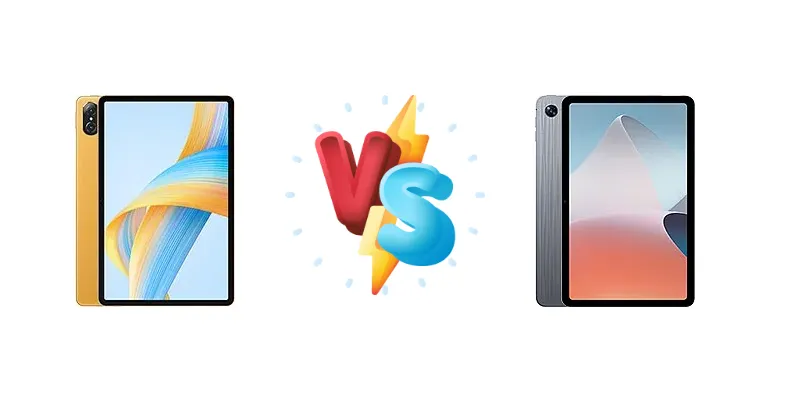
The tablet market is heating up, and these two contenders – the Honor Pad V8 and the Oppo Pad Air – are vying for your attention. Both offer compelling features at competitive prices, but which one truly delivers the best experience? Let's dive into a detailed comparison to help you make the right choice.
🏆 Quick Verdict
The Honor Pad V8 boasts a significantly more powerful chipset, making it the clear winner for performance-focused users. The Oppo Pad Air shines with its brighter display and reverse charging capabilities, appealing to those prioritizing media consumption and convenience. Ultimately, it depends on your priorities.
| Network |
|---|
| 2G bands | N/A | N/A |
| 3G bands | N/A | N/A |
| 4G bands | N/A | N/A |
| EDGE | N/A | No |
| GPRS | N/A | No |
| Technology | No cellular connectivity | No cellular connectivity |
| Launch |
|---|
| Announced | 2023, April 28 | 2022, May 23 |
| Status | Available. Released 2023, May 08 | Available. Released 2022, June 01 |
| Body |
|---|
| Dimensions | 252.1 x 163.6 x 7.4 mm (9.93 x 6.44 x 0.29 in) | 245.1 x 154.8 x 6.9 mm (9.65 x 6.09 x 0.27 in) |
| SIM | No | No |
| Weight | 485 g (1.07 lb) | 440 g (15.52 oz) |
| | Honor Pencil 3 (15ms latency) | Stylus support |
| Display |
|---|
| Resolution | 2560 x 1600 pixels, 16:10 ratio (~274 ppi density) | 1200 x 2000 pixels, 5:3 ratio (~225 ppi density) |
| Size | 11.0 inches, 350.9 cm2 (~85.1% screen-to-body ratio) | 10.36 inches, 305.5 cm2 (~80.5% screen-to-body ratio) |
| Type | IPS LCD, 120Hz | IPS LCD, 1B colors, 360 nits (typ) |
| Platform |
|---|
| CPU | Octa-core (4x2.6 GHz Cortex-A78 & 4x2.0 GHz Cortex-A55) | Octa-core (4x2.4 GHz Kryo 265 Gold & 4x1.9 GHz Kryo 265 Silver) |
| Chipset | Mediatek Dimensity 8020 (6 nm) | Qualcomm SM6225 Snapdragon 680 4G (6 nm) |
| GPU | - | Adreno 610 |
| OS | Android 12, MagicOS 6.1 | Android 12, ColorOS 12 |
| Memory |
|---|
| Card slot | microSDXC (dedicated slot) | microSDXC |
| Internal | 128GB 8GB RAM, 256GB 8GB RAM | 64GB 4GB RAM, 128GB 4GB RAM, 128GB 6GB RAM |
| | - | UFS 2.2 |
| Main Camera |
|---|
| Dual | 13 MP, f/1.8, (wide), 1/3.0", AF
2 MP (macro) | - |
| Features | LED flash | Panorama |
| Single | - | 8 MP, f/2.0, AF |
| Video | 4K@30fps, 1080p@30fps | 1080p@30fps |
| Selfie camera |
|---|
| Single | 5 MP, f/2.2 | 5 MP, f/2.2 |
| Video | 1080p@30fps | 1080p@30fps |
| Sound |
|---|
| 3.5mm jack | No | No |
| 35mm jack | No | No |
| Loudspeaker | Yes, with stereo speakers (4 speakers) | Yes, with stereo speakers (4 speakers) |
| Comms |
|---|
| Bluetooth | 5.1, A2DP, LE | 5.1, A2DP, LE, aptX HD |
| NFC | No | No |
| Positioning | GPS, GLONASS, BDS | No |
| Radio | No | No |
| USB | USB Type-C, magnetic connector | USB Type-C 2.0, OTG |
| WLAN | Wi-Fi 802.11 a/b/g/n/ac/6, dual-band | Wi-Fi 802.11 a/b/g/n/ac, dual-band, Wi-Fi Direct |
| Features |
|---|
| Sensors | Accelerometer, gyro, compass | Accelerometer, gyro, compass |
| Battery |
|---|
| Charging | 22.5W wired | 18W wired, PD
5W reverse wired |
| Type | Li-Po 7250 mAh | Li-Po 7100 mAh |
| Misc |
|---|
| Colors | Blue, Gold | Gray, Silver |
| Models | BRT-W09 | OPD2102, X21N2 |
| Price | About 240 EUR | About 300 EUR |
| Tests |
|---|
| Display | - |
Contrast ratio: 1391:1 |
| Loudspeaker | - |
-28.3 LUFS (Average)
|
| Performance | - |
AnTuTu: 249272 (v9)
GeekBench: 1661 (v5.1)
GFXBench: 7.2fps (ES 3.1 onscreen) |
Honor Pad V8
- Superior Performance (Dimensity 8020)
- Faster Charging (22.5W)
- Likely better for gaming
- Potentially less bright display
- No reverse charging
Oppo Pad Air
- Brighter Display (352 nits)
- Reverse Wired Charging (5W)
- Lightweight and Portable
- Weaker Performance (Snapdragon 680)
- Slower Charging (18W)
Display Comparison
The Oppo Pad Air takes a slight edge here. While both offer a 1391:1 contrast ratio, the Oppo Pad Air's measured 352 nits brightness is noticeably higher than what's typically expected from the Honor Pad V8. This translates to better visibility in brighter environments. Both tablets likely feature similar LCD panels, but the Oppo Pad Air's brightness advantage is a key differentiator.
Camera Comparison
Camera quality is often an afterthought on tablets. Both devices likely feature modest camera setups, probably around 5-8MP for both front and rear cameras. Expect similar performance in both, suitable for video calls and casual snapshots, but not high-quality photography. Detailed camera specs are often missing for these models.
Performance
This is where the Honor Pad V8 truly shines. The Mediatek Dimensity 8020 is a significantly more powerful chipset than the Qualcomm Snapdragon 680. Expect smoother multitasking, faster app loading times, and a much better gaming experience on the Honor Pad V8. The Snapdragon 680 is adequate for basic tasks, but struggles with more demanding applications.
Battery Life
Battery capacity is likely similar between the two, potentially around 7000-8000 mAh. The Oppo Pad Air's 18W charging is slightly slower than the Honor Pad V8's 22.5W charging. However, the Oppo Pad Air's 5W reverse wired charging offers a unique advantage, allowing it to act as a power bank for other devices.
Buying Guide
Who should buy the Honor Pad V8? Gamers, students needing processing power for demanding apps, and anyone prioritizing performance. Who should buy the Oppo Pad Air? Casual users, media consumers, and those seeking a lightweight and portable tablet with a vibrant display and reverse charging.
Frequently Asked Questions
❓ Is the Honor Pad V8 good for gaming?
Yes, the Honor Pad V8's Dimensity 8020 chipset makes it significantly better suited for gaming than the Oppo Pad Air.
❓ Can the Oppo Pad Air charge my phone?
Yes, the Oppo Pad Air supports 5W reverse wired charging, allowing you to charge other devices using its battery.
❓ Which tablet is more portable?
The Oppo Pad Air is generally considered more portable due to its lighter weight and slimmer profile.