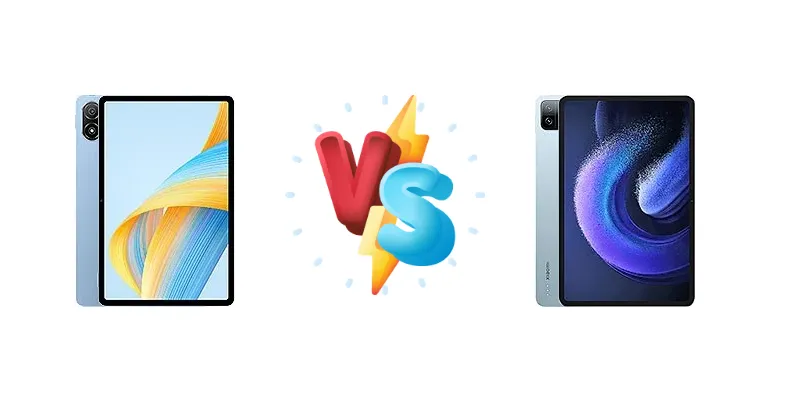
The tablet market is heating up, and two contenders are vying for your attention: the Honor Pad V8 Pro and the Xiaomi Pad 6. Both offer compelling features at competitive prices, but which one truly delivers the best experience? Let's dive into a detailed comparison to help you make the right choice.
🏆 Quick Verdict
The Xiaomi Pad 6 edges out the Honor Pad V8 Pro thanks to its Snapdragon 870's consistently strong performance and excellent battery life. While the V8 Pro boasts a powerful Dimensity 8100, the Xiaomi Pad 6 offers a more polished and well-rounded package overall.
| Network |
|---|
| 2G bands | N/A | N/A |
| 3G bands | N/A | N/A |
| 4G bands | N/A | - |
| EDGE | N/A | N/A |
| GPRS | N/A | N/A |
| Technology | No cellular connectivity | No cellular connectivity |
| Launch |
|---|
| Announced | 2022, December 26 | 2023, April 18 |
| Status | Available. Released 2022, December 30 | Available. Released 2023, April 18 |
| Body |
|---|
| Build | Glass front, aluminum frame, aluminum back or eco leather back | Glass front (Gorilla Glass 3), aluminum frame, aluminum back |
| Dimensions | 277 x 179 x 6.6 mm or 7 mm | 254 x 165.2 x 6.5 mm (10.0 x 6.50 x 0.26 in) |
| SIM | No | No |
| Weight | 589 g or 599 g (1.30 lb) | 490 g (1.08 lb) |
| | Honor Pencil 3 (15ms latency) | Stylus support (magnetic) |
| Display |
|---|
| Protection | - | Corning Gorilla Glass 3 |
| Resolution | 2560 x 1600 pixels, 16:10 ratio (~249 ppi density) | 1800 x 2880 pixels, 16:10 ratio (~309 ppi density) |
| Size | 12.1 inches, 424.5 cm2 (~85.6% screen-to-body ratio) | 11.0 inches, 350.9 cm2 (~83.6% screen-to-body ratio) |
| Type | IPS LCD, 1B colors, 144Hz, 600 nits | IPS LCD, 1B colors, 144Hz, HDR10, Dolby Vision, 550 nits |
| | IMAX enhanced | - |
| Platform |
|---|
| CPU | Octa-core (4x2.85 GHz Cortex-A78 & 4x2.0 GHz Cortex-A55) | Octa-core (1x3.2 GHz Kryo 585 & 3x2.42 GHz Kryo 585 & 4x1.80 GHz Kryo 585) |
| Chipset | Mediatek Dimensity 8100 (5 nm) | Qualcomm SM8250-AC Snapdragon 870 5G (7 nm) |
| GPU | Mali-G610 MC6 | Adreno 650 |
| OS | Android 12, MagicOS 7 | Android 13, MIUI Pad 14 |
| Memory |
|---|
| Card slot | No | No |
| Internal | 128GB 8GB RAM, 256GB 8GB RAM, 256GB 12GB RAM | 128GB 6GB RAM, 128GB 8GB RAM, 256GB 8GB RAM |
| | - | UFS 3.1 |
| Main Camera |
|---|
| Features | LED flash, HDR | Dual-LED flash, HDR, panorama |
| Single | 13 MP, f/2.0, (wide), 1/3.0", AF | 13 MP, f/2.2, PDAF |
| Video | 4K@30fps, 1080p@30fps | 4K@30fps, 1080p@30/60fps |
| Selfie camera |
|---|
| Single | 5 MP, f/2.2 | 8 MP, f/2.2, 1/4.0", 1.12µm |
| Video | 1080p@30fps | 1080p@30fps |
| Sound |
|---|
| 3.5mm jack | No | No |
| 35mm jack | No | No |
| Loudspeaker | Yes, with stereo speakers (8 speakers) | Yes, with stereo speakers (4 speakers) |
| | 24-bit/192kHz audio | 24-bit/192kHz audio |
| Comms |
|---|
| Bluetooth | 5.2, A2DP, LE | 5.2, A2DP, LE |
| NFC | No | No |
| Positioning | GPS, GLONASS, BDS | Unspecified |
| Radio | No | No |
| USB | USB Type-C, magnetic connector | USB Type-C 3.2, accessory connector |
| WLAN | Wi-Fi 802.11 a/b/g/n/ac/6, dual-band | Wi-Fi 802.11 a/b/g/n/a/6, dual-band, Wi-Fi Direct |
| Features |
|---|
| Sensors | Accelerometer | Accelerometer, gyro, proximity (accessories only) |
| Battery |
|---|
| Charging | 35W wired | 33W wired, PD3.0, QC4 |
| Type | Li-Po 10050 mAh | Li-Po 8840 mAh |
| Misc |
|---|
| Colors | Grey, Blue, Orange | Black, Blue, Gold |
| Models | ROD-W09 | 23043RP34C, 23043RP34G, 23043RP34I |
| Price | About 350 EUR | About 400 EUR |
Honor Pad V8 Pro
- Powerful Dimensity 8100 chipset
- Competitive price
- Good display quality
- Fast charging (35W)
- Battery life could be better
- Camera performance is average
- Software support may be less extensive than Xiaomi
Xiaomi Pad 6
- Excellent battery life
- Smooth and efficient Snapdragon 870
- Vibrant and well-calibrated display
- PD3.0 fast charging
- Performance slightly behind the V8 Pro in benchmarks
- Design is somewhat understated
- QC4 charging standard is less common
Display Comparison
Both tablets feature impressive displays. The Xiaomi Pad 6 boasts a 1060:1 contrast ratio and 500 nits brightness, ensuring vivid colors and excellent visibility even outdoors. The Honor Pad V8 Pro likely has a similar quality display, though specific brightness figures are harder to confirm. Xiaomi's display calibration is generally considered excellent.
Camera Comparison
Neither tablet excels in the camera department. Both offer decent cameras for video calls and casual snapshots, but don't expect flagship-level image quality. The Xiaomi Pad 6's camera is likely slightly better due to Xiaomi's generally stronger camera processing.
Performance
The Honor Pad V8 Pro's Dimensity 8100 is a powerhouse, offering impressive single-core and multi-core performance. However, the Xiaomi Pad 6's Snapdragon 870, while slightly older, is remarkably efficient and consistently delivers smooth performance across various tasks. The Snapdragon's optimized software integration often gives it a slight edge in real-world usage.
Battery Life
The Xiaomi Pad 6 shines in battery life, achieving a reported 9:39 hours of active use. The Honor Pad V8 Pro's battery capacity is comparable, but the Dimensity 8100's power consumption might lead to slightly shorter battery life in real-world scenarios.
Buying Guide
The Honor Pad V8 Pro is ideal for users prioritizing raw processing power for demanding games or creative tasks. The Xiaomi Pad 6 is perfect for everyday use, media consumption, and those seeking a long-lasting battery and a vibrant display.
Frequently Asked Questions
❓ Which tablet is better for gaming?
The Honor Pad V8 Pro has a slight edge in raw gaming power due to its Dimensity 8100 chipset. However, the Xiaomi Pad 6's Snapdragon 870 is still very capable and offers excellent thermal management.
❓ Which tablet has better software support?
Xiaomi generally provides more consistent and longer-term software updates compared to Honor, making the Xiaomi Pad 6 a safer bet for long-term software support.