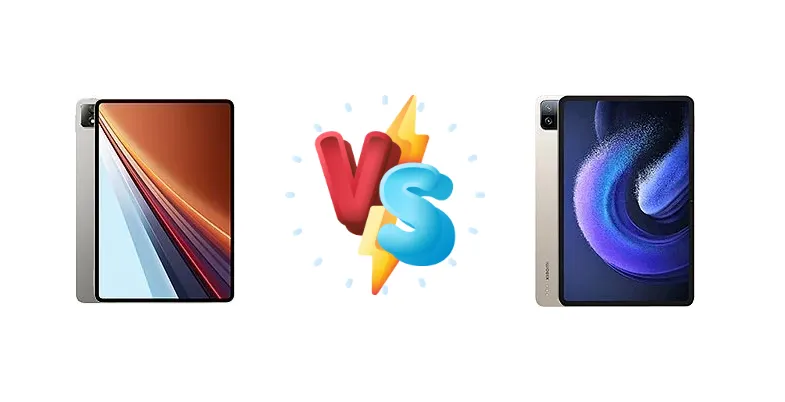
The Android tablet market is heating up, with Honor and Xiaomi delivering compelling flagship options. The Honor Pad GT2 Pro, powered by the latest Snapdragon 8 Gen 3, directly challenges the Xiaomi Pad 6 Pro, which utilizes the Snapdragon 8+ Gen 1. This comparison dissects the key differences to determine which tablet reigns supreme for power users, gamers, and everyday consumers.
🏆 Quick Verdict
For users prioritizing raw performance and future-proofing, the Honor Pad GT2 Pro is the clear winner. Its Snapdragon 8 Gen 3 chipset offers a significant leap in CPU and GPU capabilities. However, the Xiaomi Pad 6 Pro remains a strong contender, offering excellent value and a refined user experience, especially for those less demanding of peak performance.
| Network |
|---|
| 2G bands | N/A | N/A |
| 3G bands | N/A | N/A |
| 4G bands | N/A | - |
| EDGE | N/A | N/A |
| GPRS | N/A | N/A |
| Technology | No cellular connectivity | No cellular connectivity |
| Launch |
|---|
| Announced | 2025, July 15 | 2023, April 18 |
| Status | Available. Released 2025, July 28 | Available. Released 2023, April 30 |
| Body |
|---|
| Build | - | Glass front (Gorilla Glass 3), aluminum frame, aluminum back |
| Dimensions | 277.8 x 190.9 x 6 mm (10.94 x 7.52 x 0.24 in) | 254 x 165.2 x 6.5 mm (10.0 x 6.50 x 0.26 in) |
| SIM | No | No |
| Weight | 532 g (1.17 lb) | 490 g (1.08 lb) |
| | - | Stylus support (magnetic) |
| Display |
|---|
| Protection | - | Corning Gorilla Glass 3 |
| Resolution | 3048 x 2032 pixels, 3:2 ratio (~285 ppi density) | 1800 x 2880 pixels, 16:10 ratio (~309 ppi density) |
| Size | 12.5 inches, 491.7 cm2 (~92.7% screen-to-body ratio) | 11.0 inches, 350.9 cm2 (~83.6% screen-to-body ratio) |
| Type | IPS LCD, 1B colors, 165Hz, HDR | IPS LCD, 1B colors, 144Hz, HDR10, Dolby Vision, 550 nits |
| Platform |
|---|
| CPU | Octa-core (1x3.3 GHz Cortex-X4 & 3x3.2 GHz Cortex-A720 & 2x3.0 GHz Cortex-A720 & 2x2.3 GHz Cortex-A520) | Octa-core (1x3.19 GHz Cortex-X2 & 3x2.75 GHz Cortex-A710 & 4x1.80 GHz Cortex-A510) |
| Chipset | Qualcomm SM8650-AB Snapdragon 8 Gen 3 (4 nm) | Qualcomm SM8475 Snapdragon 8+ Gen 1 (4 nm) |
| GPU | Adreno 750 | Adreno 730 |
| OS | Android 15, MagicOS 9 | Android 13, MIUI 14 |
| Memory |
|---|
| Card slot | No | No |
| Internal | 128GB 8GB RAM, 256GB 8GB RAM, 256GB 12GB RAM, 512GB 16GB RAM | 128GB 8GB RAM, 256GB 8GB RAM, 256GB 12GB RAM, 512GB 12GB RAM |
| | - | UFS 3.1 |
| Main Camera |
|---|
| Dual | - | 50 MP, f/1.8, (wide), 1/2.76", 0.64µm, PDAF
Auxiliary lens |
| Features | LED flash | Dual-LED flash, HDR, panorama |
| Single | 13 MP, f/2.0, (wide), PDAF | - |
| Video | Yes | 4K@30/60fps, 1080p@30/60fps |
| Selfie camera |
|---|
| Single | 8 MP, f/2.0, (wide) | 20 MP, f/2.2, (wide), 1/3.4", 0.8µm |
| Video | Yes | 1080p@30/60fps |
| Sound |
|---|
| 3.5mm jack | - | No |
| 35mm jack | No | No |
| Loudspeaker | Yes, with stereo speakers (8 speakers) | Yes, with stereo speakers (4 speakers) |
| | - | 24-bit/192kHz audio |
| Comms |
|---|
| Bluetooth | 5.4, A2DP, LE, aptX Adaptive, LDAC, LC3 | 5.3, A2DP, LE |
| NFC | No | No |
| Positioning | No | No |
| Radio | No | No |
| USB | USB Type-C, magnetic connector | USB Type-C 3.2, accessory connector |
| WLAN | Wi-Fi 802.11 a/b/g/n/ac/6e/7, dual-band | Wi-Fi 802.11 a/b/g/n/a/6e, dual-band, Wi-Fi Direct |
| Features |
|---|
| Sensors | Accelerometer, proximity (accessories only), gyro | Accelerometer, gyro, proximity (accessories only) |
| Battery |
|---|
| Charging | 66W wired | 67W wired, PD3.0, QC4, 100% in 1 hour |
| Type | Si/C Li-Ion 10100 mAh | Li-Po 8600 mAh |
| Misc |
|---|
| Colors | Gray, White | Black, Blue, Gold |
| Models | CHG-W60 | 23046RP50C |
| Price | About 300 EUR | About 330 EUR |
Honor Pad GT2 Pro
- Significantly more powerful Snapdragon 8 Gen 3 chipset
- Improved thermal efficiency for sustained performance
- Future-proofed with the latest processor technology
- Potentially higher price point
- Lack of detailed display specifications
Xiaomi Pad 6 Pro
- Excellent value for the performance offered
- Fast 67W charging with PD3.0 and QC4 support
- Refined user experience from Xiaomi’s software
- Older Snapdragon 8+ Gen 1 chipset
- May exhibit more thermal throttling under heavy load
Display Comparison
While both tablets likely feature high-quality LCD panels (specific panel details are missing), the core difference lies in the processing power driving them. The absence of display specs necessitates focusing on the chipset's ability to render complex visuals smoothly. The Snapdragon 8 Gen 3 in the Honor Pad GT2 Pro will deliver a more fluid experience in graphically intensive applications and games, even at higher resolutions. The Xiaomi Pad 6 Pro’s Snapdragon 8+ Gen 1 is still capable, but will show its age in the most demanding scenarios.
Camera Comparison
Given the tablet form factor, camera performance isn't a primary focus. However, the absence of detailed camera specs highlights a potential area where both devices may be similar. Both are likely to feature a main camera and ultrawide lens, but image quality will depend on sensor size and image processing algorithms. Without specific details, it’s difficult to declare a clear winner. We can assume Xiaomi’s image processing, honed through its smartphone division, might offer slightly more refined results, but this is speculative.
Performance
The Honor Pad GT2 Pro’s Snapdragon 8 Gen 3 represents a substantial architectural upgrade over the Xiaomi Pad 6 Pro’s Snapdragon 8+ Gen 1. The Gen 3 features a new Cortex-X4 prime core clocked at 3.3 GHz, compared to the Gen 1’s Cortex-X2 at 3.19 GHz. This, combined with the newer Cortex-A720 performance cores, translates to a noticeable performance advantage in CPU-bound tasks. The GPU also sees a significant boost, offering improved graphics rendering and efficiency. The 4nm process node of the Snapdragon 8 Gen 3 further enhances thermal efficiency, potentially leading to less throttling during prolonged gaming sessions. The Xiaomi Pad 6 Pro’s 8+ Gen 1, while still powerful, utilizes a slightly older architecture and may exhibit more thermal throttling under sustained load.
Battery Life
Both tablets offer fast charging, with the Honor Pad GT2 Pro at 66W and the Xiaomi Pad 6 Pro at 67W. The Xiaomi Pad 6 Pro’s inclusion of PD3.0 and QC4 adds versatility, potentially allowing for compatibility with a wider range of chargers. While the charging wattage is similar, the Snapdragon 8 Gen 3’s improved efficiency in the Honor Pad GT2 Pro could translate to slightly better real-world battery life despite potentially having a similar capacity battery. The Xiaomi Pad 6 Pro’s advertised 1-hour 0-100% charge time is a strong selling point, but the Honor Pad GT2 Pro should be close behind.
Buying Guide
Buy the Honor Pad GT2 Pro if you need uncompromising performance for demanding tasks like video editing, AAA gaming, or running multiple intensive applications simultaneously. Its newer chipset and potentially superior thermal management will ensure sustained performance. Buy the Xiaomi Pad 6 Pro if you prefer a balance of performance, features, and price. It’s ideal for media consumption, productivity, and casual gaming, offering a premium experience without the flagship price tag.
Frequently Asked Questions
❓ Will the Snapdragon 8+ Gen 1 in the Xiaomi Pad 6 Pro struggle with demanding games like Genshin Impact?
While the Snapdragon 8+ Gen 1 is capable, you may need to lower graphics settings in extremely demanding titles like Genshin Impact to maintain a consistently smooth frame rate. The Honor Pad GT2 Pro’s Snapdragon 8 Gen 3 will handle these games with ease at higher settings.
❓ Does the Honor Pad GT2 Pro’s newer chipset translate to a noticeable improvement in everyday tasks like web browsing and video playback?
For basic tasks, the difference will be minimal. However, the Snapdragon 8 Gen 3’s superior CPU performance will be noticeable when multitasking, editing large files, or running multiple apps simultaneously. The Honor Pad GT2 Pro will feel more responsive and fluid in these scenarios.
❓ Is the 66W charging on the Honor Pad GT2 Pro significantly slower than the 67W charging on the Xiaomi Pad 6 Pro?
The difference in charging speed is likely to be negligible in real-world use. Both tablets should charge from 0-100% in around an hour, with the Xiaomi Pad 6 Pro having a slight edge due to its advertised 1-hour time. The inclusion of PD3.0 and QC4 on the Xiaomi Pad 6 Pro also provides greater charger compatibility.