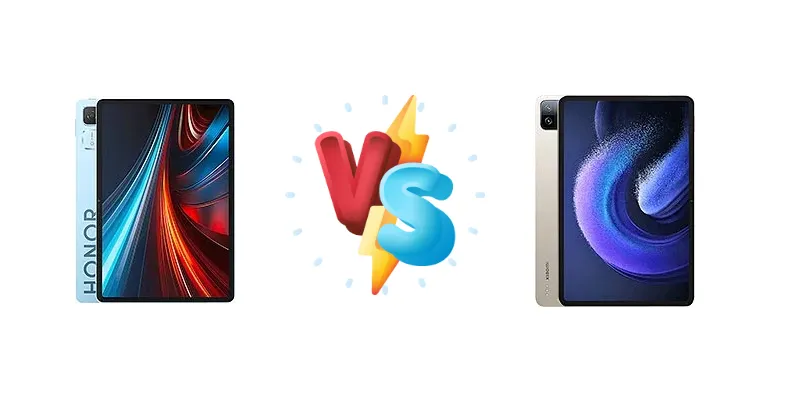
The Android tablet market is heating up, with the Honor Pad GT and Xiaomi Pad 6 Pro vying for the performance crown. Both tablets target power users, but they take different approaches. The Honor Pad GT leverages MediaTek’s Dimensity 8350, while the Xiaomi Pad 6 Pro opts for Qualcomm’s Snapdragon 8+ Gen 1. This comparison dives deep into the specifics to determine which tablet offers the best experience for gaming, productivity, and everyday use.
🏆 Quick Verdict
For most users, the Xiaomi Pad 6 Pro emerges as the stronger choice. The Snapdragon 8+ Gen 1 provides a noticeable performance edge in sustained workloads and gaming, coupled with slightly faster charging and broader compatibility with charging standards. While the Honor Pad GT is competitive, the Xiaomi’s chipset offers a more refined experience.
| Network |
|---|
| 2G bands | N/A | N/A |
| 3G bands | N/A | N/A |
| 4G bands | N/A | - |
| EDGE | N/A | N/A |
| GPRS | N/A | N/A |
| Technology | No cellular connectivity | No cellular connectivity |
| Launch |
|---|
| Announced | 2025, April 23 | 2023, April 18 |
| Status | Available. Released 2025, April 23 | Available. Released 2023, April 30 |
| Body |
|---|
| Build | - | Glass front (Gorilla Glass 3), aluminum frame, aluminum back |
| Dimensions | 259.1 x 176.1 x 6.1 mm (10.20 x 6.93 x 0.24 in) | 254 x 165.2 x 6.5 mm (10.0 x 6.50 x 0.26 in) |
| SIM | No | No |
| Weight | 480 g (1.06 lb) | 490 g (1.08 lb) |
| | - | Stylus support (magnetic) |
| Display |
|---|
| Protection | - | Corning Gorilla Glass 3 |
| Resolution | 2800 x 1840 pixels, 3:2 ratio (~291 ppi density) | 1800 x 2880 pixels, 16:10 ratio (~309 ppi density) |
| Size | 11.5 inches, 391.6 cm2 (~85.8% screen-to-body ratio) | 11.0 inches, 350.9 cm2 (~83.6% screen-to-body ratio) |
| Type | IPS LCD, 1B colors, 144Hz, HDR, 500 nits (typ) | IPS LCD, 1B colors, 144Hz, HDR10, Dolby Vision, 550 nits |
| Platform |
|---|
| CPU | Octa-core (1x3.35 GHz Cortex-A715 & 3x3.20 GHz Cortex-A715 & 4x2.20 GHz Cortex-A510) | Octa-core (1x3.19 GHz Cortex-X2 & 3x2.75 GHz Cortex-A710 & 4x1.80 GHz Cortex-A510) |
| Chipset | Mediatek Dimensity 8350 (4 nm) | Qualcomm SM8475 Snapdragon 8+ Gen 1 (4 nm) |
| GPU | Mali G615-MC6 | Adreno 730 |
| OS | Android 15, MagicOS 9 | Android 13, MIUI 14 |
| Memory |
|---|
| Card slot | No | No |
| Internal | 128GB 8GB RAM, 256GB 8GB RAM, 256GB 12GB RAM, 512GB 12GB RAM | 128GB 8GB RAM, 256GB 8GB RAM, 256GB 12GB RAM, 512GB 12GB RAM |
| | - | UFS 3.1 |
| Main Camera |
|---|
| Dual | - | 50 MP, f/1.8, (wide), 1/2.76", 0.64µm, PDAF
Auxiliary lens |
| Features | LED flash | Dual-LED flash, HDR, panorama |
| Single | 13 MP, f/2.0, (wide), AF | - |
| Video | 4K@30fps, 1080p@30fps | 4K@30/60fps, 1080p@30/60fps |
| Selfie camera |
|---|
| Single | 8 MP, f/2.0, (wide) | 20 MP, f/2.2, (wide), 1/3.4", 0.8µm |
| Video | 1080p@30fps | 1080p@30/60fps |
| Sound |
|---|
| 3.5mm jack | - | No |
| 35mm jack | No | No |
| Loudspeaker | Yes, with stereo speakers (8 speakers) | Yes, with stereo speakers (4 speakers) |
| | - | 24-bit/192kHz audio |
| Comms |
|---|
| Bluetooth | 5.2, A2DP, LE, aptX HD | 5.3, A2DP, LE |
| NFC | No | No |
| Positioning | No | No |
| Radio | No | No |
| USB | USB Type-C 2.0, magnetic connector | USB Type-C 3.2, accessory connector |
| WLAN | Wi-Fi 802.11 a/b/g/n/ac/6, dual-band, Wi-Fi Direct | Wi-Fi 802.11 a/b/g/n/a/6e, dual-band, Wi-Fi Direct |
| Features |
|---|
| Sensors | Accelerometer, proximity (accessories only), gyro | Accelerometer, gyro, proximity (accessories only) |
| Battery |
|---|
| Charging | 66W wired | 67W wired, PD3.0, QC4, 100% in 1 hour |
| Type | Si/C Li-Ion 10100 mAh | Li-Po 8600 mAh |
| Misc |
|---|
| Colors | Gray, White, Blue | Black, Blue, Gold |
| Models | ROL-W60 | 23046RP50C |
| Price | About 260 EUR | About 330 EUR |
Honor Pad GT
- Potentially more affordable price point.
- Capable Dimensity 8350 chipset for everyday tasks.
- 66W fast charging.
- Snapdragon 8+ Gen 1 offers superior gaming performance.
- Less versatile charging standard support.
Xiaomi Pad 6 Pro
- Snapdragon 8+ Gen 1 delivers top-tier performance.
- 67W fast charging with PD3.0 and QC4 support.
- Potentially better image processing.
- Likely a higher price tag.
- May experience some throttling under extreme sustained load (though less than competitors).
Display Comparison
Both tablets are expected to feature high-quality LCD panels, though specific details like resolution and refresh rate are not provided. However, the core difference lies in the processing power driving them. The absence of LTPO technology in either device suggests a fixed refresh rate, impacting battery life during static content viewing. Bezels are likely comparable, given the competitive nature of the market. Color accuracy will be crucial, and independent testing will be needed to determine which panel offers more faithful reproduction.
Camera Comparison
Given the tablet form factor, camera performance isn't a primary concern. However, the Xiaomi Pad 6 Pro is likely to benefit from Qualcomm’s image signal processor (ISP), potentially offering better image processing and noise reduction. Without specific sensor details, it’s difficult to make a definitive judgment, but Xiaomi’s history suggests a focus on computational photography, which could give it an edge. The Honor Pad GT’s camera system will likely be adequate for basic tasks, but won’t compete with flagship smartphone cameras.
Performance
The Xiaomi Pad 6 Pro’s Snapdragon 8+ Gen 1 (4nm) holds a clear advantage over the Honor Pad GT’s MediaTek Dimensity 8350 (4nm). While both are 4nm chips, the Snapdragon 8+ Gen 1 features the Cortex-X2 prime core clocked at 3.19 GHz, designed for peak performance, compared to the Dimensity 8350’s Cortex-A715 cores. The Snapdragon’s Adreno 730 GPU also surpasses the Mali-G610 MC4 in the Dimensity 8350, translating to higher frame rates and more stable performance in graphically intensive games. The Xiaomi Pad 6 Pro’s LPDDR5x RAM further contributes to faster data access and smoother multitasking. Thermal management will be key; the Snapdragon 8+ Gen 1 is known for its efficiency, potentially leading to less throttling under sustained load.
Battery Life
Both tablets offer fast charging – 67W for the Xiaomi Pad 6 Pro and 66W for the Honor Pad GT. The Xiaomi Pad 6 Pro’s support for PD3.0 and QC4 adds versatility, allowing it to charge with a wider range of chargers. Xiaomi claims a 100% charge in 1 hour, while Honor doesn’t provide a specific timeframe. The actual battery life will depend on usage patterns, but the Snapdragon 8+ Gen 1’s efficiency could offset any potential capacity differences, resulting in comparable real-world endurance.
Buying Guide
Buy the Honor Pad GT if you prioritize a potentially lower price point and are primarily focused on casual gaming and media consumption. Its Dimensity 8350 is capable, but doesn't match the sustained performance of the Snapdragon. Buy the Xiaomi Pad 6 Pro if you demand top-tier performance for demanding games, multitasking, and professional applications. The Snapdragon 8+ Gen 1, combined with its charging versatility, makes it the superior choice for power users.
Frequently Asked Questions
❓ Will the Snapdragon 8+ Gen 1 in the Xiaomi Pad 6 Pro overheat during extended gaming sessions?
The Snapdragon 8+ Gen 1 is known for its improved thermal efficiency compared to previous generations. While some throttling is inevitable under prolonged, maximum load, the Xiaomi Pad 6 Pro’s cooling system should mitigate this effectively, providing a more consistent gaming experience than tablets with less efficient chipsets.
❓ Does the Honor Pad GT support any stylus functionality or keyboard accessories?
While not explicitly stated in the provided specifications, Honor frequently offers accessories like styluses and keyboards for their tablets. Checking Honor’s official website or retailer listings is recommended to confirm compatibility and availability for the Pad GT.
❓ What kind of storage options are available for the Xiaomi Pad 6 Pro, and does it support microSD card expansion?
Storage options for the Xiaomi Pad 6 Pro typically include 128GB, 256GB, and 512GB configurations. However, Xiaomi generally does *not* include microSD card slots in their tablets, so users should carefully consider their storage needs before purchasing.
❓ How does the Dimensity 8350 in the Honor Pad GT compare to the Snapdragon 870 in terms of gaming performance?
The Dimensity 8350 generally outperforms the Snapdragon 870 in both CPU and GPU benchmarks. While the Snapdragon 870 remains a capable chip, the Dimensity 8350’s newer architecture and higher clock speeds provide a noticeable boost in gaming frame rates and overall responsiveness.