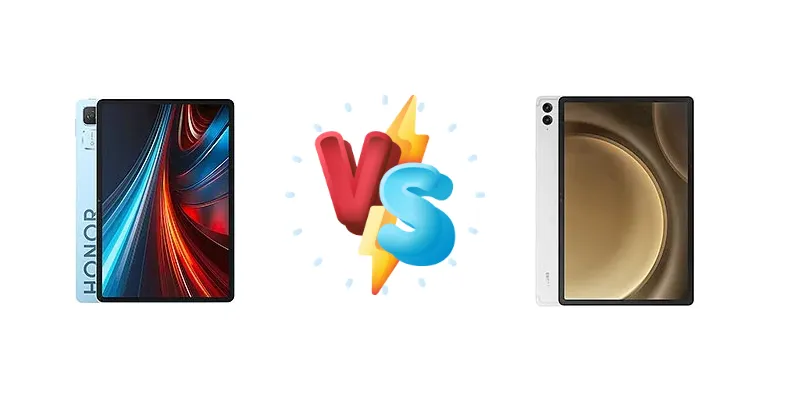
The mid-range Android tablet space is heating up, with the Honor Pad GT and Samsung Galaxy Tab S9 FE+ vying for dominance. The Honor Pad GT aggressively targets gamers with its powerful chipset and fast charging, while the Tab S9 FE+ aims for broader appeal with Samsung’s ecosystem and a larger screen option. This comparison dives deep into the specs to determine which tablet delivers the best experience for your needs.
🏆 Quick Verdict
For users prioritizing raw gaming performance and rapid charging, the Honor Pad GT emerges as the winner. Its Mediatek Dimensity 8350 offers a noticeable performance edge over the Exynos 1380 in the Tab S9 FE+. However, the Tab S9 FE+ provides a more polished software experience and broader ecosystem integration, making it a strong contender for everyday use.
| Network |
|---|
| 2G bands | N/A | GSM 850 / 900 / 1800 / 1900 |
| 3G bands | N/A | HSDPA 850 / 900 / 1700(AWS) / 1900 / 2100 |
| 4G bands | N/A | 1, 2, 3, 4, 5, 7, 8, 12, 13, 17, 20, 26, 28, 32, 38, 40, 41, 66 |
| 5G bands | - | 1, 3, 5, 7, 8, 20, 28, 38, 40, 41, 66, 77, 78 SA/NSA/Sub6 |
| EDGE | N/A | - |
| GPRS | N/A | - |
| Speed | - | HSPA, LTE, 5G - cellular model only |
| Technology | No cellular connectivity | GSM / HSPA / LTE / 5G |
| Launch |
|---|
| Announced | 2025, April 23 | 2023, October 04 |
| Status | Available. Released 2025, April 23 | Available. Released 2023, October 16 |
| Body |
|---|
| Build | - | Glass front, aluminum back, aluminum frame |
| Dimensions | 259.1 x 176.1 x 6.1 mm (10.20 x 6.93 x 0.24 in) | 285.4 x 185.4 x 6.5 mm (11.24 x 7.30 x 0.26 in) |
| SIM | No | Nano-SIM + eSIM (cellular model only) |
| Weight | 480 g (1.06 lb) | 627 g or 628 g (1.38 lb) |
| Display |
|---|
| Resolution | 2800 x 1840 pixels, 3:2 ratio (~291 ppi density) | 1600 x 2560 pixels, 16:10 ratio (~243 ppi density) |
| Size | 11.5 inches, 391.6 cm2 (~85.8% screen-to-body ratio) | 12.4 inches, 445.8 cm2 (~84.3% screen-to-body ratio) |
| Type | IPS LCD, 1B colors, 144Hz, HDR, 500 nits (typ) | IPS LCD, 90Hz |
| Platform |
|---|
| CPU | Octa-core (1x3.35 GHz Cortex-A715 & 3x3.20 GHz Cortex-A715 & 4x2.20 GHz Cortex-A510) | Octa-core (4x2.4 GHz Cortex-A78 & 4x2.0 GHz Cortex-A55) |
| Chipset | Mediatek Dimensity 8350 (4 nm) | Exynos 1380 (5 nm) |
| GPU | Mali G615-MC6 | Mali-G68 MP5 |
| OS | Android 15, MagicOS 9 | Android 13, up to 4 major Android upgrades, One UI 6 |
| Memory |
|---|
| Card slot | No | microSDXC (dedicated slot) |
| Internal | 128GB 8GB RAM, 256GB 8GB RAM, 256GB 12GB RAM, 512GB 12GB RAM | 128GB 6GB RAM, 128GB 8GB RAM, 256GB 8GB RAM, 256GB 12GB RAM |
| Main Camera |
|---|
| Dual | - | 8 MP, (wide)
8 MP, (ultrawide) |
| Features | LED flash | - |
| Single | 13 MP, f/2.0, (wide), AF | - |
| Video | 4K@30fps, 1080p@30fps | 4K@30fps, 1080p@30fps |
| Selfie camera |
|---|
| Single | 8 MP, f/2.0, (wide) | 12 MP, (ultrawide) |
| Video | 1080p@30fps | Yes |
| Sound |
|---|
| 35mm jack | No | No |
| Loudspeaker | Yes, with stereo speakers (8 speakers) | Yes, with stereo speakers |
| Comms |
|---|
| Bluetooth | 5.2, A2DP, LE, aptX HD | 5.3, A2DP, LE |
| NFC | No | No |
| Positioning | No | GPS, GALILEO, GLONASS, BDS, QZSS - cellular model only |
| Radio | No | No |
| USB | USB Type-C 2.0, magnetic connector | USB Type-C 2.0, magnetic connector |
| WLAN | Wi-Fi 802.11 a/b/g/n/ac/6, dual-band, Wi-Fi Direct | Wi-Fi 802.11 a/b/g/n/ac/6, dual-band, Wi-Fi Direct |
| Features |
|---|
| Sensors | Accelerometer, proximity (accessories only), gyro | Fingerprint (side-mounted), accelerometer, gyro, compass, proximity (accessories only) |
| Battery |
|---|
| Charging | 66W wired | 45W wired, QC2.0 |
| Type | Si/C Li-Ion 10100 mAh | Li-Po 10090 mAh |
| Misc |
|---|
| Colors | Gray, White, Blue | Mint, Silver, Gray, Lavender |
| Models | ROL-W60 | SM-X610, SM-X616B |
| Price | About 260 EUR | About 770 EUR |
| SAR | - | 0.77 W/kg (body) |
| SAR EU | - | 0.50 W/kg (body) |
Honor Pad GT
- Superior gaming performance due to the Dimensity 8350 chipset.
- Significantly faster 66W wired charging.
- Potentially better thermal management thanks to the 4nm process.
- Software experience may not be as polished as Samsung’s One UI.
- Ecosystem integration is less comprehensive than Samsung’s.
Samsung Galaxy Tab S9 FE+
- Seamless integration with the Samsung ecosystem.
- Available in larger 12.4-inch display option.
- Refined software experience with One UI.
- Less powerful Exynos 1380 chipset compared to the Dimensity 8350.
- Slower 45W charging.
- Potential for throttling under sustained heavy load.
Display Comparison
While both tablets likely feature LCD panels (specific panel tech is unstated), the focus here is on size and performance. The Tab S9 FE+ is available in 12.4-inch and 11-inch variants, offering more screen real estate for multitasking and media consumption. The Honor Pad GT’s display size is not specified, but its focus on gaming suggests a high refresh rate is likely. The Exynos 1380’s GPU may struggle to consistently drive a larger, higher-resolution display at maximum settings, potentially giving the Honor Pad GT an advantage in maintaining smooth frame rates. Bezels are a key consideration, and without specific data, Samsung’s typically refined design language may offer a more premium look.
Camera Comparison
Camera performance is unlikely to be a primary decision factor for most tablet buyers. However, the Tab S9 FE+ likely benefits from Samsung’s image processing expertise. Without specific sensor details, it’s difficult to make a definitive comparison. The inclusion of a 2MP macro camera on either device is largely inconsequential; its limited resolution and fixed focus make it unlikely to produce compelling results. Focus should be on the main sensor’s megapixel count and aperture, but this data is unavailable. The Honor Pad GT’s camera is likely geared towards basic functionality, while the Tab S9 FE+ may offer slightly more refined image quality.
Performance
The core difference lies in the chipsets. The Honor Pad GT’s Mediatek Dimensity 8350, built on a 4nm process, boasts a more modern CPU architecture (Cortex-A715) and a higher peak clock speed (3.35 GHz) compared to the Samsung Galaxy Tab S9 FE+'s Exynos 1380 (5nm). The Dimensity 8350’s architecture, with its mix of A715 and A510 cores, is designed for sustained performance, crucial for extended gaming sessions. The Exynos 1380, utilizing older Cortex-A78 and A55 cores, will likely deliver adequate performance for everyday tasks but may exhibit more throttling under heavy load. The 4nm node of the Dimensity 8350 also contributes to better thermal efficiency, potentially reducing performance drops during prolonged use. RAM speed (likely LPDDR5x on both) is not specified, but the chipset difference is the dominant factor.
Battery Life
Battery capacity is not specified for either device. However, the Honor Pad GT’s 66W wired charging is a significant advantage over the Tab S9 FE+'s 45W charging with QC2.0 support. This translates to substantially faster charging times, allowing users to quickly top up their battery and get back to gaming or work. While the Tab S9 FE+ may have a larger battery capacity, the Honor Pad GT’s faster charging mitigates the impact of a potentially smaller battery. A full charge on the Honor Pad GT is likely to be achieved in under an hour, while the Tab S9 FE+ will take considerably longer.
Buying Guide
Buy the Honor Pad GT if you need a tablet primarily for demanding mobile games and value fast charging speeds. Its Dimensity 8350 chipset and 66W charging are geared towards power users. Buy the Samsung Galaxy Tab S9 FE+ if you prefer a tablet deeply integrated with the Samsung ecosystem, prioritize a larger display, and value a more refined software experience, even if it means sacrificing some peak gaming performance.
Frequently Asked Questions
❓ Does the Exynos 1380 in the Tab S9 FE+ overheat during extended gaming sessions?
The Exynos 1380 is a capable chip, but its 5nm process and older core architecture are more prone to thermal throttling than the Dimensity 8350’s 4nm process. Expect some performance reduction after prolonged gaming, especially on the 12.4-inch model where heat dissipation is more challenging.
❓ How much faster is the 66W charging on the Honor Pad GT compared to the 45W charging on the Tab S9 FE+?
The 66W charging on the Honor Pad GT can realistically shave 30-45 minutes off a full charge compared to the Tab S9 FE+. This is a significant advantage for users who need to quickly top up their battery between gaming sessions or work tasks.
❓ Is the performance difference between the Dimensity 8350 and Exynos 1380 noticeable in everyday tasks?
For typical tasks like browsing, video streaming, and social media, the performance difference will be minimal. Both chips are more than capable of handling these workloads. The advantage of the Dimensity 8350 becomes apparent in demanding applications like graphically intensive games and video editing.
❓ Does the Samsung Galaxy Tab S9 FE+ support the S Pen?
Yes, the Samsung Galaxy Tab S9 FE+ supports the S Pen, offering enhanced productivity and creative capabilities. This is a key advantage for users who frequently take notes, sketch, or edit documents on their tablet.