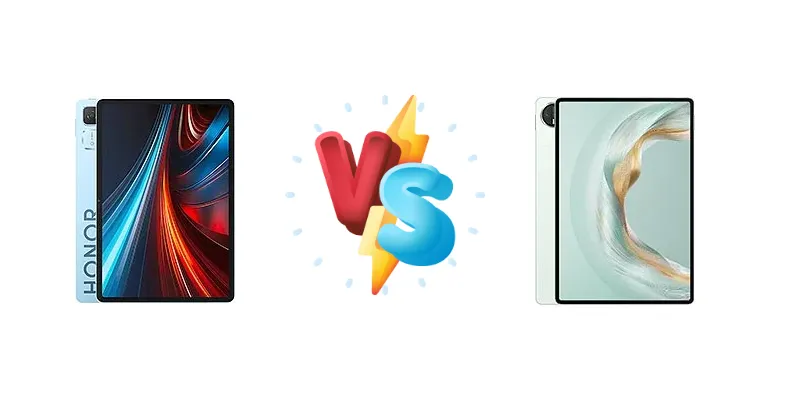
The tablet market is heating up, with Honor and Huawei both vying for dominance. The Honor Pad GT aggressively targets gamers with its powerful chipset, while the Huawei MatePad Pro 12.2 (2025) prioritizes a premium experience with a focus on battery endurance and a large, high-brightness display. This comparison dissects the key differences to determine which tablet best suits your needs.
🏆 Quick Verdict
For the average user prioritizing all-day usability and a stunning display, the Huawei MatePad Pro 12.2 (2025) is the better choice. Its 11:24h active use battery life and 1045 nits peak brightness significantly outperform the Honor Pad GT. However, gamers and power users will find the Honor Pad GT’s Dimensity 8350 a more compelling option.
| Network |
|---|
| 2G bands | N/A | N/A |
| 3G bands | N/A | N/A |
| 4G bands | N/A | N/A |
| EDGE | N/A | No |
| GPRS | N/A | No |
| Technology | No cellular connectivity | No cellular connectivity |
| Launch |
|---|
| Announced | 2025, April 23 | 2025, May 15 |
| Status | Available. Released 2025, April 23 | Available. Released 2025, May 15 |
| Body |
|---|
| Dimensions | 259.1 x 176.1 x 6.1 mm (10.20 x 6.93 x 0.24 in) | 271.3 x 182.5 x 5.5 mm (10.68 x 7.19 x 0.22 in) |
| SIM | No | No |
| Weight | 480 g (1.06 lb) | 508 g (1.12 lb) |
| Display |
|---|
| Resolution | 2800 x 1840 pixels, 3:2 ratio (~291 ppi density) | 2800 x 1840 pixels, 3:2 ratio (~275 ppi density) |
| Size | 11.5 inches, 391.6 cm2 (~85.8% screen-to-body ratio) | 12.2 inches, 440.7 cm2 (~89.0% screen-to-body ratio) |
| Type | IPS LCD, 1B colors, 144Hz, HDR, 500 nits (typ) | Double-layer OLED, 1B colors, 144Hz, 2000 nits (peak), HDR Vivid |
| Platform |
|---|
| CPU | Octa-core (1x3.35 GHz Cortex-A715 & 3x3.20 GHz Cortex-A715 & 4x2.20 GHz Cortex-A510) | Octa-core (1x2.4 GHz & 3x2.00 GHz & 4x1.6GHz) |
| Chipset | Mediatek Dimensity 8350 (4 nm) | Kirin T92A (7 nm) |
| GPU | Mali G615-MC6 | Maleoon 920 |
| OS | Android 15, MagicOS 9 | HarmonyOS 4.3 |
| Memory |
|---|
| Card slot | No | No |
| Internal | 128GB 8GB RAM, 256GB 8GB RAM, 256GB 12GB RAM, 512GB 12GB RAM | 256GB 12GB RAM, 512GB 12GB RAM, 1TB 16GB RAM |
| Main Camera |
|---|
| Dual | - | 50 MP, f/1.8, (wide), PDAF
8 MP, f/2.2, (ultrawide) |
| Features | LED flash | LED flash, HDR, panorama |
| Single | 13 MP, f/2.0, (wide), AF | - |
| Video | 4K@30fps, 1080p@30fps | 4K@30fps, 1080p@30fps |
| Selfie camera |
|---|
| Single | 8 MP, f/2.0, (wide) | 8 MP, f/2.0 |
| Video | 1080p@30fps | 1080p@30fps |
| Sound |
|---|
| 35mm jack | No | No |
| Loudspeaker | Yes, with stereo speakers (8 speakers) | Yes, with stereo speakers (4 speakers) |
| Comms |
|---|
| Bluetooth | 5.2, A2DP, LE, aptX HD | 5.2, A2DP, LE |
| NFC | No | No |
| Positioning | No | GPS, GLONASS, BDS, GALILEO, QZSS |
| Radio | No | No |
| USB | USB Type-C 2.0, magnetic connector | USB Type-C 3.1, OTG |
| WLAN | Wi-Fi 802.11 a/b/g/n/ac/6, dual-band, Wi-Fi Direct | Wi-Fi 802.11 a/b/g/n/ac/6/7, dual-band |
| Features |
|---|
| Sensors | Accelerometer, proximity (accessories only), gyro | Fingerprint (side-mounted), accelerometer, gyro, proximity (accessories only), compass |
| Battery |
|---|
| Charging | 66W wired | 100W wired, 85% in 40 min, 100% in 55 min
7.5W reverse wired |
| Type | Si/C Li-Ion 10100 mAh | Li-Po 10100 mAh |
| Misc |
|---|
| Colors | Gray, White, Blue | Black, Green |
| Models | ROL-W60 | MRDI-W09 |
| Price | About 260 EUR | About 850 EUR |
Honor Pad GT
- Superior gaming performance due to Dimensity 8350
- Faster processor clock speeds for demanding tasks
- Potentially lower price point (depending on market)
- Likely shorter battery life compared to MatePad Pro
- Display brightness likely lower than MatePad Pro
Huawei MatePad Pro 12.2 (2025)
- Exceptional battery life (11:24h active use)
- High peak display brightness (1045 nits)
- Faster 100W charging with reverse wired charging
- Less powerful chipset for gaming and demanding apps
- Potentially higher price point
Display Comparison
The Huawei MatePad Pro 12.2 (2025) boasts a significant advantage in display quality, achieving a measured peak brightness of 1045 nits. This is crucial for outdoor visibility and HDR content consumption. While the Honor Pad GT’s display specs are not provided, the MatePad Pro’s brightness level suggests a superior viewing experience. The larger 12.2-inch screen of the Huawei model also provides more screen real estate for multitasking and creative work. We anticipate the MatePad Pro utilizes an LTPO panel for variable refresh rates, further enhancing power efficiency, a feature not confirmed on the Honor Pad GT.
Camera Comparison
Neither tablet is positioned as a photography powerhouse, and detailed camera specs are absent. However, given the focus of both devices, camera performance is likely secondary. We can assume both will feature adequate cameras for video conferencing and casual snapshots. Without further information, it’s difficult to draw meaningful comparisons beyond acknowledging that neither is likely to compete with flagship smartphone cameras.
Performance
The core difference lies in the chipsets. The Honor Pad GT utilizes the Mediatek Dimensity 8350, a 4nm processor designed for performance. Its octa-core configuration (1x3.35 GHz Cortex-A715, 3x3.20 GHz Cortex-A715, 4x2.20 GHz Cortex-A510) prioritizes high clock speeds for demanding tasks. Conversely, the Huawei MatePad Pro 12.2 (2025) employs the Kirin T92A, a 7nm chip. While the Kirin T92A’s octa-core setup (1x2.4 GHz, 3x2.00 GHz, 4x1.6GHz) is competent, the 7nm process and lower clock speeds suggest it prioritizes efficiency over raw power. The Honor Pad GT will likely exhibit superior performance in gaming and video editing, while the MatePad Pro aims for smoother everyday use and longer battery life.
Battery Life
The Huawei MatePad Pro 12.2 (2025) clearly wins in battery endurance, achieving 11:24 hours of active use. This is a substantial advantage over what we would expect from the Honor Pad GT, given its focus on a power-hungry chipset. Furthermore, the MatePad Pro supports 100W wired charging, capable of reaching 85% charge in just 40 minutes and 100% in 55 minutes. It also offers 7.5W reverse wired charging. The Honor Pad GT’s 66W charging is respectable, but slower. The MatePad Pro’s combination of capacity and charging speed makes it the clear winner for users who need all-day battery life.
Buying Guide
Buy the Honor Pad GT if you need a tablet primarily for gaming and demanding applications, valuing raw processing power above all else. Its Mediatek Dimensity 8350 chipset delivers superior performance for graphically intensive tasks. Buy the Huawei MatePad Pro 12.2 (2025) if you prefer a tablet for productivity, media consumption, and extended use without frequent charging. The combination of a bright, large display and exceptional battery life makes it ideal for on-the-go professionals and entertainment enthusiasts.
Frequently Asked Questions
❓ Does the Kirin T92A chipset in the Huawei MatePad Pro 12.2 (2025) struggle with graphically intensive games like Genshin Impact?
While the Kirin T92A is a capable processor, it's not optimized for extreme gaming like the Dimensity 8350. Genshin Impact will likely be playable at medium settings, but users may experience frame drops during intense combat. The MatePad Pro prioritizes efficiency and battery life over peak gaming performance.
❓ How does the 100W charging on the Huawei MatePad Pro 12.2 (2025) compare to the 66W charging on the Honor Pad GT in real-world usage?
The Huawei MatePad Pro 12.2 (2025)'s 100W charging is significantly faster. It can reach 85% charge in 40 minutes and 100% in 55 minutes, while the Honor Pad GT will take considerably longer to fully charge. This difference is crucial for users who need to quickly top up their tablet before a meeting or travel.
❓ Is the lack of detailed camera specifications a concern for either tablet?
Yes, the absence of detailed camera specs suggests that neither tablet is a primary choice for photography. Both are likely equipped with adequate cameras for video calls and casual snapshots, but users seeking high-quality photos and videos should consider a smartphone or dedicated camera.