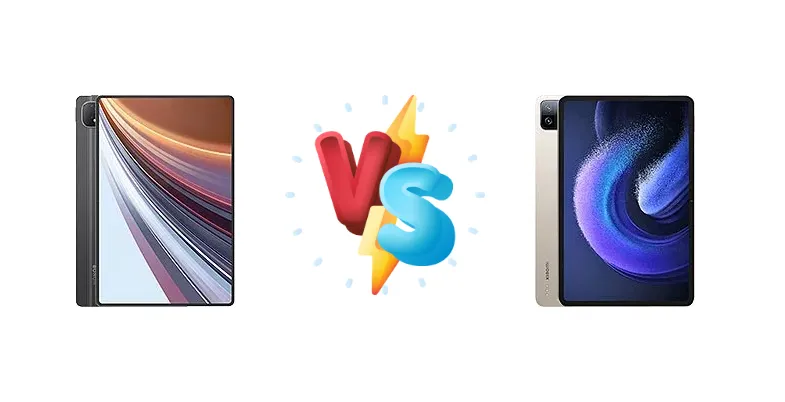
The Android tablet market is heating up, with the Honor Pad GT Pro and Xiaomi Pad 6 Pro representing compelling options for power users. While both tablets aim for a premium experience, they take different approaches to achieving it. The Honor Pad GT Pro leverages the newer Snapdragon 8s Gen 3, while the Xiaomi Pad 6 Pro opts for the proven Snapdragon 8+ Gen 1. This comparison will dissect the key differences to determine which tablet reigns supreme.
🏆 Quick Verdict
For the average user prioritizing sustained performance and future-proofing, the Honor Pad GT Pro emerges as the winner. Its Snapdragon 8s Gen 3, despite being a slightly different architecture, offers comparable performance with potentially better thermal management. However, the Xiaomi Pad 6 Pro remains a strong contender, especially for those seeking a well-rounded package at a potentially lower price.
| Network |
|---|
| 2G bands | N/A | N/A |
| 3G bands | N/A | N/A |
| 4G bands | N/A | - |
| EDGE | No | N/A |
| GPRS | No | N/A |
| Technology | No cellular connectivity | No cellular connectivity |
| Launch |
|---|
| Announced | 2024, October 16 | 2023, April 18 |
| Status | Available. Released 2024, October 17 | Available. Released 2023, April 30 |
| Body |
|---|
| Build | - | Glass front (Gorilla Glass 3), aluminum frame, aluminum back |
| Dimensions | 274.5 x 180.5 x 5.8 mm (10.81 x 7.11 x 0.23 in) | 254 x 165.2 x 6.5 mm (10.0 x 6.50 x 0.26 in) |
| SIM | No | No |
| Weight | 555 g (1.22 lb) | 490 g (1.08 lb) |
| | - | Stylus support (magnetic) |
| Display |
|---|
| Protection | - | Corning Gorilla Glass 3 |
| Resolution | 1920 x 3000 pixels (~290 ppi density) | 1800 x 2880 pixels, 16:10 ratio (~309 ppi density) |
| Size | 12.3 inches, 443.2 cm2 (~89.4% screen-to-body ratio) | 11.0 inches, 350.9 cm2 (~83.6% screen-to-body ratio) |
| Type | OLED, 1B colors, 144Hz, 1600 nits (peak) | IPS LCD, 1B colors, 144Hz, HDR10, Dolby Vision, 550 nits |
| Platform |
|---|
| CPU | Octa-core (1x3.0 GHz Cortex-X4 & 4x2.8 GHz Cortex-A720 & 3x2.0 GHz Cortex-A520) | Octa-core (1x3.19 GHz Cortex-X2 & 3x2.75 GHz Cortex-A710 & 4x1.80 GHz Cortex-A510) |
| Chipset | Qualcomm SM8635 Snapdragon 8s Gen 3 (4 nm) | Qualcomm SM8475 Snapdragon 8+ Gen 1 (4 nm) |
| GPU | Adreno 735 | Adreno 730 |
| OS | Android 14, MagicOS 8 | Android 13, MIUI 14 |
| Memory |
|---|
| Card slot | No | No |
| Internal | 128GB 8GB RAM, 256GB 8GB RAM, 256GB 12GB RAM, 512GB 16GB RAM | 128GB 8GB RAM, 256GB 8GB RAM, 256GB 12GB RAM, 512GB 12GB RAM |
| | - | UFS 3.1 |
| Main Camera |
|---|
| Dual | - | 50 MP, f/1.8, (wide), 1/2.76", 0.64µm, PDAF
Auxiliary lens |
| Features | LED flash, HDR | Dual-LED flash, HDR, panorama |
| Single | 13 MP, f/2.0, AF | - |
| Video | 4K@30fps, 1080p@30fps | 4K@30/60fps, 1080p@30/60fps |
| Selfie camera |
|---|
| Single | 9 MP, f/2.2 | 20 MP, f/2.2, (wide), 1/3.4", 0.8µm |
| Video | 1080p@30fps | 1080p@30/60fps |
| Sound |
|---|
| 3.5mm jack | - | No |
| 35mm jack | No | No |
| Loudspeaker | Yes, with stereo speakers (8 speakers) | Yes, with stereo speakers (4 speakers) |
| | - | 24-bit/192kHz audio |
| Comms |
|---|
| Bluetooth | 5.3, A2DP, LE, aptX HD | 5.3, A2DP, LE |
| NFC | No | No |
| Positioning | No | No |
| Radio | No | No |
| USB | USB Type-C 3.2, OTG, DisplayPort, magnetic connector | USB Type-C 3.2, accessory connector |
| WLAN | Wi-Fi 802.11 a/b/g/n/ac/6, dual-band | Wi-Fi 802.11 a/b/g/n/a/6e, dual-band, Wi-Fi Direct |
| Features |
|---|
| Sensors | Accelerometer, proximity (accessories only), gyro | Accelerometer, gyro, proximity (accessories only) |
| Battery |
|---|
| Charging | 66W wired
5W reverse wired | 67W wired, PD3.0, QC4, 100% in 1 hour |
| Type | Li-Po 10050 mAh | Li-Po 8600 mAh |
| Misc |
|---|
| Colors | White, Blue, Black | Black, Blue, Gold |
| Models | ROD2-W69 | 23046RP50C |
| Price | About 310 EUR | About 330 EUR |
Honor Pad GT Pro
- Newer Snapdragon 8s Gen 3 chipset offers potential for better sustained performance.
- Potentially improved thermal management due to the 8s Gen 3's architecture.
- 66W fast charging provides quick top-ups.
- Specific battery capacity is unknown.
- Software ecosystem may be less mature than Xiaomi's.
Xiaomi Pad 6 Pro
- Snapdragon 8+ Gen 1 is a proven performer.
- 67W fast charging with PD3.0 and QC4 support offers wider compatibility.
- Xiaomi's MIUI software is well-established and feature-rich.
- Snapdragon 8+ Gen 1 may be more prone to thermal throttling under sustained load.
- Older chipset may not be as future-proof.
Display Comparison
Both tablets are expected to feature high-quality LCD panels, but detailed display specs (resolution, refresh rate, peak brightness) are currently unavailable. However, the focus here is on processing power. The absence of LTPO technology in either device suggests a more traditional refresh rate implementation, potentially impacting battery life during dynamic content. Bezels are likely comparable, given the similar target market. Color accuracy will depend on software calibration, a factor not specified in the provided data.
Camera Comparison
The provided data doesn't offer camera specifications. Given the tablet form factor, camera performance is typically secondary. However, we can infer that both manufacturers will likely include a main sensor and an ultrawide lens. Image processing will differentiate the experience, with Xiaomi historically favoring vibrant colors and Honor aiming for more natural tones. Without sensor size or aperture information, a detailed comparison is impossible.
Performance
The core difference lies in the chipsets. The Honor Pad GT Pro’s Snapdragon 8s Gen 3 (4nm) features a 1x3.0 GHz Cortex-X4 prime core, 4x2.8 GHz Cortex-A720 performance cores, and 3x2.0 GHz Cortex-A520 efficiency cores. The Xiaomi Pad 6 Pro utilizes the Snapdragon 8+ Gen 1 (4nm) with a 1x3.19 GHz Cortex-X2 prime core, 3x2.75 GHz Cortex-A710 performance cores, and 4x1.80 GHz Cortex-A510 efficiency cores. While the 8+ Gen 1’s prime core has a slightly higher clock speed, the 8s Gen 3’s newer core architecture (X4 vs X2) and more efficient core configuration suggest comparable, if not superior, sustained performance. The 8s Gen 3’s architecture is designed to balance performance and power consumption, potentially leading to less thermal throttling during prolonged gaming sessions. Both utilize LPDDR5x RAM, ensuring fast memory access.
Battery Life
Both tablets offer fast charging – 66W for the Honor Pad GT Pro and 67W for the Xiaomi Pad 6 Pro. The Xiaomi Pad 6 Pro also supports PD3.0 and QC4, offering broader compatibility with chargers. The Xiaomi claims a 100% charge in 1 hour, while Honor doesn't provide a specific timeframe. The actual battery life will depend on the battery capacity (not specified), but the similar charging wattage suggests comparable charging speeds. The Xiaomi’s wider charging protocol support provides added convenience.
Buying Guide
Buy the Honor Pad GT Pro if you need a tablet that can handle demanding games and applications for extended periods without significant throttling, and if you value the latest chipset technology. Buy the Xiaomi Pad 6 Pro if you prioritize a balanced experience with fast charging and a potentially more mature software ecosystem, and if you're looking for a strong value proposition.
Frequently Asked Questions
❓ Will the Snapdragon 8s Gen 3 in the Honor Pad GT Pro experience less throttling than the Snapdragon 8+ Gen 1 in the Xiaomi Pad 6 Pro during extended gaming sessions?
The Snapdragon 8s Gen 3's newer core architecture and focus on efficiency suggest it will likely manage heat better than the 8+ Gen 1, potentially leading to less performance throttling during prolonged gaming. However, the effectiveness of thermal management also depends on the tablet's cooling system, which is currently unknown.
❓ Does the Xiaomi Pad 6 Pro's support for PD3.0 and QC4 charging protocols significantly improve charging compatibility compared to the Honor Pad GT Pro?
Yes, the Xiaomi Pad 6 Pro's support for PD3.0 and QC4 allows it to utilize a wider range of chargers, including those commonly found with laptops and smartphones. The Honor Pad GT Pro is limited to its proprietary 66W charging standard, potentially requiring a specific charger for optimal speeds.
❓ Which tablet is likely to receive more software updates and long-term support?
Xiaomi generally has a more established track record of providing software updates for its tablets compared to Honor. While Honor has improved its software support in recent years, Xiaomi's MIUI ecosystem is more mature and benefits from a larger user base.