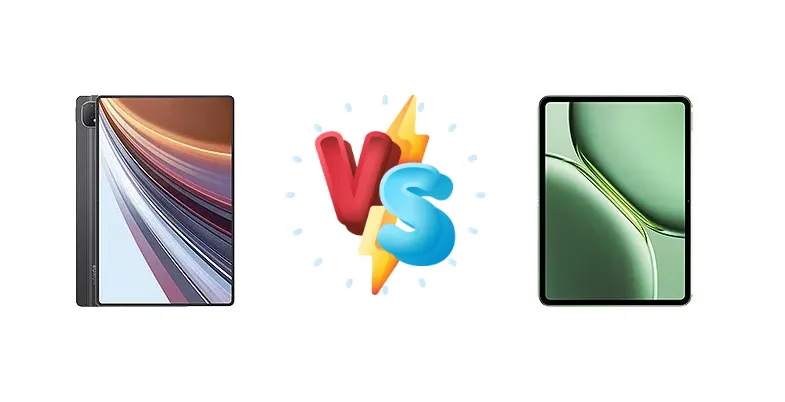
The Android tablet market is heating up, with Honor and OnePlus both vying for dominance with their premium offerings. The Honor Pad GT Pro and OnePlus Pad Pro represent distinct approaches to tablet design, focusing on performance and features. This comparison dissects the core differences between these two devices, focusing on their Snapdragon chipsets, charging capabilities, and overall user experience.
🏆 Quick Verdict
For most users, the OnePlus Pad Pro emerges as the superior choice. Its Snapdragon 8 Gen 3 chipset provides a noticeable performance edge over the Honor Pad GT Pro’s 8s Gen 3, justifying the price difference. While the Honor Pad GT Pro offers competitive charging, the OnePlus Pad Pro’s overall refinement and processing power make it the winner.
| Network |
|---|
| 2G bands | N/A | N/A |
| 3G bands | N/A | N/A |
| 4G bands | N/A | N/A |
| EDGE | No | No |
| GPRS | No | No |
| Technology | No cellular connectivity | No cellular connectivity |
| Launch |
|---|
| Announced | 2024, October 16 | 2024, June 27 |
| Status | Available. Released 2024, October 17 | Available. Released 2024, June 29 |
| Body |
|---|
| Build | - | Glass front, aluminum back, aluminum frame |
| Dimensions | 274.5 x 180.5 x 5.8 mm (10.81 x 7.11 x 0.23 in) | 268.7 x 195.1 x 6.5 mm (10.58 x 7.68 x 0.26 in) |
| SIM | No | No |
| Weight | 555 g (1.22 lb) | 584 g (1.29 lb) |
| Display |
|---|
| Resolution | 1920 x 3000 pixels (~290 ppi density) | 2120 x 3000 pixels (~304 ppi density) |
| Size | 12.3 inches, 443.2 cm2 (~89.4% screen-to-body ratio) | 12.1 inches, 445.2 cm2 (~84.9% screen-to-body ratio) |
| Type | OLED, 1B colors, 144Hz, 1600 nits (peak) | IPS LCD, 68B colors, Dolby Vision, HDR10+, 144Hz, 600 nits (typ), 900 nits (peak) |
| Platform |
|---|
| CPU | Octa-core (1x3.0 GHz Cortex-X4 & 4x2.8 GHz Cortex-A720 & 3x2.0 GHz Cortex-A520) | Octa-core (1x3.3 GHz Cortex-X4 & 3x3.2 GHz Cortex-A720 & 2x3.0 GHz Cortex-A720 & 2x2.3 GHz Cortex-A520) |
| Chipset | Qualcomm SM8635 Snapdragon 8s Gen 3 (4 nm) | Qualcomm SM8650-AB Snapdragon 8 Gen 3 (4 nm) |
| GPU | Adreno 735 | Adreno 750 |
| OS | Android 14, MagicOS 8 | Android 14, OxygenOS 14.1 |
| Memory |
|---|
| Card slot | No | No |
| Internal | 128GB 8GB RAM, 256GB 8GB RAM, 256GB 12GB RAM, 512GB 16GB RAM | 128GB 8GB RAM, 256GB 8GB RAM, 256GB 12GB RAM, 512GB 16GB RAM |
| Main Camera |
|---|
| Features | LED flash, HDR | LED flash |
| Single | 13 MP, f/2.0, AF | 13 MP, f/2.2, 23mm (wide) |
| Video | 4K@30fps, 1080p@30fps | 4K@30fps, 1080p@30ps, gyro-EIS |
| Selfie camera |
|---|
| Single | 9 MP, f/2.2 | 8 MP, f/2.3, (wide), 1/4.0", 1.12µm |
| Video | 1080p@30fps | 1080p@30fps |
| Sound |
|---|
| 35mm jack | No | No |
| Loudspeaker | Yes, with stereo speakers (8 speakers) | Yes, with stereo speakers (4 speakers) |
| Comms |
|---|
| Bluetooth | 5.3, A2DP, LE, aptX HD | 5.4, A2DP, LE, aptX HD, LHDC |
| NFC | No | NFC (data sharing only) |
| Positioning | No | No |
| Radio | No | No |
| USB | USB Type-C 3.2, OTG, DisplayPort, magnetic connector | USB Type-C 3.2, OTG, accessory connector |
| WLAN | Wi-Fi 802.11 a/b/g/n/ac/6, dual-band | Wi-Fi 802.11 a/b/g/n/ac/6/7, dual-band |
| Features |
|---|
| Sensors | Accelerometer, proximity (accessories only), gyro | Accelerometer, gyro, proximity (accessories only), compass |
| Battery |
|---|
| Charging | 66W wired
5W reverse wired | 67W wired, PD, QC |
| Type | Li-Po 10050 mAh | Li-Po 9510 mAh |
| Misc |
|---|
| Colors | White, Blue, Black | Gray, Green |
| Models | ROD2-W69 | OPD2404 |
| Price | About 310 EUR | About 370 EUR |
Honor Pad GT Pro
- Competitive 66W wired charging.
- Potentially more affordable price point.
- Capable Snapdragon 8s Gen 3 processor for everyday tasks.
- Snapdragon 8s Gen 3 is outperformed by the 8 Gen 3.
- Likely lacks advanced display features like LTPO.
OnePlus Pad Pro
- Superior performance with Snapdragon 8 Gen 3.
- Wider charger compatibility with PD and QC.
- Potentially better thermal management due to chipset efficiency.
- Higher price tag.
- May not offer a significant battery life advantage despite chipset efficiency.
Display Comparison
Both tablets likely feature high-quality LCD panels, though specific details like peak brightness and color gamut coverage are not provided. The absence of LTPO technology in either device suggests a standard refresh rate, potentially impacting battery life during prolonged use. Bezels are a critical factor, and without specific measurements, it's difficult to determine which offers a more immersive viewing experience. Color accuracy will likely be good on both, given the brands' reputations, but independent testing is needed to confirm.
Camera Comparison
Without detailed camera specifications, a direct comparison is limited. However, given the tablet form factor, camera quality is often secondary to performance and display. Both manufacturers likely prioritize a functional camera setup for video calls and casual photography. The absence of information regarding sensor size, OIS, or lens apertures makes it impossible to assess image quality differences. It's reasonable to assume both tablets will offer adequate, but not exceptional, camera performance.
Performance
The core difference lies in the chipsets. The OnePlus Pad Pro’s Snapdragon 8 Gen 3 (4nm) boasts a higher peak CPU clock speed of 3.3 GHz (Cortex-X4) compared to the Honor Pad GT Pro’s Snapdragon 8s Gen 3 (4nm) at 3.0 GHz. The OnePlus also features a more robust configuration of Cortex-A720 cores (3x3.2 GHz + 2x3.0 GHz) versus the Honor’s (4x2.8 GHz + 3x2.0 GHz). This translates to faster processing speeds and improved multitasking capabilities on the OnePlus. While both use the 4nm process for efficiency, the Gen 3 is a newer architecture, offering gains in both CPU and GPU performance. The OnePlus Pad Pro will demonstrably outperform the Honor Pad GT Pro in graphically intensive tasks and sustained workloads.
Battery Life
Both tablets offer fast charging, with the OnePlus Pad Pro supporting 67W wired charging (PD, QC) and the Honor Pad GT Pro offering 66W. The slight advantage of the OnePlus’s support for PD and QC allows for broader compatibility with chargers. While battery capacity isn’t specified, the efficiency gains of the Snapdragon 8 Gen 3 in the OnePlus Pad Pro could offset a potentially smaller battery size, resulting in comparable or even better real-world battery life. The 66W/67W charging speeds will deliver rapid top-ups, minimizing downtime for both devices.
Buying Guide
Buy the Honor Pad GT Pro if you prioritize value and are seeking a capable tablet for everyday tasks and moderate gaming. Its 66W charging is excellent for the price point. Buy the OnePlus Pad Pro if you demand the highest possible performance for demanding games, content creation, or multitasking, and are willing to pay a premium for the Snapdragon 8 Gen 3 and its associated benefits.
Frequently Asked Questions
❓ Will the Snapdragon 8s Gen 3 in the Honor Pad GT Pro struggle with demanding games like Genshin Impact?
While the Snapdragon 8s Gen 3 is a capable chip, it will likely require reduced graphics settings and may experience some throttling during extended Genshin Impact sessions. The OnePlus Pad Pro’s Snapdragon 8 Gen 3 will provide a smoother, more consistent gaming experience at higher settings.
❓ Does the OnePlus Pad Pro support external displays via USB-C, and what resolution/refresh rate is supported?
While not explicitly stated, the OnePlus Pad Pro, given its Snapdragon 8 Gen 3 chipset and USB-C port, is highly likely to support DisplayPort Alternate Mode for connecting to external displays. Expect support for up to 4K resolution at 60Hz, but confirmation from OnePlus is needed.
❓ How does the 66W vs 67W charging translate to real-world charging times?
The difference in charging wattage is minimal. Both tablets should achieve a full charge in approximately 60-75 minutes. The OnePlus Pad Pro’s PD/QC support may allow for slightly faster charging with compatible chargers.