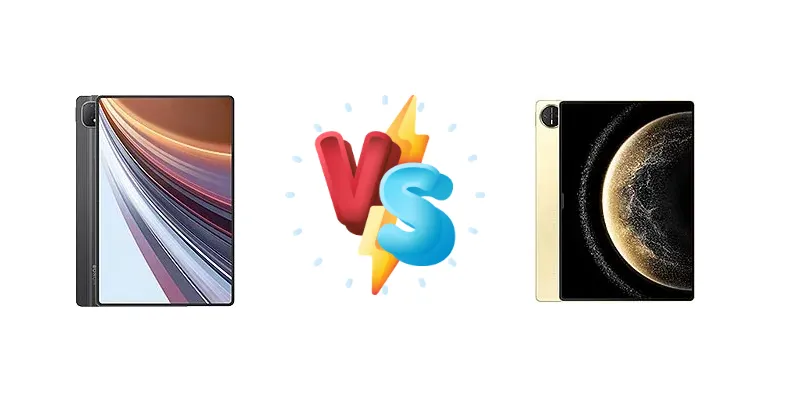
The high-end Android tablet space is heating up, with Honor and Huawei both vying for dominance. The Honor Pad GT Pro, powered by Qualcomm’s Snapdragon 8s Gen 3, focuses on delivering a strong gaming experience. Meanwhile, Huawei’s MatePad Pro 13.2 (2025) champions a premium experience with its in-house Kirin T92 chipset and significantly faster charging capabilities. This comparison dissects the key differences to help you choose the right tablet for your needs.
🏆 Quick Verdict
For the average user prioritizing all-around performance and faster charging, the Huawei MatePad Pro 13.2 (2025) emerges as the winner. Its 100W charging significantly reduces downtime, and while the Kirin T92’s performance is less documented, Huawei’s optimization typically delivers a smooth experience. However, gamers may find the Snapdragon 8s Gen 3 in the Honor Pad GT Pro appealing.
| Network |
|---|
| 2G bands | N/A | GSM 850 / 900 / 1800 / 1900 |
| 3G bands | N/A | HSDPA 850 / 900 / 1900 / 2100 |
| 4G bands | N/A | LTE |
| EDGE | No | - |
| GPRS | No | - |
| Speed | - | HSPA, LTE - cellular model only |
| Technology | No cellular connectivity | GSM / HSPA / LTE |
| Launch |
|---|
| Announced | 2024, October 16 | 2024, November 26 |
| Status | Available. Released 2024, October 17 | Available. Released 2024, December 12 |
| Body |
|---|
| Build | - | Glass front, nylon fiber back, magnesium alloy frame |
| Dimensions | 274.5 x 180.5 x 5.8 mm (10.81 x 7.11 x 0.23 in) | 289.1 x 196.1 x 5.5 mm (11.38 x 7.72 x 0.22 in) |
| SIM | No | Nano-SIM (cellular model only) |
| Weight | 555 g (1.22 lb) | 580 g (Wi-FI) or 590 g (LTE) (1.28 lb) |
| Display |
|---|
| Resolution | 1920 x 3000 pixels (~290 ppi density) | 2880 x 1920 pixels, 3:2 ratio (~262 ppi density) |
| Size | 12.3 inches, 443.2 cm2 (~89.4% screen-to-body ratio) | 13.2 inches, 518.8 cm2 (~91.5% screen-to-body ratio) |
| Type | OLED, 1B colors, 144Hz, 1600 nits (peak) | OLED, 1B colors, 144Hz, HDR Vivid, 1000 nits (peak) |
| Platform |
|---|
| CPU | Octa-core (1x3.0 GHz Cortex-X4 & 4x2.8 GHz Cortex-A720 & 3x2.0 GHz Cortex-A520) | Octa-core |
| Chipset | Qualcomm SM8635 Snapdragon 8s Gen 3 (4 nm) | Kirin T92 |
| GPU | Adreno 735 | - |
| OS | Android 14, MagicOS 8 | Harmony OS 4.3 |
| Memory |
|---|
| Card slot | No | No |
| Internal | 128GB 8GB RAM, 256GB 8GB RAM, 256GB 12GB RAM, 512GB 16GB RAM | 256GB 12GB RAM, 512GB 12GB RAM, 1TB 16GB RAM |
| Main Camera |
|---|
| Dual | - | 50 MP, f/1.8, (wide), PDAF
8 MP, f/2.2, (ultrawide) |
| Features | LED flash, HDR | LED flash |
| Single | 13 MP, f/2.0, AF | - |
| Video | 4K@30fps, 1080p@30fps | 4K@30fps, 1080p@30fps |
| Selfie camera |
|---|
| Single | 9 MP, f/2.2 | 16 MP, f/2.2 |
| Video | 1080p@30fps | 1080p@30fps |
| Sound |
|---|
| 35mm jack | No | No |
| Loudspeaker | Yes, with stereo speakers (8 speakers) | Yes, with stereo speakers (6 speakers) |
| Comms |
|---|
| Bluetooth | 5.3, A2DP, LE, aptX HD | 5.2, A2DP, LE, L2HC |
| NFC | No | No |
| Positioning | No | GPS, GALILEO, GLONASS, BDS |
| Radio | No | No |
| USB | USB Type-C 3.2, OTG, DisplayPort, magnetic connector | USB Type-C 3.1, OTG, DisplayPort 1.2, accessory connector pins |
| WLAN | Wi-Fi 802.11 a/b/g/n/ac/6, dual-band | Wi-Fi 802.11 a/b/g/n/ac/6, dual-band |
| Features |
|---|
| Sensors | Accelerometer, proximity (accessories only), gyro | Fingerprint (side-mounted), accelerometer, gyro, compass, proximity (accessories only) |
| Battery |
|---|
| Charging | 66W wired
5W reverse wired | 100W wired
7.5W reverse wired |
| Type | Li-Po 10050 mAh | Li-Po 10100 mAh |
| Misc |
|---|
| Colors | White, Blue, Black | Black, White, Gold |
| Models | ROD2-W69 | WEB-W00, PCE-W29 |
| Price | About 310 EUR | About 680 EUR |
Honor Pad GT Pro
- Proven Snapdragon 8s Gen 3 performance
- Optimized for gaming with Adreno GPU
- Faster reverse wired charging (5W vs 7.5W)
- Slower 66W wired charging
- Less established ecosystem compared to Huawei
Huawei MatePad Pro 13.2 (2025)
- Ultra-fast 100W wired charging
- Potentially optimized Kirin T92 chipset
- Larger 13.2-inch display for immersive viewing
- Kirin T92 performance is unproven
- Reliance on Huawei ecosystem
Display Comparison
Both tablets are expected to feature high-resolution displays, but specific details like panel type (OLED vs. LCD) and refresh rates are currently unknown. However, the larger 13.2-inch screen of the MatePad Pro suggests a more immersive viewing experience. Bezels will be a key differentiator, and Huawei typically excels in minimizing these. Color accuracy and peak brightness will be crucial for content creators and media consumers, and we anticipate both tablets will target DCI-P3 coverage.
Camera Comparison
Given the tablet form factor, camera performance isn't a primary concern for most users. However, the inclusion of quality sensors can be beneficial for document scanning and video conferencing. Details on camera specifications are currently unavailable for either device. We expect both tablets to feature a main camera and an ultrawide lens, but the sensor size and aperture will dictate image quality in low-light conditions. Optical Image Stabilization (OIS) would be a welcome addition, particularly for video recording.
Performance
The core of the difference lies in the chipsets. The Honor Pad GT Pro’s Qualcomm Snapdragon 8s Gen 3 (4nm) is built on a well-understood architecture, featuring an octa-core configuration with a Cortex-X4 prime core clocked at 3.0 GHz. This promises strong single-core performance and efficient multi-tasking. The Huawei MatePad Pro 13.2 (2025) utilizes the Kirin T92, an octa-core processor with undisclosed core configurations. While the Kirin T92’s raw performance remains to be seen, Huawei’s history suggests a focus on AI-enhanced performance and power efficiency. The Snapdragon’s Adreno GPU is a known quantity for gaming, while the Kirin’s GPU performance will be a critical factor in determining the MatePad Pro’s gaming capabilities. Both are expected to pair with ample LPDDR5x RAM.
Battery Life
The Huawei MatePad Pro 13.2 (2025) takes a clear lead in charging speed with its 100W wired charging, promising significantly faster top-ups compared to the Honor Pad GT Pro’s 66W charging. While battery capacity remains unknown for both devices, the faster charging of the MatePad Pro mitigates the impact of a potentially smaller battery. The Honor Pad GT Pro offers 5W reverse wired charging, allowing it to charge smaller accessories, while the MatePad Pro 13.2 (2025) provides 7.5W reverse charging, offering slightly more versatility.
Buying Guide
Buy the Honor Pad GT Pro if you are a mobile gamer who prioritizes a proven chipset architecture and a potentially more optimized gaming experience. Buy the Huawei MatePad Pro 13.2 (2025) if you value rapid charging, a premium build quality, and are invested in the Huawei ecosystem, potentially benefiting from seamless integration with other Huawei devices and accessories.
Frequently Asked Questions
❓ Will the Kirin T92 chipset in the Huawei MatePad Pro 13.2 (2025) suffer from thermal throttling during extended gaming sessions?
Huawei has a strong track record of thermal management in its Kirin chipsets. While the T92’s performance is unknown, Huawei typically employs advanced cooling solutions and software optimizations to mitigate throttling. Real-world testing will be crucial to determine its sustained performance under load.
❓ Does the Honor Pad GT Pro support any gaming-specific features like trigger buttons or enhanced cooling?
While not explicitly stated in the provided specifications, Honor often incorporates gaming-centric features in its 'GT' series. It's likely the Pad GT Pro will include software optimizations for gaming, and potentially enhanced cooling solutions to maintain peak performance during prolonged gaming sessions. The inclusion of physical gaming triggers remains unconfirmed.
❓ How does the 100W charging on the Huawei MatePad Pro 13.2 (2025) translate to real-world charging times?
100W charging should allow the MatePad Pro 13.2 (2025) to charge from 0% to 100% in approximately 30-45 minutes, depending on battery capacity. This is a significant improvement over the Honor Pad GT Pro’s 66W charging, which would likely take closer to 60-75 minutes for a full charge.