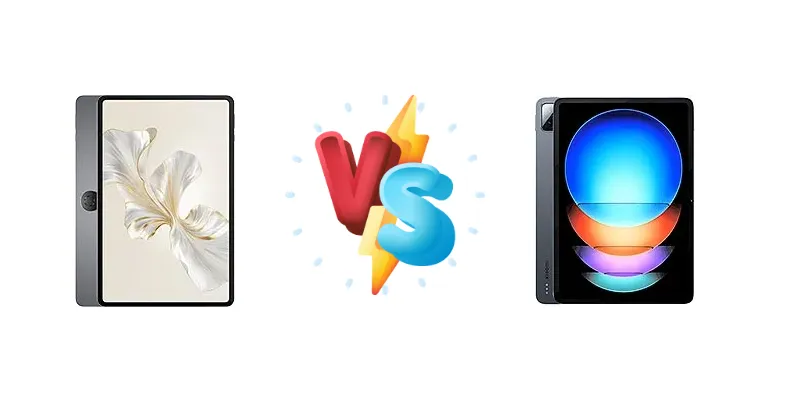
The Android tablet market is heating up, with both Honor and Xiaomi offering compelling options. The Honor Pad 9 aims for a balance of affordability and features, while the Xiaomi Pad 6S Pro 12.4 positions itself as a premium, performance-focused device. This comparison dissects their key differences to determine which tablet best suits your needs.
🏆 Quick Verdict
For the average user prioritizing raw power and future-proofing, the Xiaomi Pad 6S Pro 12.4 is the clear winner. Its Snapdragon 8 Gen 2 chipset and significantly faster 120W charging outweigh the Honor Pad 9’s longer battery life in active use. However, the Pad 9 remains a viable option for budget-conscious users.
| Network |
|---|
| 2G bands | N/A | N/A |
| 3G bands | N/A | N/A |
| 4G bands | LTE | - |
| 5G bands | SA/NSA | - |
| EDGE | No | N/A |
| GPRS | No | N/A |
| Speed | LTE, 5G | - |
| Technology | LTE / 5G | No cellular connectivity |
| Launch |
|---|
| Announced | 2023, December 21 | 2024, February 22 |
| Status | Available. Released 2023, December 21 | Available. Released 2024, February 22 |
| Body |
|---|
| Build | Glass front, aluminum frame, aluminum back | Glass front (Gorilla Glass 5), aluminum frame, aluminum back |
| Dimensions | 278.2 x 180.1 x 6.9 mm (10.95 x 7.09 x 0.27 in) | 278.7 x 191.6 x 6.3 mm (10.97 x 7.54 x 0.25 in) |
| SIM | Yes (cellular model only) | No |
| Weight | 555 g or 568 g (1.22 lb) | 590 g (1.30 lb) |
| Display |
|---|
| Protection | Anti-glare glass | Corning Gorilla Glass 5 |
| Resolution | 1600 x 2560 pixels, 16:10 ratio (~249 ppi density) | 2032 x 3048 pixels, 3:2 ratio (~295 ppi density) |
| Size | 12.1 inches, 424.5 cm2 (~84.7% screen-to-body ratio) | 12.4 inches, 457.8 cm2 (~85.7% screen-to-body ratio) |
| Type | IPS LCD, 1B colors, 120Hz, 500 nits (typ) | IPS LCD, 68B colors, 144Hz, HDR10, Dolby Vision, 900 nits (peak) |
| Platform |
|---|
| CPU | Octa-core (4x2.2 GHz Cortex-A78 & 4x1.8 GHz Cortex-A55) | Octa-core (1x3.2 GHz Cortex-X3 & 2x2.8 GHz Cortex-A715 & 2x2.8 GHz Cortex-A710 & 3x2.0 GHz Cortex-A510) |
| Chipset | Qualcomm SM6450 Snapdragon 6 Gen 1 (4 nm) | Qualcomm SM8550-AB Snapdragon 8 Gen 2 (4 nm) |
| GPU | Adreno 710 | Adreno 740 |
| OS | Android 13, up to 1 major Android upgrades, Magic OS 7.2 | Android 14, up to 3 major Android upgrades, HyperOS |
| Memory |
|---|
| Card slot | microSDXC (cellular model only) | No |
| Internal | 128GB 8GB RAM, 256GB 8GB RAM, 256GB 12GB RAM, 512GB 12GB RAM | 256GB 8GB RAM, 256GB 12GB RAM, 512GB 12GB RAM, 1TB 16GB RAM |
| Main Camera |
|---|
| Dual | - | 50 MP, f/1.8, (wide), 1/2.76", 0.64µm, PDAF
Auxiliary lens |
| Features | HDR | LED flash, HDR, panorama |
| Single | 13 MP, f/2.0, (wide), AF | - |
| Video | 4K@30fps, 1080p@30fps | 4K@30/60fps, 1080p@30/60fps |
| Selfie camera |
|---|
| Single | 8 MP, f/2.2, (wide) | 32 MP, f/2.2, (wide), 1/3.6", 0.61µm |
| Video | 1080p@30fps | 1080p@30fps |
| Sound |
|---|
| 35mm jack | No | No |
| Loudspeaker | Yes, with stereo speakers (8 speakers) | Yes, with stereo speakers (6 speakers) |
| Comms |
|---|
| Bluetooth | 5.1, A2DP, LE | 5.3, A2DP, LE, LHDC |
| NFC | No | Yes (file transfer only) |
| Positioning | No | No |
| Radio | No | No |
| USB | USB Type-C 2.0, OTG | USB Type-C 3.2, accessory connector |
| WLAN | Wi-Fi 802.11 a/b/g/n/ac, dual-band, Wi-Fi Direct | Wi-Fi 802.11 a/b/g/n/a/6/7, dual-band, Wi-Fi Direct |
| Features |
|---|
| Sensors | Accelerometer | Fingerprint (side-mounted), accelerometer, gyro, proximity (accessories only), compass |
| Battery |
|---|
| Charging | 35W wired | 120W wired, PD3.0, QC4, 45% in 10 min, 100% in 35 min |
| Type | Li-Po 8300 mAh | 10000 mAh |
| Misc |
|---|
| Colors | Gray, Blue, White | Black, Blue, Green |
| Models | HEY2-W09 | 24018RPACG |
| Price | About 190 EUR | About 700 EUR |
| SAR EU | - | 0.99 W/kg (body) |
Honor Pad 9
- Longer battery life in active use.
- More affordable price point.
- Sufficient performance for basic tasks.
- Significantly weaker processor than the competition.
- Slower charging speed.
- Less vibrant display.
Xiaomi Pad 6S Pro 12.4
- Flagship-level Snapdragon 8 Gen 2 performance.
- Ultra-fast 120W charging.
- Brighter and higher-contrast display.
- Shorter battery life compared to the Honor Pad 9.
- Higher price tag.
- Potentially more heat generation under sustained load.
Display Comparison
The Xiaomi Pad 6S Pro 12.4 boasts a superior display, achieving a measured peak brightness of 848 nits compared to the Honor Pad 9’s 530 nits. This translates to better visibility in bright environments. Furthermore, the 6S Pro’s 1378:1 contrast ratio significantly exceeds the Pad 9’s 1128:1, resulting in richer blacks and a more immersive viewing experience. While both utilize LCD technology, the Xiaomi’s panel is demonstrably more vibrant and detailed. The larger screen size of the 6S Pro also contributes to a more expansive visual experience.
Camera Comparison
While tablets aren't typically purchased for their cameras, the Xiaomi Pad 6S Pro 12.4 likely offers a more capable imaging system due to its higher-tier chipset and potentially larger sensor (details not provided). The Honor Pad 9’s camera specifications are not available, making a direct comparison difficult. However, given its positioning, it’s reasonable to expect a more basic camera setup focused on video calls and casual snapshots. We'll refrain from analyzing any potential 2MP macro lenses on either device, as their utility is limited.
Performance
The performance gap between these tablets is substantial. The Xiaomi Pad 6S Pro 12.4 is equipped with the Qualcomm SM8550-AB Snapdragon 8 Gen 2 (4nm), featuring a prime Cortex-X3 core clocked at 3.2 GHz. This is a flagship-level chipset designed for demanding tasks. In contrast, the Honor Pad 9 utilizes the Qualcomm SM6450 Snapdragon 6 Gen 1 (4nm), with a more modest CPU configuration (4x2.2 GHz Cortex-A78 & 4x1.8 GHz Cortex-A55). The 8 Gen 2’s architectural advantages, including its more powerful core and improved GPU, will result in significantly faster app loading times, smoother multitasking, and a superior gaming experience. The 6S Pro’s LPDDR5x RAM further enhances performance.
Battery Life
The Xiaomi Pad 6S Pro 12.4 offers a compelling combination of battery life and charging speed. It achieves 11:14h of active use, while the Honor Pad 9 manages 9:18h. While the Pad 9 has a slight edge in endurance, the 6S Pro’s 120W wired charging is a game-changer. It can reach 45% charge in just 10 minutes and fully charge in 35 minutes, minimizing downtime. The Honor Pad 9’s 35W charging is considerably slower, requiring significantly more time to reach a full charge. The 6S Pro also supports PD3.0 and QC4 standards for wider compatibility.
Buying Guide
Buy the Honor Pad 9 if you need a reliable tablet for everyday tasks like browsing, streaming, and light productivity, and value extended battery life over peak performance. Buy the Xiaomi Pad 6S Pro 12.4 if you prioritize demanding applications like video editing, gaming, or multitasking, and appreciate the convenience of incredibly fast charging and a brighter, higher-contrast display.
Frequently Asked Questions
❓ Does the Snapdragon 8 Gen 2 in the Xiaomi Pad 6S Pro 12.4 generate excessive heat during prolonged gaming sessions?
While the Snapdragon 8 Gen 2 is a powerful chip, Qualcomm has made significant strides in thermal management. The 4nm process node and optimized architecture contribute to better efficiency. However, sustained, demanding tasks *will* generate heat. Xiaomi likely incorporates a robust cooling solution (details not provided) to mitigate throttling and maintain stable performance. Expect some warmth, but not necessarily overheating.
❓ How does the 120W charging on the Xiaomi Pad 6S Pro 12.4 impact battery health over the long term?
Modern battery management systems are designed to mitigate the potential impact of fast charging on battery health. The Xiaomi Pad 6S Pro 12.4 likely employs intelligent charging algorithms that reduce charging speed as the battery nears full capacity. While some degradation is inevitable over time with any rechargeable battery, the 120W charging shouldn't significantly accelerate this process compared to slower charging methods.
❓ Is the difference in display brightness between the Honor Pad 9 and Xiaomi Pad 6S Pro 12.4 noticeable in everyday use?
Yes, the 318-nit difference in peak brightness is quite noticeable, especially when using the tablets outdoors or in brightly lit environments. The Xiaomi Pad 6S Pro 12.4’s brighter display will offer a much more comfortable and clear viewing experience in these conditions. The higher contrast ratio also contributes to a more vibrant and immersive image.