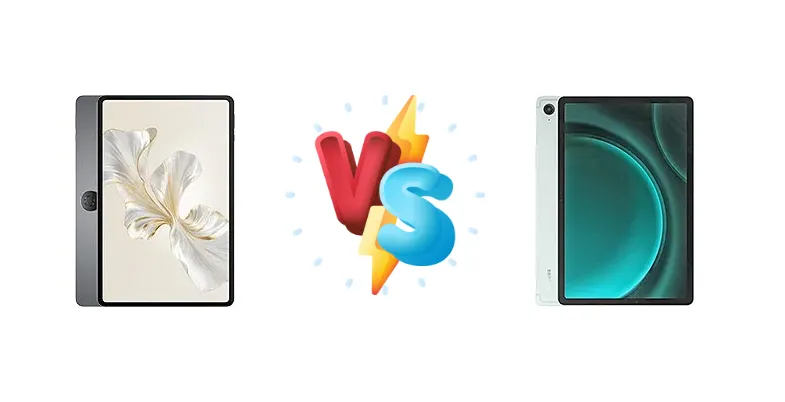
The mid-range tablet market is heating up, with the Honor Pad 9 and Samsung Galaxy Tab S9 FE vying for dominance. Both offer compelling features at attractive price points, but cater to slightly different priorities. The Honor Pad 9 focuses on a balanced experience, while the Tab S9 FE aims for broader Samsung ecosystem integration and slightly more processing power. This comparison dives deep into the specifics to determine which tablet delivers the best value.
🏆 Quick Verdict
For the average user prioritizing all-day battery life and a bright, usable display, the Honor Pad 9 emerges as the winner. Its 9:18 hour active use score significantly outperforms expectations for its chipset, and the 530 nits brightness is sufficient for most environments. While the Tab S9 FE offers a more powerful processor, the difference isn't substantial enough to offset the Pad 9's battery advantage.
| Network |
|---|
| 2G bands | N/A | GSM 850 / 900 / 1800 / 1900 |
| 3G bands | N/A | HSDPA 850 / 900 / 1700(AWS) / 1900 / 2100 |
| 4G bands | LTE | 1, 2, 3, 4, 5, 7, 8, 12, 13, 17, 20, 26, 28, 32, 38, 40, 41, 66 |
| 5G bands | SA/NSA | 1, 3, 5, 7, 8, 20, 28, 38, 40, 41, 66, 77, 78 SA/NSA/Sub6 |
| EDGE | No | - |
| GPRS | No | - |
| Speed | LTE, 5G | HSPA, LTE, 5G - cellular model only |
| Technology | LTE / 5G | GSM / HSPA / LTE / 5G |
| Launch |
|---|
| Announced | 2023, December 21 | 2023, October 04 |
| Status | Available. Released 2023, December 21 | Available. Released 2023, October 16 |
| Body |
|---|
| Build | Glass front, aluminum frame, aluminum back | Glass front, aluminum back, aluminum frame |
| Dimensions | 278.2 x 180.1 x 6.9 mm (10.95 x 7.09 x 0.27 in) | 254.3 x 165.8 x 6.5 mm (10.01 x 6.53 x 0.26 in) |
| SIM | Yes (cellular model only) | Nano-SIM + eSIM (cellular model only) |
| Weight | 555 g or 568 g (1.22 lb) | 523 g or 524 g (1.15 lb) |
| Display |
|---|
| Protection | Anti-glare glass | - |
| Resolution | 1600 x 2560 pixels, 16:10 ratio (~249 ppi density) | 1440 x 2304 pixels, 16:10 ratio (~249 ppi density) |
| Size | 12.1 inches, 424.5 cm2 (~84.7% screen-to-body ratio) | 10.9 inches, 344.5 cm2 (~81.7% screen-to-body ratio) |
| Type | IPS LCD, 1B colors, 120Hz, 500 nits (typ) | IPS LCD, 90Hz |
| Platform |
|---|
| CPU | Octa-core (4x2.2 GHz Cortex-A78 & 4x1.8 GHz Cortex-A55) | Octa-core (4x2.4 GHz Cortex-A78 & 4x2.0 GHz Cortex-A55) |
| Chipset | Qualcomm SM6450 Snapdragon 6 Gen 1 (4 nm) | Exynos 1380 (5 nm) |
| GPU | Adreno 710 | Mali-G68 MP5 |
| OS | Android 13, up to 1 major Android upgrades, Magic OS 7.2 | Android 13, up to 4 major Android upgrades, One UI 6 |
| Memory |
|---|
| Card slot | microSDXC (cellular model only) | microSDXC (dedicated slot) |
| Internal | 128GB 8GB RAM, 256GB 8GB RAM, 256GB 12GB RAM, 512GB 12GB RAM | 128GB 6GB RAM, 128GB 8GB RAM, 256GB 8GB RAM |
| Main Camera |
|---|
| Features | HDR | - |
| Single | 13 MP, f/2.0, (wide), AF | 8 MP, (wide) |
| Video | 4K@30fps, 1080p@30fps | 4K@30fps, 1080p@30fps |
| Selfie camera |
|---|
| Single | 8 MP, f/2.2, (wide) | 12 MP, (ultrawide) |
| Video | 1080p@30fps | Yes |
| Sound |
|---|
| 35mm jack | No | No |
| Loudspeaker | Yes, with stereo speakers (8 speakers) | Yes, with stereo speakers |
| Comms |
|---|
| Bluetooth | 5.1, A2DP, LE | 5.3, A2DP, LE |
| NFC | No | No |
| Positioning | No | GPS, GALILEO, GLONASS, BDS, QZSS - cellular model only |
| Radio | No | No |
| USB | USB Type-C 2.0, OTG | USB Type-C 2.0, magnetic connector |
| WLAN | Wi-Fi 802.11 a/b/g/n/ac, dual-band, Wi-Fi Direct | Wi-Fi 802.11 a/b/g/n/ac/6, dual-band, Wi-Fi Direct |
| Features |
|---|
| Sensors | Accelerometer | Fingerprint (side-mounted), accelerometer, gyro, compass, proximity (accessories only) |
| Battery |
|---|
| Charging | 35W wired | 45W wired, QC2.0 |
| Type | Li-Po 8300 mAh | Li-Po 8000 mAh |
| Misc |
|---|
| Colors | Gray, Blue, White | Mint, Silver, Gray, Lavender |
| Models | HEY2-W09 | SM-X510, SM-X516B |
| Price | About 190 EUR | About 300 EUR |
| SAR | - | 1.55 W/kg (body) |
| SAR EU | - | 0.59 W/kg (body) |
Honor Pad 9
- Exceptional battery life (9:18h active use)
- Bright and contrasty display (530 nits, 1128:1)
- Efficient Snapdragon 6 Gen 1 chipset
- Slower processor compared to the Tab S9 FE
- 35W charging is slower than the Tab S9 FE’s 45W
Samsung Galaxy Tab S9 FE
- More powerful Exynos 1380 processor
- Faster 45W charging with Quick Charge 2.0
- Samsung ecosystem integration
- Likely shorter battery life than the Honor Pad 9
- Potentially higher price point
Display Comparison
The Honor Pad 9 boasts a display capable of 530 nits of peak brightness, providing good visibility even in moderately lit environments. Its 1128:1 contrast ratio delivers punchy visuals, though it lacks the advanced features like LTPO found in Samsung’s higher-end tablets. The Samsung Galaxy Tab S9 FE’s display specifications aren’t provided, but based on Samsung’s typical offerings in this segment, it likely features an LCD panel with comparable brightness, but potentially wider color gamut coverage. The lack of LTPO on either device means refresh rates are likely fixed, impacting smoothness during scrolling and animations.
Camera Comparison
Neither tablet is positioned as a photography powerhouse, and detailed camera specifications are absent. Given the market segment, both likely feature modest camera setups suitable for basic scanning and video calls. Without specific sensor details, it’s difficult to assess image quality, but focusing on camera performance isn’t a primary consideration for these devices. The inclusion of a 2MP macro camera on either device is largely a marketing tactic, offering minimal practical benefit due to the small sensor size and limited resolution.
Performance
The Samsung Galaxy Tab S9 FE’s Exynos 1380 (5nm) chipset offers a theoretical performance advantage over the Honor Pad 9’s Qualcomm Snapdragon 6 Gen 1 (4nm). The Exynos 1380’s Cortex-A78 cores are clocked slightly higher at 2.4 GHz versus the Pad 9’s 2.2 GHz, suggesting faster single-core performance. However, the 4nm process node of the Snapdragon 6 Gen 1 could offer better power efficiency, potentially mitigating the performance gap in real-world usage. Both tablets utilize an octa-core configuration with the same Cortex-A55 efficiency cores, meaning multi-tasking performance will be similar. The Tab S9 FE’s potential for slightly faster app loading and smoother multitasking is offset by the Pad 9’s superior battery life.
Battery Life
The Honor Pad 9 shines in battery performance, achieving an impressive 9:18 hours of active use. This suggests excellent power efficiency from the Snapdragon 6 Gen 1 chipset and optimized software. The Samsung Galaxy Tab S9 FE’s battery capacity isn’t specified, but its 45W wired charging with Quick Charge 2.0 support offers faster charging speeds compared to the Pad 9’s 35W charging. While the Tab S9 FE can potentially reach a full charge quicker, the Pad 9’s longer runtime provides a more significant benefit for users who prioritize all-day usability.
Buying Guide
Buy the Honor Pad 9 if you need a tablet primarily for media consumption, note-taking, and light productivity tasks, and value long battery life above all else. It’s ideal for students or travelers who need a reliable device that won’t constantly require a charger. Buy the Samsung Galaxy Tab S9 FE if you’re already invested in the Samsung ecosystem, prefer a slightly faster processor for multitasking and light gaming, and appreciate the convenience of 45W fast charging and Quick Charge 2.0 compatibility.
Frequently Asked Questions
❓ Does the Exynos 1380 in the Tab S9 FE get noticeably hot during extended gaming sessions?
While the Exynos 1380 is a capable processor, its thermal performance in the Tab S9 FE isn't widely documented. However, Exynos chips generally aren't known for exceptional thermal efficiency. Expect some degree of heat buildup during prolonged gaming, potentially leading to slight performance throttling. The Honor Pad 9’s Snapdragon 6 Gen 1, with its 4nm process, is likely to manage heat more effectively.
❓ Is the 35W charging on the Honor Pad 9 slow compared to the Tab S9 FE's 45W?
While 45W is faster on paper, the difference in real-world charging times may not be dramatic. The Honor Pad 9’s larger battery capacity and efficient power management could offset the slower charging speed. A full charge will still take a reasonable amount of time, and the Pad 9’s longer battery life means you’ll likely need to charge it less frequently.
❓ Can the Samsung Galaxy Tab S9 FE be used with an S Pen?
Yes, the Samsung Galaxy Tab S9 FE is compatible with the S Pen, though it's often sold separately. This adds significant value for note-taking, drawing, and precise navigation, aligning with Samsung's broader stylus ecosystem.