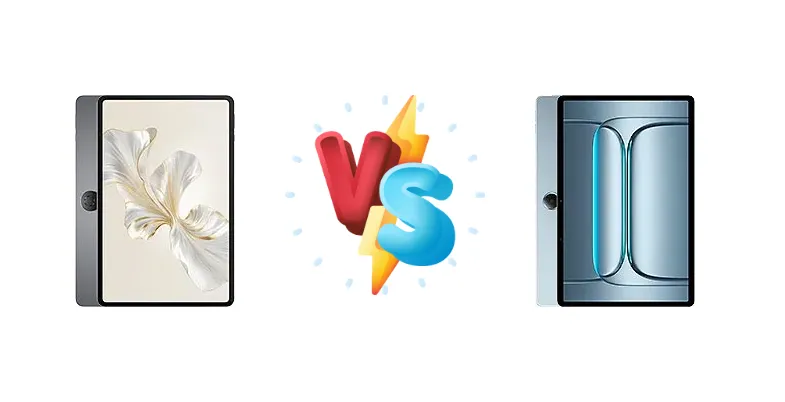
The mid-range tablet market is heating up, with the Honor Pad 9 and OnePlus Pad Lite vying for attention. Both aim to deliver a compelling experience without breaking the bank, but they take different approaches. The Honor Pad 9 leverages a newer Qualcomm chipset, while the OnePlus Pad Lite opts for a MediaTek solution. This comparison will dissect their strengths and weaknesses to determine which tablet reigns supreme.
🏆 Quick Verdict
For most users, the Honor Pad 9 emerges as the better choice. Its Snapdragon 6 Gen 1 chipset, built on a more efficient 4nm process, provides a performance edge and potentially better long-term thermal management. While the OnePlus Pad Lite is a capable device, the Honor Pad 9’s superior display and chipset give it a noticeable advantage.
| Network |
|---|
| 2G bands | N/A | GSM 850 / 900 / 1800 / 1900 - cellular model only |
| 3G bands | N/A | HSDPA 850 / 900 / 2100 - cellular model only |
| 4G bands | LTE | LTE - cellular model only |
| 5G bands | SA/NSA | - |
| EDGE | No | - |
| GPRS | No | - |
| Speed | LTE, 5G | HSPA, LTE - cellular model only |
| Technology | LTE / 5G | GSM / HSPA / LTE |
| Launch |
|---|
| Announced | 2023, December 21 | 2025, July 08 |
| Status | Available. Released 2023, December 21 | Available. Released 2025, August 14 |
| Body |
|---|
| Build | Glass front, aluminum frame, aluminum back | - |
| Dimensions | 278.2 x 180.1 x 6.9 mm (10.95 x 7.09 x 0.27 in) | 254.9 x 166.5 x 7.4 mm (10.04 x 6.56 x 0.29 in) |
| SIM | Yes (cellular model only) | Yes - cellular model only |
| Weight | 555 g or 568 g (1.22 lb) | 530 g (1.17 lb) |
| Display |
|---|
| Protection | Anti-glare glass | - |
| Resolution | 1600 x 2560 pixels, 16:10 ratio (~249 ppi density) | 1200 x 1920 pixels, 16:10 ratio (~207 ppi density) |
| Size | 12.1 inches, 424.5 cm2 (~84.7% screen-to-body ratio) | 11.0 inches, 347.5 cm2 (~81.9% screen-to-body ratio) |
| Type | IPS LCD, 1B colors, 120Hz, 500 nits (typ) | IPS LCD, 1B colors, 90Hz, 500 nits |
| Platform |
|---|
| CPU | Octa-core (4x2.2 GHz Cortex-A78 & 4x1.8 GHz Cortex-A55) | Octa-core (2x2.2 GHz Cortex-A76 & 6x2.0 GHz Cortex-A55) |
| Chipset | Qualcomm SM6450 Snapdragon 6 Gen 1 (4 nm) | Mediatek Helio G100 (6 nm) |
| GPU | Adreno 710 | Mali-G57 MC2 |
| OS | Android 13, up to 1 major Android upgrades, Magic OS 7.2 | Android 15, OxygenOS 15 |
| Memory |
|---|
| Card slot | microSDXC (cellular model only) | Unspecified |
| Internal | 128GB 8GB RAM, 256GB 8GB RAM, 256GB 12GB RAM, 512GB 12GB RAM | 128GB 6GB RAM, 128GB 8GB RAM |
| Main Camera |
|---|
| Features | HDR | - |
| Single | 13 MP, f/2.0, (wide), AF | 5 MP |
| Video | 4K@30fps, 1080p@30fps | 1080p@30fps |
| Selfie camera |
|---|
| Single | 8 MP, f/2.2, (wide) | 5 MP |
| Video | 1080p@30fps | 1080p@30fps |
| Sound |
|---|
| 35mm jack | No | No |
| Loudspeaker | Yes, with stereo speakers (8 speakers) | Yes, with stereo speakers (4 speakers, Hi-Res audio) |
| Comms |
|---|
| Bluetooth | 5.1, A2DP, LE | 5.2, A2DP, LE, aptX HD |
| NFC | No | No |
| Positioning | No | GPS, (cellular model only) - unconfirmed |
| Radio | No | No |
| USB | USB Type-C 2.0, OTG | USB Type-C 2.0 |
| WLAN | Wi-Fi 802.11 a/b/g/n/ac, dual-band, Wi-Fi Direct | Wi-Fi 802.11 a/b/g/n/ac, dual-band |
| Features |
|---|
| Sensors | Accelerometer | Unspecified |
| Battery |
|---|
| Charging | 35W wired | 33W wired |
| Type | Li-Po 8300 mAh | Li-Po 9340 mAh |
| Misc |
|---|
| Colors | Gray, Blue, White | Aero Blue |
| Models | HEY2-W09 | OPD2480 |
| Price | About 190 EUR | About 200 EUR |
Honor Pad 9
- Superior chipset performance with Snapdragon 6 Gen 1
- Brighter and higher contrast display (530 nits, 1128:1)
- Faster 35W wired charging
- Potentially higher price point
- Camera specs are unknown
OnePlus Pad Lite
- More affordable price
- Decent performance for basic tasks
- Likely lightweight design
- Less efficient 6nm chipset
- Potentially lower display quality
- Slower 33W charging
Display Comparison
The Honor Pad 9 boasts a display capable of reaching 530 nits of peak brightness, coupled with a 1128:1 contrast ratio. This translates to a vibrant and easily viewable screen, even in well-lit environments. While the OnePlus Pad Lite’s display specifications aren’t provided, it’s reasonable to expect a lower peak brightness and contrast ratio given its positioning. The higher brightness of the Honor Pad 9 is particularly beneficial for outdoor use and HDR content viewing. The contrast ratio also impacts the depth and richness of colors, giving the Honor Pad 9 an edge in visual fidelity.
Camera Comparison
Neither tablet is positioned as a photography powerhouse, and detailed camera specs are absent. However, given the market segment, it’s safe to assume both will feature modest camera setups primarily intended for video calls and casual snapshots. Without specific sensor details, it’s difficult to draw definitive conclusions, but the Honor brand generally prioritizes image processing, potentially giving it a slight advantage in image quality.
Performance
The core difference lies in the chipsets. The Honor Pad 9 utilizes the Qualcomm Snapdragon 6 Gen 1 (4nm), featuring an octa-core CPU with 4x2.2 GHz Cortex-A78 and 4x1.8 GHz Cortex-A55 cores. This 4nm fabrication process is crucial, offering improved power efficiency and thermal performance compared to the OnePlus Pad Lite’s MediaTek Helio G100 (6nm). The Helio G100’s CPU configuration – 2x2.2 GHz Cortex-A76 and 6x2.0 GHz Cortex-A55 – suggests a focus on burst performance, but the larger node size may lead to more throttling under sustained loads. The Snapdragon 6 Gen 1’s architecture is more balanced, potentially delivering smoother performance during extended use.
Battery Life
The Honor Pad 9 achieves an impressive 9:18 hours of active use, demonstrating strong battery life. The OnePlus Pad Lite’s battery performance is not provided. However, the Honor Pad 9’s 35W wired charging is faster than the OnePlus Pad Lite’s 33W charging. While the difference isn’t massive, it translates to quicker top-ups, reducing downtime. The Snapdragon 6 Gen 1’s 4nm efficiency likely contributes to the Honor Pad 9’s longer runtime.
Buying Guide
Buy the Honor Pad 9 if you prioritize sustained performance for multitasking, gaming, or demanding applications, and value a brighter, higher-contrast display for media consumption. Buy the OnePlus Pad Lite if you’re on a tighter budget and primarily need a tablet for basic tasks like web browsing, video streaming, and light productivity – accepting a slight performance trade-off.
Frequently Asked Questions
❓ Will the Snapdragon 6 Gen 1 in the Honor Pad 9 handle demanding games like Genshin Impact?
While the Snapdragon 6 Gen 1 isn't a flagship chipset, it should be capable of running Genshin Impact at medium settings with reasonable frame rates. The 4nm process helps mitigate thermal throttling, allowing for sustained performance during gaming sessions. However, don't expect the same level of performance as tablets with higher-end Snapdragon 8 series chips.
❓ How does the MediaTek Helio G100 perform with multitasking on the OnePlus Pad Lite?
The Helio G100 is adequate for basic multitasking, such as switching between web browsing, email, and video streaming. However, running multiple demanding applications simultaneously may result in noticeable slowdowns due to the chipset's limitations and the 6nm fabrication process. It's best suited for users who primarily engage in single-app usage.
❓ Is the difference in charging speed (35W vs 33W) between the Honor Pad 9 and OnePlus Pad Lite significant in real-world use?
While a 2W difference may seem small, it can accumulate over time. The Honor Pad 9’s 35W charging will likely shave off approximately 10-15 minutes from a full 0-100% charge compared to the OnePlus Pad Lite’s 33W charging. This can be a convenient benefit for users who frequently need to quickly top up their tablet.