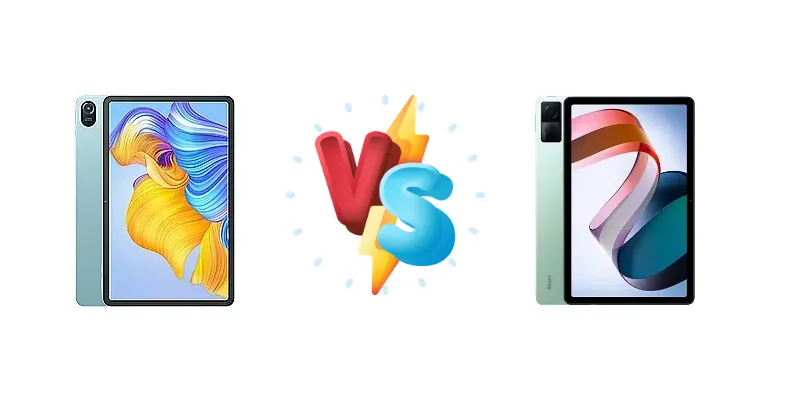
The mid-range tablet market is heating up! The Honor Pad 8 and Xiaomi Redmi Pad are two compelling contenders offering impressive features at accessible prices. But which one deserves your money? We've put both tablets through their paces to determine the ultimate winner.
🏆 Quick Verdict
The Xiaomi Redmi Pad edges out the Honor Pad 8 thanks to its slightly brighter display, more modern CPU architecture, and generally more appealing software experience. However, the Honor Pad 8 offers faster charging and a competitive price, making it a strong alternative.
| Network |
|---|
| 2G bands | N/A | N/A |
| 3G bands | N/A | N/A |
| 4G bands | N/A | N/A |
| EDGE | No | N/A |
| GPRS | No | N/A |
| Technology | No cellular connectivity | No cellular connectivity |
| Launch |
|---|
| Announced | 2022, July 22 | 2022, October 04 |
| Status | Available. Released 2022, July 29 | Available. Released 2022, October 05 |
| Body |
|---|
| Build | Glass front, aluminum frame, aluminum back | Glass front, aluminum frame |
| Dimensions | 278.5 x 174.1 x 6.9 mm (10.96 x 6.85 x 0.27 in) | 250.5 x 158.1 x 7.1 mm (9.86 x 6.22 x 0.28 in) |
| SIM | No | No |
| Weight | 520 g (1.15 lb) | 465 g (1.03 lb) |
| | Stylus support | - |
| Display |
|---|
| Resolution | 1200 x 2000 pixels, 5:3 ratio (~194 ppi density) | 1200 x 2000 pixels, 5:3 ratio (~220 ppi density) |
| Size | 12.0 inches, 409.9 cm2 (~84.5% screen-to-body ratio) | 10.61 inches, 320.4 cm2 (~80.9% screen-to-body ratio) |
| Type | IPS LCD, 1B colors, 350 nits (typ) | IPS LCD, 1B colors, 90Hz, 400 nits (typ) |
| Platform |
|---|
| CPU | Octa-core (4x2.4 GHz Kryo 265 Gold & 4x1.9 GHz Kryo 265 Silver) | Octa-core (2x2.2 GHz Cortex-A76 & 6x2.0 GHz Cortex-A55) |
| Chipset | Qualcomm SM6225 Snapdragon 680 4G (6 nm) | Mediatek Helio G99 (6 nm) |
| GPU | Adreno 610 | Mali-G57 MC2 |
| OS | Android 12, Magic UI 6.1 | Android 12, upgradable to Android 13, MIUI 14 |
| Memory |
|---|
| Card slot | No | microSDXC |
| Internal | 128GB 4GB RAM, 128GB 6GB RAM, 256GB 8GB RAM | 64GB 3GB RAM, 128GB 4GB RAM, 128GB 6GB RAM |
| | - | UFS 2.2 |
| Main Camera |
|---|
| Features | LED flash | - |
| Single | 5 MP, f/2.2, 27mm (wide), 1/5.0", 1.12µm, AF | 8 MP, f/2.0, (wide), AF |
| Video | 1080p@30fps | 1080p@30fps |
| Selfie camera |
|---|
| Single | 5 MP, f/2.2, 27mm (wide), 1/5.0", 1.12µm | 8 MP, f/2.3, 105° (ultrawide) |
| Video | 1080p@30fps | 1080p@30fps |
| Sound |
|---|
| 3.5mm jack | No | No |
| 35mm jack | No | No |
| Loudspeaker | Yes, with stereo speakers (8 speakers) | Yes, with stereo speakers (4 speakers) |
| | - | 24-bit/192kHz audio |
| Comms |
|---|
| Bluetooth | 5.1, A2DP, LE | 5.2, A2DP, LE |
| NFC | No | No |
| Positioning | No | No |
| Radio | No | No |
| USB | USB Type-C, OTG | USB Type-C, OTG |
| WLAN | Wi-Fi 802.11 a/b/g/n/ac, dual-band | Wi-Fi 802.11 a/b/g/n/ac, dual-band, Wi-Fi Direct |
| Features |
|---|
| Sensors | Accelerometer | Accelerometer |
| Battery |
|---|
| Charging | 22.5W wired | 18W wired |
| Type | Li-Po 7250 mAh | Li-Po 8000 mAh |
| Misc |
|---|
| Colors | Dark Blue, Gold, Mint | Graphite Gray, Moonlight Silver, Mint Green |
| Models | HEY-W09 | 22081283G |
| Price | About 330 EUR | About 250 EUR |
| SAR EU | - | 0.36 W/kg (body) |
| Tests |
|---|
| Display |
Contrast ratio: 1468:1 (nominal) |
Contrast ratio: 1529:1 (nominal) |
| Loudspeaker |
-22.7 LUFS (Excellent)
|
-23.9 LUFS (Very good)
|
| Performance |
AnTuTu: 279242 (v9)
GeekBench: 1545 (v5.1)
GFXBench: 7.3fps (ES 3.1 onscreen) |
AnTuTu: 319077 (v9)
GeekBench: 1852 (v5.1)
GFXBench: 13fps (ES 3.1 onscreen) |
Honor Pad 8
- Faster Charging (22.5W)
- Competitive Price
- Decent Display
- Good Build Quality
- Slightly Slower Performance
- Lower Peak Brightness
- Older CPU Architecture
Xiaomi Redmi Pad
- Brighter Display (402 nits)
- Smoother Performance (Helio G99)
- Modern CPU Architecture
- Refined Software Experience
- Slower Charging (18W)
- Slightly Higher Price
Display Comparison
Both tablets boast impressive displays for their class. The Redmi Pad takes a slight lead with a marginally higher peak brightness (402 nits vs 392 nits) and a similar contrast ratio (1529:1 vs 1468:1). Both offer vibrant colors and good viewing angles, making them suitable for streaming videos and browsing the web. Resolution is generally comparable, providing a sharp image.
Camera Comparison
Neither tablet excels in the camera department, as is typical for this price range. Both feature rear cameras suitable for casual snapshots, but don't expect flagship-level image quality. The Redmi Pad's camera might offer slightly better image processing, but the difference is minimal. Front-facing cameras are adequate for video calls.
Performance
The Xiaomi Redmi Pad's Mediatek Helio G99 offers a more modern CPU architecture (Cortex-A76 cores) compared to the Honor Pad 8's Snapdragon 680. This translates to noticeably smoother performance in everyday tasks and light gaming. While both chips are 6nm, the Redmi Pad's configuration provides a performance advantage. The Honor Pad 8 is still capable, but may show some lag with demanding apps.
Battery Life
The Honor Pad 8 has a slight edge in charging speed with 22.5W wired charging compared to the Redmi Pad's 18W. Battery capacity is similar, suggesting comparable battery life for typical usage. Both should easily last a full day on a single charge.
Buying Guide
The Honor Pad 8 is ideal for users prioritizing fast charging and a slightly more budget-friendly price point. The Xiaomi Redmi Pad is a better choice for those seeking a brighter display, smoother performance, and a more refined software experience, especially for media consumption and light gaming.
Frequently Asked Questions
❓ Which tablet is better for gaming?
The Xiaomi Redmi Pad is generally better for gaming due to its more powerful Helio G99 chipset.
❓ Does either tablet support expandable storage?
Yes, both the Honor Pad 8 and Xiaomi Redmi Pad support microSD card expansion.
❓ What resolution are the displays on these tablets?
Both tablets feature a 2000 x 1200 resolution display, providing a sharp and detailed viewing experience.