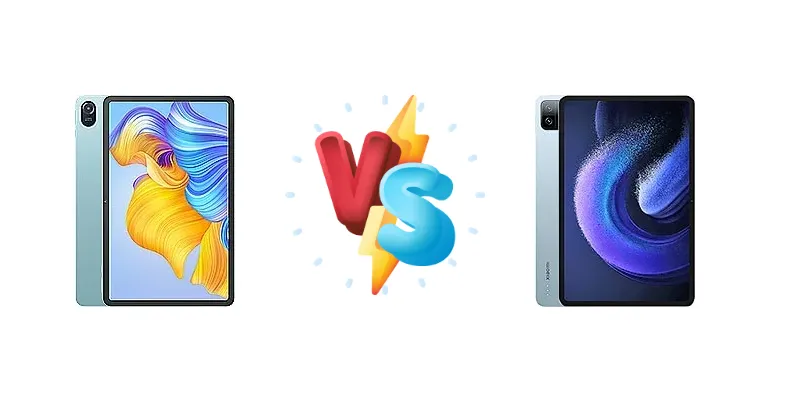
The tablet market is heating up, and two contenders are vying for your attention: the Honor Pad 8 and the Xiaomi Pad 6. Both offer compelling features at competitive prices, but which one is the better choice for your needs? Let's dive into a detailed comparison to find out.
🏆 Quick Verdict
The Xiaomi Pad 6 emerges as the clear winner thanks to its significantly more powerful Snapdragon 870 chipset, brighter display, and faster charging. While the Honor Pad 8 offers good value, the Xiaomi Pad 6 delivers a superior overall experience for performance-focused users.
| Network |
|---|
| 2G bands | N/A | N/A |
| 3G bands | N/A | N/A |
| 4G bands | N/A | - |
| EDGE | No | N/A |
| GPRS | No | N/A |
| Technology | No cellular connectivity | No cellular connectivity |
| Launch |
|---|
| Announced | 2022, July 22 | 2023, April 18 |
| Status | Available. Released 2022, July 29 | Available. Released 2023, April 18 |
| Body |
|---|
| Build | Glass front, aluminum frame, aluminum back | Glass front (Gorilla Glass 3), aluminum frame, aluminum back |
| Dimensions | 278.5 x 174.1 x 6.9 mm (10.96 x 6.85 x 0.27 in) | 254 x 165.2 x 6.5 mm (10.0 x 6.50 x 0.26 in) |
| SIM | No | No |
| Weight | 520 g (1.15 lb) | 490 g (1.08 lb) |
| | Stylus support | Stylus support (magnetic) |
| Display |
|---|
| Protection | - | Corning Gorilla Glass 3 |
| Resolution | 1200 x 2000 pixels, 5:3 ratio (~194 ppi density) | 1800 x 2880 pixels, 16:10 ratio (~309 ppi density) |
| Size | 12.0 inches, 409.9 cm2 (~84.5% screen-to-body ratio) | 11.0 inches, 350.9 cm2 (~83.6% screen-to-body ratio) |
| Type | IPS LCD, 1B colors, 350 nits (typ) | IPS LCD, 1B colors, 144Hz, HDR10, Dolby Vision, 550 nits |
| Platform |
|---|
| CPU | Octa-core (4x2.4 GHz Kryo 265 Gold & 4x1.9 GHz Kryo 265 Silver) | Octa-core (1x3.2 GHz Kryo 585 & 3x2.42 GHz Kryo 585 & 4x1.80 GHz Kryo 585) |
| Chipset | Qualcomm SM6225 Snapdragon 680 4G (6 nm) | Qualcomm SM8250-AC Snapdragon 870 5G (7 nm) |
| GPU | Adreno 610 | Adreno 650 |
| OS | Android 12, Magic UI 6.1 | Android 13, MIUI Pad 14 |
| Memory |
|---|
| Card slot | No | No |
| Internal | 128GB 4GB RAM, 128GB 6GB RAM, 256GB 8GB RAM | 128GB 6GB RAM, 128GB 8GB RAM, 256GB 8GB RAM |
| | - | UFS 3.1 |
| Main Camera |
|---|
| Features | LED flash | Dual-LED flash, HDR, panorama |
| Single | 5 MP, f/2.2, 27mm (wide), 1/5.0", 1.12µm, AF | 13 MP, f/2.2, PDAF |
| Video | 1080p@30fps | 4K@30fps, 1080p@30/60fps |
| Selfie camera |
|---|
| Single | 5 MP, f/2.2, 27mm (wide), 1/5.0", 1.12µm | 8 MP, f/2.2, 1/4.0", 1.12µm |
| Video | 1080p@30fps | 1080p@30fps |
| Sound |
|---|
| 3.5mm jack | No | No |
| 35mm jack | No | No |
| Loudspeaker | Yes, with stereo speakers (8 speakers) | Yes, with stereo speakers (4 speakers) |
| | - | 24-bit/192kHz audio |
| Comms |
|---|
| Bluetooth | 5.1, A2DP, LE | 5.2, A2DP, LE |
| NFC | No | No |
| Positioning | No | Unspecified |
| Radio | No | No |
| USB | USB Type-C, OTG | USB Type-C 3.2, accessory connector |
| WLAN | Wi-Fi 802.11 a/b/g/n/ac, dual-band | Wi-Fi 802.11 a/b/g/n/a/6, dual-band, Wi-Fi Direct |
| Features |
|---|
| Sensors | Accelerometer | Accelerometer, gyro, proximity (accessories only) |
| Battery |
|---|
| Charging | 22.5W wired | 33W wired, PD3.0, QC4 |
| Type | Li-Po 7250 mAh | Li-Po 8840 mAh |
| Misc |
|---|
| Colors | Dark Blue, Gold, Mint | Black, Blue, Gold |
| Models | HEY-W09 | 23043RP34C, 23043RP34G, 23043RP34I |
| Price | About 330 EUR | About 400 EUR |
| Tests |
|---|
| Display |
Contrast ratio: 1468:1 (nominal) | - |
| Loudspeaker |
-22.7 LUFS (Excellent)
| - |
| Performance |
AnTuTu: 279242 (v9)
GeekBench: 1545 (v5.1)
GFXBench: 7.3fps (ES 3.1 onscreen) | - |
Honor Pad 8
- Large Display
- Good Value
- Decent Media Consumption
- Less Powerful Chipset
- Lower Brightness
- Slower Charging
Xiaomi Pad 6
- Powerful Snapdragon 870
- Brighter Display
- Fast Charging (33W)
- Excellent Battery Life
- Slightly Higher Price
- Design may be less premium than some competitors
Display Comparison
The Xiaomi Pad 6 boasts a brighter display (500 nits vs 392 nits) and a slightly better contrast ratio (1060:1 vs 1468:1, though the Honor Pad 8's ratio is nominal). Both offer good viewing angles and color accuracy for their price range, but the Xiaomi Pad 6's extra brightness makes it more comfortable to use outdoors.
Camera Comparison
Camera quality is generally not a primary concern for tablets. Both devices feature decent but unremarkable cameras. The Xiaomi Pad 6 likely has a slight edge in image processing due to its more powerful chipset, but don't expect flagship-level photography from either device. (Specific camera specs are missing for both devices, so this is a general assessment).
Performance
This is where the Xiaomi Pad 6 truly shines. Its Snapdragon 870 chipset is significantly faster than the Honor Pad 8's Snapdragon 680. Expect smoother multitasking, faster app loading times, and a much better gaming experience on the Xiaomi Pad 6. The 870 is a flagship-level chip from a previous generation, offering substantial power.
Battery Life
The Xiaomi Pad 6 demonstrates impressive battery life, scoring 9:39h in active use tests. While the Honor Pad 8's battery capacity is unknown, the Xiaomi Pad 6's longevity is a significant advantage, especially given its more powerful processor.
Buying Guide
The Honor Pad 8 is ideal for budget-conscious users who prioritize a large display for media consumption and light productivity tasks. The Xiaomi Pad 6 is perfect for those seeking a powerful tablet for gaming, multitasking, and demanding applications, and who appreciate a premium feel and faster charging.
Frequently Asked Questions
❓ Which tablet is better for gaming?
The Xiaomi Pad 6 is significantly better for gaming due to its powerful Snapdragon 870 chipset. It can handle demanding games with higher frame rates and graphics settings.
❓ Is the Honor Pad 8 worth buying if I'm on a tight budget?
Yes, the Honor Pad 8 offers good value for its price. It's a decent option for basic media consumption and light productivity tasks, but don't expect flagship-level performance.