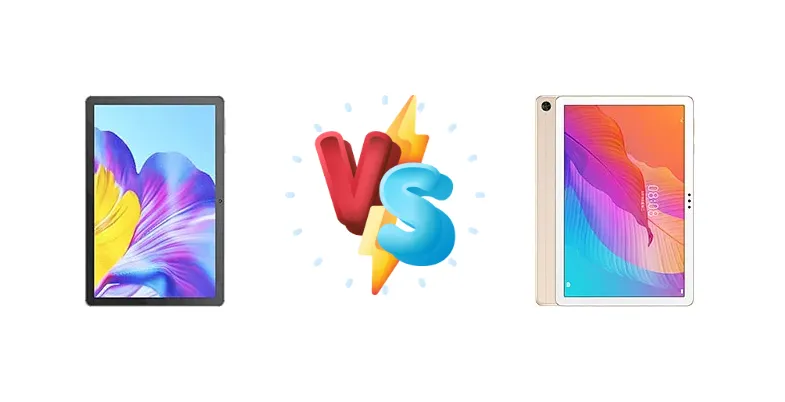
The Honor Pad 6 and Huawei MatePad T 10s present a unique comparison challenge. Both tablets are powered by the same Kirin 710A chipset, resulting in nearly identical core performance. This review dives beyond the spec sheet to analyze the subtle differences in software, brand ecosystem, and potential user benefits to determine which tablet offers the best overall value.
🏆 Quick Verdict
For the average user, the choice between the Honor Pad 6 and Huawei MatePad T 10s comes down to brand preference and software ecosystem. While performance is a dead heat, the Honor Pad 6 often presents a more competitive price, making it the slight winner for budget-conscious buyers.
| Network |
|---|
| 2G bands | GSM 850 / 900 / 1800 / 1900 | GSM 850 / 900 / 1800 / 1900 |
| 3G bands | HSDPA 2100 | HSDPA 850 / 900 / 1700(AWS) / 1900 / 2100 |
| 4G bands | LTE | 1, 3, 5, 7, 8, 18, 19, 20, 26, 28, 38, 40, 41 |
| Speed | HSPA, LTE - cellular model only | HSPA, LTE - cellular model only |
| Technology | GSM / HSPA / LTE | GSM / HSPA / LTE |
| Launch |
|---|
| Announced | 2020, July 17. Released 2020, July 28 | 2020, September 09. Released 2020, September 09 |
| Status | Discontinued | Discontinued |
| Body |
|---|
| Build | Glass front, aluminum frame, aluminum back | - |
| Dimensions | 240.2 x 159 x 7.6 mm (9.46 x 6.26 x 0.30 in) | 240.2 x 159 x 7.9 mm (9.46 x 6.26 x 0.31 in) |
| SIM | Nano-SIM (cellular model only) | Nano-SIM (cellular model only) |
| Weight | 460 g (1.01 lb) | 450 g (0.99 lb) |
| | Stylus support | Stylus support |
| Display |
|---|
| Resolution | 1200 x 1920 pixels, 16:10 ratio (~224 ppi density) | 1200 x 1920 pixels, 16:10 ratio (~224 ppi density) |
| Size | 10.1 inches, 295.8 cm2 (~77.4% screen-to-body ratio) | 10.1 inches, 295.8 cm2 (~77.4% screen-to-body ratio) |
| Type | IPS LCD | IPS LCD |
| Platform |
|---|
| CPU | Octa-core (4x2.0 GHz Cortex-A73 & 4x1.7 GHz Cortex-A53) | Octa-core (4x2.0 GHz Cortex-A73 & 4x1.7 GHz Cortex-A53) |
| Chipset | Kirin 710A (14 nm) | Kirin 710A (14 nm) |
| GPU | Mali-G51 MP4 | Mali-G51 MP4 |
| OS | Android 10, Magic UI 3.1, no Google Play Services | Android 10, EMUI 10.1, no Google Play Services |
| Memory |
|---|
| Card slot | No | microSDXC |
| Internal | 64GB 4GB RAM, 128GB 4GB RAM | 16GB 2GB RAM, 32GB 2GB RAM, 64GB 3GB RAM, 64GB 4GB RAM, 128GB 4GB RAM |
| | - | eMMC 5.1 |
| Main Camera |
|---|
| Features | HDR, panorama | HDR, panorama |
| Single | 5 MP, f/2.2, AF | 5 MP, f/2.2, PDAF |
| Video | 1080p@30fps | 1080p@30fps |
| Selfie camera |
|---|
| Single | 2 MP, f/2.4 | 2 MP, f/2.4 |
| Video | 720p@30fps | - |
| Sound |
|---|
| 3.5mm jack | Yes | Yes |
| 35mm jack | Yes | Yes |
| Loudspeaker | Yes, with stereo speakers | Yes, with stereo speakers |
| | - | Tuned by Harman Kardon |
| Comms |
|---|
| Bluetooth | 5.1, A2DP, LE | 5.0, A2DP, LE |
| NFC | No | No |
| Positioning | GPS - cellular model only | GPS, GLONASS, BDS - cellular model only |
| Radio | No | No |
| USB | USB Type-C 2.0 | USB Type-C 2.0, OTG |
| WLAN | Wi-Fi 802.11 a/b/g/n/ac, dual-band, Wi-Fi Direct | Wi-Fi 802.11 a/b/g/n/ac, dual-band, Wi-Fi Direct |
| Features |
|---|
| Sensors | Accelerometer | Accelerometer, proximity |
| Battery |
|---|
| Charging | 10W wired | 10W wired |
| Type | Li-Po 5100 mAh | Li-Po 5100 mAh |
| Misc |
|---|
| Colors | Space Gray | Gold, Deepsea Blue |
| Models | AGS3-W09, AGS3-AL09 | AGS3-L09, AGS3-W09, AGS3K-W09 |
| Price | - | About 200 EUR |
Honor Pad 6
- Potentially lower price point
- More open Android experience (depending on model)
- Strong brand recognition in some markets
- May lack Google Mobile Services (depending on model)
- Limited detailed specifications available
Huawei MatePad T 10s
- Integration with Huawei ecosystem
- Huawei’s EMUI software features
- Potentially better software support in some regions
- May lack Google Mobile Services
- Limited detailed specifications available
Display Comparison
Both the Honor Pad 6 and Huawei MatePad T 10s lack detailed display specifications in the provided data. However, given their price point, we can assume both utilize IPS LCD panels. The absence of information regarding resolution, peak brightness, or color gamut suggests neither tablet prioritizes display quality as a key selling point. Expect adequate viewing angles and color reproduction for everyday tasks, but not vibrant colors or high contrast ratios. Bezels are likely to be substantial on both devices, typical for this market segment.
Camera Comparison
Camera performance is unlikely to be a deciding factor for buyers in this segment. The provided data doesn't specify camera sensors or features. Given the price point, expect basic camera modules suitable for casual snapshots and video calls. Image quality will likely be acceptable in good lighting conditions but will struggle in low light. The absence of Optical Image Stabilization (OIS) is expected. Focusing on camera specs would be misleading without further information.
Performance
The core of both tablets is the Kirin 710A (14 nm) chipset, featuring an octa-core CPU configuration with 4x2.0 GHz Cortex-A73 and 4x1.7 GHz Cortex-A53 cores. This means CPU performance will be virtually indistinguishable between the two. The identical chipset also implies similar GPU performance, suitable for casual gaming and video playback. The lack of information regarding RAM capacity is a significant omission; however, performance will be constrained by the amount of RAM available. Thermal management should be adequate for the Kirin 710A’s power draw, but sustained heavy workloads may lead to some throttling. The 14nm process node isn't the most efficient, but it's sufficient for this class of device.
Battery Life
Both tablets feature 10W wired charging. This is a relatively slow charging speed by modern standards. Battery capacity is not specified, but given the similar hardware and target market, we can estimate capacities around 5000-6000 mAh. Expect around 3-4 hours of screen-on time with moderate usage. The slow charging speed means a full charge will take several hours, making overnight charging the most practical option. The impact of the 14nm Kirin 710A on battery life will be similar on both devices.
Buying Guide
Buy the Honor Pad 6 if you prioritize value for money and prefer a more open Android experience, potentially with access to Google Mobile Services (depending on the specific model). Buy the Huawei MatePad T 10s if you are already invested in the Huawei ecosystem, appreciate Huawei’s EMUI software customizations, and don't rely heavily on Google apps. Both are excellent choices for casual media consumption and light productivity.
Frequently Asked Questions
❓ Do both tablets support microSD card expansion for storage?
While not explicitly stated, tablets in this price range often include microSD card slots. It's highly probable that both the Honor Pad 6 and Huawei MatePad T 10s offer expandable storage, allowing users to increase the internal storage capacity. Check the official product specifications for confirmation.
❓ Will I be able to use Google apps like YouTube and Gmail on the Huawei MatePad T 10s?
This is a key concern for potential Huawei MatePad T 10s buyers. Due to ongoing restrictions, the MatePad T 10s may not come with Google Mobile Services (GMS) pre-installed. However, Huawei’s AppGallery offers alternative apps, and workarounds exist to sideload some Google apps, though this is not officially supported and may have limitations.
❓ Is the Kirin 710A chipset sufficient for multitasking and running multiple apps simultaneously?
The Kirin 710A is a capable chipset for basic multitasking, such as switching between web browsing, email, and social media apps. However, with limited RAM (the amount is unspecified), running numerous demanding apps simultaneously may result in slowdowns or app reloading. It's best suited for moderate multitasking rather than heavy workloads.