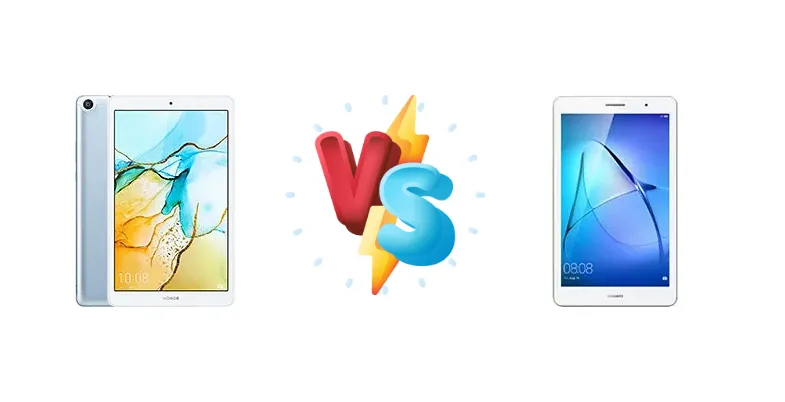
The Honor Pad 5 8 and Huawei MediaPad T3 8.0 represent the entry-level end of the Android tablet market. Both aim to provide basic functionality at an affordable price, but significant differences in their core hardware – specifically the chipset – dictate their real-world performance and suitability for different users. This comparison dissects those differences to help you choose the right tablet for your needs.
🏆 Quick Verdict
For the average user prioritizing responsiveness and multitasking, the Honor Pad 5 8 is the clear winner. Its Kirin 710 chipset offers a substantial performance advantage over the MediaPad T3 8.0’s Snapdragon 425, making it better suited for streaming, light gaming, and general app usage. However, the MediaPad T3 8.0 remains a viable option for extremely basic tasks.
| Network |
|---|
| 2G bands | GSM 850 / 900 / 1800 / 1900 | GSM 850 / 900 / 1800 / 1900 - KOB-L09 |
| 3G bands | HSDPA 850 / 900 / 2100 | HSDPA 850 / 900 / 1900 / 2100 - KOB-L09 |
| 4G bands | LTE | 1, 3, 5, 7, 8, 20, 38, 39, 40, 41 - KOB-L09 |
| Speed | HSPA, LTE - cellular model only | HSPA 42.2/5.76 Mbps, LTE Cat4 150/50 Mbps |
| Technology | GSM / HSPA / LTE | GSM / HSPA / LTE |
| Launch |
|---|
| Announced | 2019, June. Released 2019, July | 2017, April. Released 2017, May |
| Status | Discontinued | Discontinued |
| Body |
|---|
| Dimensions | 204.2 x 122.2 x 8.2 mm (8.04 x 4.81 x 0.32 in) | 211.1 x 124.7 x 8 mm (8.31 x 4.91 x 0.31 in) |
| SIM | Nano-SIM (cellular model only) | Nano-SIM |
| Weight | - | 350 g (12.35 oz) |
| Display |
|---|
| Resolution | 1920 x 1200 pixels, 16:10 ratio (~283 ppi density) | 800 x 1280 pixels, 16:10 ratio (~189 ppi density) |
| Size | 8.0 inches, 185.6 cm2 (~74.4% screen-to-body ratio) | 8.0 inches, 185.6 cm2 (~70.5% screen-to-body ratio) |
| Type | IPS LCD | IPS LCD |
| Platform |
|---|
| CPU | Octa-core (4x2.2 GHz Cortex-A73 & 4x1.7 GHz Cortex-A53) | Quad-core 1.4 GHz Cortex-A53 |
| Chipset | Kirin 710 (12 nm) | Qualcomm MSM8917 Snapdragon 425 (28 nm) |
| GPU | Mali-G51 MP4 | Adreno 308 |
| OS | Android 9.0 (Pie), Magic 2.0 | Android 7.0 (Nougat), EMUI 5.1 |
| Memory |
|---|
| Card slot | microSDXC (dedicated slot) | No |
| Internal | 32GB 3GB RAM, 64GB 4GB RAM | 16GB 2GB RAM, 32GB 3GB RAM |
| | - | eMMC 5.1 |
| Main Camera |
|---|
| Features | LED flash, HDR, panorama | - |
| Single | 8 MP, AF | 5 MP, AF |
| Video | 1080p@30fps | 1080p@30fps |
| Selfie camera |
|---|
| Single | 8 MP | 2 MP |
| Sound |
|---|
| 3.5mm jack | Yes | Yes |
| 35mm jack | Yes | Yes |
| Loudspeaker | Yes, with stereo speakers | Yes |
| Comms |
|---|
| Bluetooth | 4.2, A2DP, LE | 4.0, A2DP |
| NFC | No | No |
| Positioning | GPS, GLONASS - cellular model only | GPS, GLONASS, BDS |
| Radio | No | No |
| USB | microUSB 2.0 | microUSB 2.0 |
| WLAN | Wi-Fi 802.11 a/b/g/n/ac, dual-band, Wi-Fi Direct | Wi-Fi 802.11 b/g/n or a/b/g/n, Wi-Fi Direct |
| Features |
|---|
| Sensors | Accelerometer, proximity | Accelerometer |
| Battery |
|---|
| Stand-by | Up to 816 h (2G) / Up to 696 h (3G) | - |
| Talk time | Up to 46 h (2G) / Up to 18 h (3G) | - |
| Type | Li-Po 5100 mAh, non-removable | Li-Ion 4800 mAh, non-removable |
| Misc |
|---|
| Colors | Champagne Gold, Dark Gray, Glacial Blue | Space Gray, Luxurious Gold |
| Models | JDN2-AL00HN | KOB-L09, KOB-W09 |
| Price | About 200 EUR | About 160 EUR |
Honor Pad 5 8
- Significantly faster processor (Kirin 710)
- More efficient 12nm process for better battery life
- Smoother multitasking and app performance
- May be slightly more expensive
- Display quality likely similar to MediaPad T3 8.0
Huawei MediaPad T3 8.0
- Lower price point
- Acceptable for basic tasks like reading
- Potentially longer battery life *if* battery capacity is significantly larger
- Slow processor (Snapdragon 425)
- Less efficient 28nm process
- Struggles with multitasking and demanding apps
Display Comparison
Neither device boasts a particularly impressive display. Given the context data focuses on processing power, we can infer both likely utilize IPS LCD panels, common in this price bracket. The key difference will likely be color accuracy and brightness. The Honor Pad 5 8, being a slightly newer device, may benefit from minor improvements in panel quality. However, both will likely struggle with outdoor visibility. Bezels are expected to be substantial on both, reflecting their budget positioning.
Camera Comparison
Given the target market, camera quality is unlikely to be a priority on either device. Without specific sensor details, it’s safe to assume both feature basic cameras suitable for casual snapshots. Image processing will likely be minimal. Any differences in image quality will likely be marginal and overshadowed by the limitations of the sensors themselves. Focusing on the chipset difference, the Kirin 710’s ISP (Image Signal Processor) is likely more capable, potentially offering slightly better image processing, but this won’t bridge a significant gap if the sensors are comparable.
Performance
The performance gap is the defining characteristic of this comparison. The Honor Pad 5 8’s Kirin 710, built on a 12nm process, features an octa-core configuration (4x2.2 GHz Cortex-A73 & 4x1.7 GHz Cortex-A53). This architecture provides a significant uplift in both single-core and multi-core performance compared to the Huawei MediaPad T3 8.0’s Qualcomm MSM8917 Snapdragon 425, a quad-core 1.4 GHz Cortex-A53 processor fabricated on a much older 28nm process. The Kirin 710’s A73 cores offer a substantial performance boost over the A53 cores in the Snapdragon 425, resulting in faster app loading times, smoother multitasking, and a more responsive user interface. The 28nm process of the Snapdragon 425 also implies lower power efficiency and potentially more heat generation, further impacting sustained performance.
Battery Life
Without knowing the battery capacities, it’s difficult to make a definitive statement. However, the Snapdragon 425’s less efficient 28nm process will likely result in shorter battery life compared to the Honor Pad 5 8, despite potentially having a similar or even larger battery capacity. The Kirin 710’s 12nm process offers better power efficiency, translating to longer usage times. Charging speeds are also likely to be slower on the MediaPad T3 8.0, further compounding the disadvantage.
Buying Guide
Buy the Honor Pad 5 8 if you need a tablet capable of handling more than just basic web browsing and video playback. It’s ideal for students, casual gamers, and anyone who wants a smoother, more responsive experience. Buy the Huawei MediaPad T3 8.0 if your primary use case is limited to reading ebooks, occasional web browsing, and simple tasks where performance isn’t critical, and you are on a very tight budget.
Frequently Asked Questions
❓ Will the Huawei MediaPad T3 8.0 struggle with video streaming services like YouTube or Netflix?
Yes, the Snapdragon 425’s limited processing power may result in buffering, lag, and reduced video quality when streaming high-resolution content. While it can handle standard definition video, expect a less-than-ideal experience with 720p or 1080p streams.
❓ Is the Honor Pad 5 8 suitable for playing modern Android games?
The Honor Pad 5 8 can handle some light gaming, but don’t expect to play demanding titles at high settings. The Kirin 710 is capable of running less graphically intensive games smoothly, but you may need to lower the graphics settings for more demanding games to avoid lag and stuttering.
❓ Which tablet is better for reading ebooks and browsing the web?
While both tablets can handle these tasks, the Honor Pad 5 8 offers a more responsive experience. Page turns and web browsing will be noticeably smoother due to the faster processor. However, the MediaPad T3 8.0 is still adequate for these basic functions if budget is the primary concern.