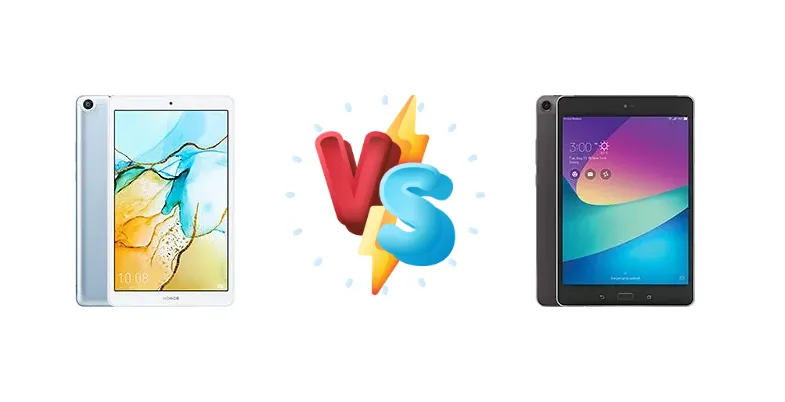
The Honor Pad 5 8 and Asus Zenpad Z8s ZT582KL represent distinct approaches to the affordable tablet market. The Honor Pad 5 8, powered by Huawei’s Kirin 710, aims for balanced performance and efficiency. Conversely, the Asus Zenpad Z8s, with its older Snapdragon 652, attempts to compensate with potentially faster charging speeds (depending on region) and a more established brand reputation. This comparison dives deep into the specifics to determine which tablet delivers the best value.
🏆 Quick Verdict
For the average user prioritizing consistent performance and a modern chipset, the Honor Pad 5 8 emerges as the better choice. While the Asus Zenpad Z8s boasts faster charging (particularly in China), its older Snapdragon 652 and 28nm process node are less efficient and offer lower overall performance than the Kirin 710’s 12nm architecture.
| Network |
|---|
| 2G bands | GSM 850 / 900 / 1800 / 1900 | GSM 850 / 900 / 1800 / 1900 |
| 3G bands | HSDPA 850 / 900 / 2100 | HSDPA |
| 4G bands | LTE | 2, 4, 5, 13 |
| 5G bands | - | 1, 3, 28, 41, 78 SA/NSA - India |
| EDGE | - | Yes |
| GPRS | - | Yes |
| Speed | HSPA, LTE - cellular model only | HSPA 42.2/5.76 Mbps, LTE Cat4 150/50 Mbps |
| Technology | GSM / HSPA / LTE | GSM / HSPA / LTE |
| Launch |
|---|
| Announced | 2019, June. Released 2019, July | 2017, August. Released 2017, August |
| Status | Discontinued | Discontinued |
| Body |
|---|
| Build | - | Glass front, aluminum back, aluminum frame |
| Dimensions | 204.2 x 122.2 x 8.2 mm (8.04 x 4.81 x 0.32 in) | 204 x 133.9 x 6.9 mm (8.03 x 5.27 x 0.27 in) |
| SIM | Nano-SIM (cellular model only) | Nano-SIM |
| Weight | - | 306 g (10.79 oz) |
| Display |
|---|
| Resolution | 1920 x 1200 pixels, 16:10 ratio (~283 ppi density) | 1536 x 2048 pixels, 4:3 ratio (~324 ppi density) |
| Size | 8.0 inches, 185.6 cm2 (~74.4% screen-to-body ratio) | 7.9 inches, 193.3 cm2 (~70.8% screen-to-body ratio) |
| Type | IPS LCD | S-IPS LCD |
| Platform |
|---|
| CPU | Octa-core (4x2.2 GHz Cortex-A73 & 4x1.7 GHz Cortex-A53) | Octa-core (4x1.8 GHz Cortex-A72 & 4x1.2 GHz Cortex-A53) |
| Chipset | Kirin 710 (12 nm) | Qualcomm MSM8976 Snapdragon 652 (28 nm) |
| GPU | Mali-G51 MP4 | Adreno 510 |
| OS | Android 9.0 (Pie), Magic 2.0 | Android 7.0 (Nougat) |
| Memory |
|---|
| Card slot | microSDXC (dedicated slot) | microSDXC (dedicated slot) |
| Internal | 32GB 3GB RAM, 64GB 4GB RAM | 16GB 3GB RAM |
| | - | eMMC 5.1 |
| Main Camera |
|---|
| Features | LED flash, HDR, panorama | Dual-LED dual-tone flash, HDR, panorama |
| Quad | - | 48 MP, f/1.8, 26mm (wide), 1/2.0", 0.8µm, PDAF, OIS
13 MP, f/2.5, 50mm (telephoto), 1/2.8", 0.8µm, PDAF, 2x optical zoom
13 MP, f/2.2, 120˚, 16mm (ultrawide) |
| Single | 8 MP, AF | 13 MP, f/2.0, AF |
| Video | 1080p@30fps | 1080p@30fps |
| Selfie camera |
|---|
| Features | - | HDR |
| Single | 8 MP | 5 MP |
| Sound |
|---|
| 3.5mm jack | Yes | Yes |
| 35mm jack | Yes | Yes |
| Loudspeaker | Yes, with stereo speakers | Yes, with stereo speakers |
| Comms |
|---|
| Bluetooth | 4.2, A2DP, LE | 4.2, A2DP, LE, aptX |
| NFC | No | No |
| Positioning | GPS, GLONASS - cellular model only | GPS, GLONASS |
| Radio | No | No |
| USB | microUSB 2.0 | USB Type-C |
| WLAN | Wi-Fi 802.11 a/b/g/n/ac, dual-band, Wi-Fi Direct | Wi-Fi 802.11 a/b/g/n/ac, dual-band, Wi-Fi Direct |
| Features |
|---|
| Sensors | Accelerometer, proximity | Accelerometer, gyro, proximity, compass |
| Battery |
|---|
| Charging | - | 120W wired, 100% in 15 min (China)
66W wired (International) |
| Stand-by | Up to 816 h (2G) / Up to 696 h (3G) | - |
| Talk time | Up to 46 h (2G) / Up to 18 h (3G) | - |
| Type | Li-Po 5100 mAh, non-removable | Li-Po 4680 mAh, non-removable (18 Wh) |
| Misc |
|---|
| Colors | Champagne Gold, Dark Gray, Glacial Blue | Black |
| Models | JDN2-AL00HN | V2049A, I2009 |
| Price | About 200 EUR | About 210 EUR |
| SAR | - | 1.19 W/kg (body) |
Honor Pad 5 8
- More modern and efficient Kirin 710 chipset
- Better sustained performance due to 12nm process
- Potentially longer battery life due to chipset efficiency
- Lacks ultra-fast charging capabilities
- Display specs are unknown and likely average
Asus Zenpad Z8s ZT582KL
- Extremely fast charging (120W in China, 66W internationally)
- Established brand reputation (Asus)
- Potentially lower price point (depending on retailer)
- Older and less efficient Snapdragon 652 chipset
- 28nm process node leads to higher heat and lower performance
- May have larger bezels and a less refined design
Display Comparison
Neither device boasts a particularly standout display. Both are likely to feature IPS LCD panels, common in this price bracket. However, detailed specs like resolution and peak brightness are missing. The Asus Zenpad Z8s, being an older model, may suffer from larger bezels. The Honor Pad 5 8’s display quality will likely be adequate for media consumption, but neither tablet will challenge higher-end displays in terms of color accuracy or viewing angles.
Camera Comparison
Camera performance is unlikely to be a key strength for either device. Details regarding sensor sizes and image processing are unavailable. Given the market segment, both tablets likely feature basic camera setups primarily suitable for casual snapshots. The Asus Zenpad Z8s may have a slight edge if it incorporates more advanced image processing algorithms, but this is speculative. Focusing on the core processors, the ISP within the Kirin 710 is likely more modern and capable than that of the Snapdragon 652.
Performance
The core difference lies in the chipsets. The Honor Pad 5 8’s Kirin 710 (12nm) utilizes a more modern architecture with Cortex-A73 cores clocked at 2.2 GHz, paired with Cortex-A53 cores at 1.7 GHz. This contrasts with the Asus Zenpad Z8s’ Snapdragon 652 (28nm), featuring Cortex-A72 cores at 1.8 GHz and Cortex-A53 cores at 1.2 GHz. The 12nm process of the Kirin 710 offers significantly improved power efficiency and thermal performance compared to the 28nm Snapdragon 652. While the Snapdragon 652’s A72 cores have a slightly higher clock speed, the Kirin 710’s newer architecture and process node will result in better sustained performance and less throttling under load. This translates to smoother multitasking and a more responsive user experience for the Honor Pad 5 8.
Battery Life
Battery capacity details are missing for both devices. However, the Asus Zenpad Z8s attempts to mitigate a potentially smaller battery with incredibly fast charging – 120W in China and 66W internationally. This allows for a full charge in just 15 minutes (China) or a still-impressive timeframe internationally. The Honor Pad 5 8 lacks this rapid charging capability, relying on a more standard charging rate. While the Honor Pad 5 8’s more efficient Kirin 710 chipset will likely result in better battery life during typical use, the Asus Zenpad Z8s offers a significant convenience factor for users who frequently need to top up their battery quickly.
Buying Guide
Buy the Honor Pad 5 8 if you need a tablet for everyday tasks like browsing, streaming, and light gaming, and value a more modern and efficient processor. Buy the Asus Zenpad Z8s ZT582KL if extremely fast charging is a top priority (and you're in a region with 120W support) and you're willing to accept a less efficient chipset and potentially lower sustained performance.
Frequently Asked Questions
❓ Will the Snapdragon 652 in the Asus Zenpad Z8s struggle with demanding games?
Yes, the Snapdragon 652 is an older chipset and will likely struggle with graphically intensive games at higher settings. Expect reduced frame rates and potential stuttering. The Kirin 710 in the Honor Pad 5 8 will offer a smoother gaming experience, though neither tablet is a dedicated gaming device.
❓ Is the 120W charging on the Asus Zenpad Z8s ZT582KL universally available?
No, the 120W charging is exclusive to the Chinese market version of the Asus Zenpad Z8s ZT582KL. International models are limited to 66W charging, which is still fast but not as rapid as the Chinese variant.
❓ How does the Kirin 710 handle multitasking compared to the Snapdragon 652?
The Kirin 710’s newer architecture and more efficient design allow it to handle multitasking more smoothly than the Snapdragon 652. You’ll experience less lag when switching between apps and a more responsive overall user experience.
❓ Are software updates likely to be consistent on either device?
Software update support is a concern for both devices. Honor/Huawei’s update track record has been inconsistent, and the Asus Zenpad Z8s is an older model that may no longer receive regular updates. Expect limited long-term software support on both tablets.