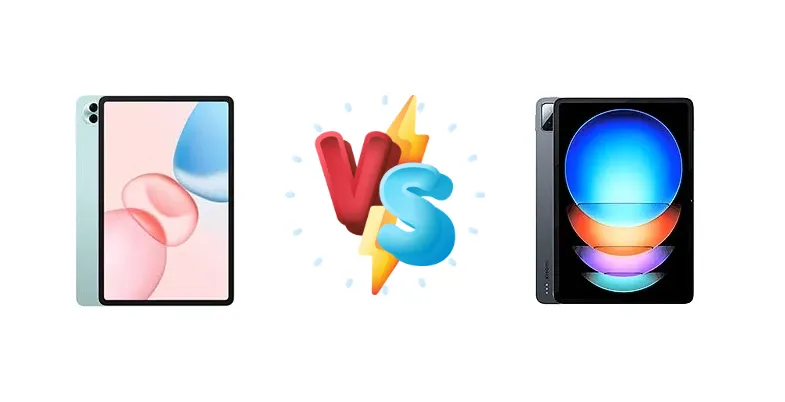
The Android tablet market is heating up, with both Honor and Xiaomi delivering compelling options. The Honor Pad 10 focuses on sustained performance and exceptional battery endurance, while the Xiaomi Pad 6S Pro 12.4 prioritizes raw processing power and incredibly fast charging. This comparison dissects the key differences to help you determine which tablet best suits your needs.
🏆 Quick Verdict
For the average user prioritizing long-term reliability and all-day battery life, the Honor Pad 10 is the better choice. However, power users demanding the fastest possible performance and willing to charge frequently will find the Xiaomi Pad 6S Pro 12.4 a more compelling option.
| Network |
|---|
| 2G bands | N/A | N/A |
| 3G bands | N/A | N/A |
| 4G bands | LTE - cellular model only | - |
| 5G bands | SA/NSA - cellular model only | - |
| EDGE | No | N/A |
| GPRS | No | N/A |
| Speed | LTE, 5G - cellular model only | - |
| Technology | LTE / 5G | No cellular connectivity |
| Launch |
|---|
| Announced | 2025, May 22 | 2024, February 22 |
| Status | Available. Released 2025, May 29 | Available. Released 2024, February 22 |
| Body |
|---|
| Build | Glass front, aluminum frame, aluminum back | Glass front (Gorilla Glass 5), aluminum frame, aluminum back |
| Dimensions | 277.1 x 179.3 x 6.3 mm (10.91 x 7.06 x 0.25 in) | 278.7 x 191.6 x 6.3 mm (10.97 x 7.54 x 0.25 in) |
| SIM | Yes (cellular model only) | No |
| Weight | 525 g (1.16 lb) | 590 g (1.30 lb) |
| Display |
|---|
| Protection | Mohs level 4 | Corning Gorilla Glass 5 |
| Resolution | 1600 x 2560 pixels, 16:10 ratio (~249 ppi density) | 2032 x 3048 pixels, 3:2 ratio (~295 ppi density) |
| Size | 12.1 inches, 424.5 cm2 (~85.4% screen-to-body ratio) | 12.4 inches, 457.8 cm2 (~85.7% screen-to-body ratio) |
| Type | IPS LCD, 1B colors, 120Hz, HDR | IPS LCD, 68B colors, 144Hz, HDR10, Dolby Vision, 900 nits (peak) |
| Platform |
|---|
| CPU | Octa-core (1x2.63 GHz Cortex-A715 & 3x2.4 GHz Cortex-A715 & 4x1.8 GHz Cortex-A510) | Octa-core (1x3.2 GHz Cortex-X3 & 2x2.8 GHz Cortex-A715 & 2x2.8 GHz Cortex-A710 & 3x2.0 GHz Cortex-A510) |
| Chipset | Qualcomm SM7550-AB Snapdragon 7 Gen 3 (4 nm) | Qualcomm SM8550-AB Snapdragon 8 Gen 2 (4 nm) |
| GPU | Adreno 720 | Adreno 740 |
| OS | Android 15, MagicOS 9 | Android 14, up to 3 major Android upgrades, HyperOS |
| Memory |
|---|
| Card slot | Unspecified | No |
| Internal | 256GB 8GB RAM | 256GB 8GB RAM, 256GB 12GB RAM, 512GB 12GB RAM, 1TB 16GB RAM |
| Main Camera |
|---|
| Dual | - | 50 MP, f/1.8, (wide), 1/2.76", 0.64µm, PDAF
Auxiliary lens |
| Features | - | LED flash, HDR, panorama |
| Single | 8 MP, f/2.0, (wide), AF | - |
| Video | Yes | 4K@30/60fps, 1080p@30/60fps |
| Selfie camera |
|---|
| Single | 8 MP, f/2.2, (wide) | 32 MP, f/2.2, (wide), 1/3.6", 0.61µm |
| Video | 1080p@30fps | 1080p@30fps |
| Sound |
|---|
| 35mm jack | No | No |
| Loudspeaker | Yes, with stereo speakers (6 speakers) | Yes, with stereo speakers (6 speakers) |
| Comms |
|---|
| Bluetooth | 5.3, A2DP, LE, aptX HD | 5.3, A2DP, LE, LHDC |
| NFC | No | Yes (file transfer only) |
| Positioning | Unspecified | No |
| Radio | No | No |
| USB | USB Type-C | USB Type-C 3.2, accessory connector |
| WLAN | Wi-Fi 802.11 a/b/g/n/ac/6, dual-band, Wi-Fi Direct | Wi-Fi 802.11 a/b/g/n/a/6/7, dual-band, Wi-Fi Direct |
| Features |
|---|
| Sensors | Accelerometer | Fingerprint (side-mounted), accelerometer, gyro, proximity (accessories only), compass |
| Battery |
|---|
| Charging | 35W wired | 120W wired, PD3.0, QC4, 45% in 10 min, 100% in 35 min |
| Type | Li-Po 10100 mAh | 10000 mAh |
| Misc |
|---|
| Colors | Cyan, Gray | Black, Blue, Green |
| Models | HEY3-W00 | 24018RPACG |
| Price | About 300 EUR | About 700 EUR |
| SAR EU | - | 0.99 W/kg (body) |
| EU LABEL |
|---|
| Battery | 112:53h endurance, 1400 cycles | - |
| Energy | Class F | - |
| Free fall | Class E (4 falls) | - |
| Repairability | Class C | - |
Honor Pad 10
- Exceptional battery life (112:53h endurance)
- Long battery lifespan (1400 charge cycles)
- Efficient Snapdragon 7 Gen 3 chipset
- Slower charging speed (35W)
- Less powerful processor than the Xiaomi
Xiaomi Pad 6S Pro 12.4
- Blazing-fast 120W charging (0-100% in 35 min)
- Powerful Snapdragon 8 Gen 2 processor
- Bright and high-contrast display (848 nits, 1378:1)
- Shorter battery life compared to Honor Pad 10
- Potentially faster battery degradation due to faster charging
Display Comparison
The Xiaomi Pad 6S Pro 12.4 boasts a significantly brighter display, reaching a measured 848 nits, compared to the Honor Pad 10 (brightness data unavailable). This makes the Xiaomi tablet more usable outdoors. The 1378:1 contrast ratio on the Xiaomi also contributes to a more vibrant and immersive viewing experience. While the Honor Pad 10’s display specs are less defined, the larger screen real estate is a benefit for multitasking. The absence of LTPO technology on either device suggests both will rely on adaptive refresh rates to conserve power, but the Xiaomi’s brighter panel will likely consume more energy.
Camera Comparison
Camera details for both tablets are limited. Given the focus on tablet use cases, camera quality is less critical. However, the Xiaomi Pad 6S Pro 12.4 is likely to offer a more refined camera experience due to the superior image signal processor (ISP) integrated within the Snapdragon 8 Gen 2. The Honor Pad 10’s camera system is likely adequate for casual snapshots and video calls, but won’t compete with dedicated camera-focused devices.
Performance
The Xiaomi Pad 6S Pro 12.4’s Snapdragon 8 Gen 2 (4nm) is a clear performance leader over the Honor Pad 10’s Snapdragon 7 Gen 3 (4nm). The 8 Gen 2 features a prime Cortex-X3 core clocked at 3.2 GHz, alongside more powerful Cortex-A715 and A710 cores, resulting in substantially faster CPU and GPU performance. The Honor Pad 10’s CPU configuration, while still octa-core, relies on Cortex-A715 and A510 cores, indicating a focus on efficiency rather than peak performance. The Xiaomi’s LPDDR5x RAM further enhances its performance capabilities. While both chipsets are built on a 4nm process, the architectural advantages of the Snapdragon 8 Gen 2 translate to a more responsive and capable tablet for demanding tasks.
Battery Life
The Xiaomi Pad 6S Pro 12.4’s 120W wired charging is a game-changer, achieving 45% charge in just 10 minutes and a full charge in 35 minutes. This drastically reduces downtime. The Honor Pad 10’s 35W charging is considerably slower. However, the Honor Pad 10 compensates with exceptional battery endurance, rated at 112:53h, and a remarkable 1400 charge cycles, suggesting a longer lifespan. The Xiaomi Pad 6S Pro 12.4’s active use score of 11:14h is respectable, but the Honor Pad 10’s endurance is in a different league, making it ideal for users who prioritize minimizing charging frequency.
Buying Guide
Buy the Honor Pad 10 if you need a tablet for extended reading, note-taking, or streaming during travel, where access to power is limited. Its impressive 112:53h endurance and 1400 charge cycles offer peace of mind. Buy the Xiaomi Pad 6S Pro 12.4 if you’re a gamer, video editor, or frequently run demanding applications, and value the speed of the Snapdragon 8 Gen 2 and the convenience of 120W fast charging.
Frequently Asked Questions
❓ Does the Xiaomi Pad 6S Pro 12.4’s Snapdragon 8 Gen 2 generate significant heat during prolonged gaming sessions?
The Snapdragon 8 Gen 2 is a powerful chip, and while efficient, it can generate heat under sustained load. Xiaomi likely employs thermal management solutions like vapor chambers to mitigate throttling, but extended gaming at maximum settings may still result in some performance reduction. The Honor Pad 10’s Snapdragon 7 Gen 3 will run cooler, but at the cost of peak performance.
❓ How does the 1400 charge cycle rating of the Honor Pad 10 translate to real-world battery lifespan?
The 1400 charge cycle rating suggests the Honor Pad 10’s battery is designed to retain a significant portion of its original capacity even after numerous charge-discharge cycles. This means the battery should remain usable for a longer period compared to tablets with lower cycle ratings, potentially extending the device’s overall lifespan.
❓ Is the 120W charging of the Xiaomi Pad 6S Pro 12.4 compatible with all USB-PD chargers?
The Xiaomi Pad 6S Pro 12.4 supports PD3.0 and QC4, but to achieve the full 120W charging speed, you’ll need a charger specifically rated for that wattage and supporting the appropriate protocols. Using a standard USB-PD charger will still charge the tablet, but at a slower rate.