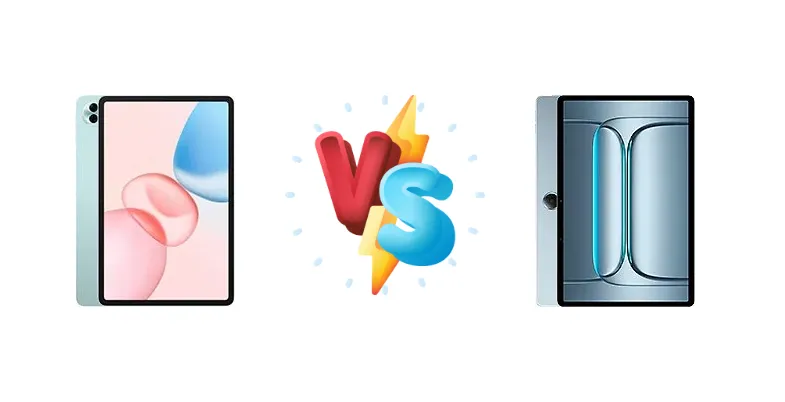
The mid-range tablet market is heating up, with the Honor Pad 10 and OnePlus Pad Lite vying for attention. Both aim to deliver a compelling experience without breaking the bank, but they take different approaches. The Honor Pad 10 leverages Qualcomm’s newer Snapdragon 7 Gen 3, while the OnePlus Pad Lite opts for MediaTek’s Helio G100. This comparison dissects these key differences to determine which tablet best suits your needs.
🏆 Quick Verdict
For users prioritizing sustained performance and longevity, the Honor Pad 10 emerges as the stronger choice. Its Snapdragon 7 Gen 3 chipset, built on a 4nm process, offers a significant advantage in efficiency and processing power. While the OnePlus Pad Lite provides a competitive experience, the Honor Pad 10’s superior chipset and battery endurance make it the overall winner.
| Network |
|---|
| 2G bands | N/A | GSM 850 / 900 / 1800 / 1900 - cellular model only |
| 3G bands | N/A | HSDPA 850 / 900 / 2100 - cellular model only |
| 4G bands | LTE - cellular model only | LTE - cellular model only |
| 5G bands | SA/NSA - cellular model only | - |
| EDGE | No | - |
| GPRS | No | - |
| Speed | LTE, 5G - cellular model only | HSPA, LTE - cellular model only |
| Technology | LTE / 5G | GSM / HSPA / LTE |
| Launch |
|---|
| Announced | 2025, May 22 | 2025, July 08 |
| Status | Available. Released 2025, May 29 | Available. Released 2025, August 14 |
| Body |
|---|
| Build | Glass front, aluminum frame, aluminum back | - |
| Dimensions | 277.1 x 179.3 x 6.3 mm (10.91 x 7.06 x 0.25 in) | 254.9 x 166.5 x 7.4 mm (10.04 x 6.56 x 0.29 in) |
| SIM | Yes (cellular model only) | Yes - cellular model only |
| Weight | 525 g (1.16 lb) | 530 g (1.17 lb) |
| Display |
|---|
| Protection | Mohs level 4 | - |
| Resolution | 1600 x 2560 pixels, 16:10 ratio (~249 ppi density) | 1200 x 1920 pixels, 16:10 ratio (~207 ppi density) |
| Size | 12.1 inches, 424.5 cm2 (~85.4% screen-to-body ratio) | 11.0 inches, 347.5 cm2 (~81.9% screen-to-body ratio) |
| Type | IPS LCD, 1B colors, 120Hz, HDR | IPS LCD, 1B colors, 90Hz, 500 nits |
| Platform |
|---|
| CPU | Octa-core (1x2.63 GHz Cortex-A715 & 3x2.4 GHz Cortex-A715 & 4x1.8 GHz Cortex-A510) | Octa-core (2x2.2 GHz Cortex-A76 & 6x2.0 GHz Cortex-A55) |
| Chipset | Qualcomm SM7550-AB Snapdragon 7 Gen 3 (4 nm) | Mediatek Helio G100 (6 nm) |
| GPU | Adreno 720 | Mali-G57 MC2 |
| OS | Android 15, MagicOS 9 | Android 15, OxygenOS 15 |
| Memory |
|---|
| Card slot | Unspecified | Unspecified |
| Internal | 256GB 8GB RAM | 128GB 6GB RAM, 128GB 8GB RAM |
| Main Camera |
|---|
| Single | 8 MP, f/2.0, (wide), AF | 5 MP |
| Video | Yes | 1080p@30fps |
| Selfie camera |
|---|
| Single | 8 MP, f/2.2, (wide) | 5 MP |
| Video | 1080p@30fps | 1080p@30fps |
| Sound |
|---|
| 35mm jack | No | No |
| Loudspeaker | Yes, with stereo speakers (6 speakers) | Yes, with stereo speakers (4 speakers, Hi-Res audio) |
| Comms |
|---|
| Bluetooth | 5.3, A2DP, LE, aptX HD | 5.2, A2DP, LE, aptX HD |
| NFC | No | No |
| Positioning | Unspecified | GPS, (cellular model only) - unconfirmed |
| Radio | No | No |
| USB | USB Type-C | USB Type-C 2.0 |
| WLAN | Wi-Fi 802.11 a/b/g/n/ac/6, dual-band, Wi-Fi Direct | Wi-Fi 802.11 a/b/g/n/ac, dual-band |
| Features |
|---|
| Sensors | Accelerometer | Unspecified |
| Battery |
|---|
| Charging | 35W wired | 33W wired |
| Type | Li-Po 10100 mAh | Li-Po 9340 mAh |
| Misc |
|---|
| Colors | Cyan, Gray | Aero Blue |
| Models | HEY3-W00 | OPD2480 |
| Price | About 300 EUR | About 200 EUR |
| EU LABEL |
|---|
| Battery | 112:53h endurance, 1400 cycles | - |
| Energy | Class F | - |
| Free fall | Class E (4 falls) | - |
| Repairability | Class C | - |
Honor Pad 10
- Superior chipset performance with Snapdragon 7 Gen 3
- Exceptional battery endurance (112:53h)
- Faster 35W charging
- Price may be slightly higher
- Display specifications currently unknown
OnePlus Pad Lite
- More affordable price point
- Decent performance for everyday tasks
- 33W fast charging
- Less efficient Helio G100 chipset
- Likely shorter battery life
Display Comparison
Display specifications are currently unavailable for both devices. However, given the price points, we anticipate both tablets will feature LCD panels. The choice between them will likely hinge on color accuracy and brightness, which require hands-on testing. Bezels are also a key consideration, impacting immersion and overall aesthetics. Brand history suggests OnePlus typically prioritizes a more refined display experience, but this remains to be confirmed.
Camera Comparison
Camera details are absent from the provided data. In this price bracket, tablet cameras are rarely a primary selling point. Expect both devices to feature basic camera setups suitable for video calls and casual snapshots. Image quality will likely be similar, with performance heavily reliant on software processing. Without specific sensor information, it’s difficult to draw meaningful conclusions.
Performance
The core difference lies in the chipsets. The Honor Pad 10’s Qualcomm Snapdragon 7 Gen 3 (4nm) is a clear step up from the OnePlus Pad Lite’s MediaTek Helio G100 (6nm). The 4nm fabrication process of the Snapdragon translates to significantly improved power efficiency and thermal management. The Snapdragon 7 Gen 3’s CPU configuration – a mix of Cortex-A715 cores – offers a more modern architecture than the Helio G100’s Cortex-A76 and A55 setup. This means faster app loading times, smoother multitasking, and better performance in demanding games. While the Helio G100 is capable, it will likely exhibit more throttling under sustained load.
Battery Life
The Honor Pad 10 boasts an impressive 112:53h endurance rating and a claimed 1400 charge cycles, indicating exceptional battery life and longevity. While the OnePlus Pad Lite’s battery capacity is unknown, the less efficient Helio G100 chipset will likely result in shorter runtimes. The Honor Pad 10’s 35W wired charging is also faster than the OnePlus Pad Lite’s 33W, allowing for quicker top-ups. The combination of superior efficiency and faster charging gives the Honor Pad 10 a distinct advantage in this category.
Buying Guide
Buy the Honor Pad 10 if you need a tablet capable of handling demanding tasks like gaming or video editing, and value long-term battery health. The Snapdragon 7 Gen 3 provides a smoother, more responsive experience. Buy the OnePlus Pad Lite if you prioritize affordability and casual tablet use, such as streaming video and browsing the web. It’s a solid option for everyday tasks, but may struggle with more intensive workloads.
Frequently Asked Questions
❓ Will the Snapdragon 7 Gen 3 in the Honor Pad 10 handle demanding games like Genshin Impact at high settings?
The Snapdragon 7 Gen 3 is a capable chipset, and should be able to run Genshin Impact at medium to high settings with playable frame rates. However, sustained performance will depend on the tablet’s thermal management. The 4nm process should help mitigate throttling, but it’s not a guarantee of a consistently smooth experience.
❓ How does the MediaTek Helio G100 perform with multitasking and app switching?
The Helio G100 is adequate for basic multitasking, such as switching between web browsing, email, and social media apps. However, it may exhibit some lag when handling numerous apps simultaneously or running resource-intensive applications in the background. The Snapdragon 7 Gen 3 in the Honor Pad 10 will provide a noticeably smoother multitasking experience.
❓ What is the expected real-world charging time for the Honor Pad 10 with its 35W charging?
While a precise 0-100% charging time requires testing, the 35W charging should allow the Honor Pad 10 to reach a full charge in approximately 1.5 to 2 hours. This is faster than the OnePlus Pad Lite’s 33W charging, which will likely take closer to 2 to 2.5 hours.