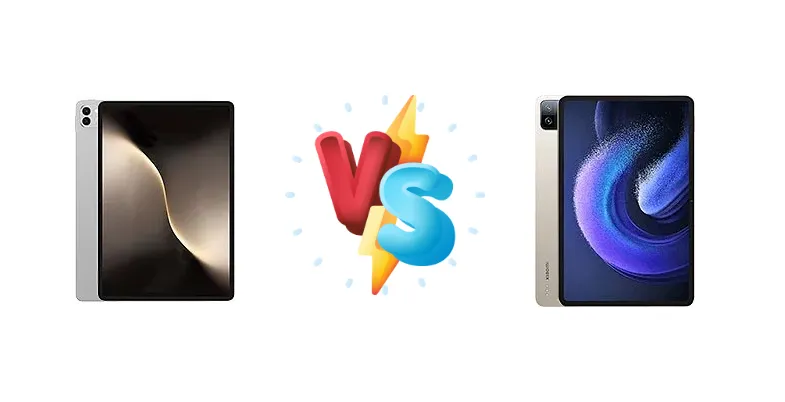
The Android tablet market is heating up, with Honor and Xiaomi delivering compelling options. The Honor MagicPad 3 arrives boasting the latest Snapdragon 8 Gen 3, while the Xiaomi Pad 6 Pro leverages the proven Snapdragon 8+ Gen 1. This comparison dissects the key differences to determine which tablet offers the best experience for power users, gamers, and everyday consumers.
🏆 Quick Verdict
For users prioritizing raw performance and future-proofing, the Honor MagicPad 3 is the clear winner thanks to its Snapdragon 8 Gen 3. However, the Xiaomi Pad 6 Pro offers a strong value proposition with its capable chipset and competitive charging speeds, making it ideal for those seeking a balance of performance and affordability.
| Network |
|---|
| 2G bands | N/A | N/A |
| 3G bands | N/A | N/A |
| 4G bands | N/A | - |
| EDGE | No | N/A |
| GPRS | No | N/A |
| Technology | No cellular connectivity | No cellular connectivity |
| Launch |
|---|
| Announced | 2025, July 02 | 2023, April 18 |
| Status | Available. Released 2025, July 02 | Available. Released 2023, April 30 |
| Body |
|---|
| Build | - | Glass front (Gorilla Glass 3), aluminum frame, aluminum back |
| Dimensions | 293.9 x 201.4 x 5.8 mm (11.57 x 7.93 x 0.23 in) | 254 x 165.2 x 6.5 mm (10.0 x 6.50 x 0.26 in) |
| SIM | No | No |
| Weight | 595 g (1.31 lb) | 490 g (1.08 lb) |
| | - | Stylus support (magnetic) |
| Display |
|---|
| Protection | - | Corning Gorilla Glass 3 |
| Resolution | 2136 x 3200 pixels, 3:2 ratio (~289 ppi density) | 1800 x 2880 pixels, 16:10 ratio (~309 ppi density) |
| Size | 13.3 inches, 527.0 cm2 (~89.0% screen-to-body ratio) | 11.0 inches, 350.9 cm2 (~83.6% screen-to-body ratio) |
| Type | IPS LCD, 1B colors, 165Hz, HDR Vivid, 1000 nits (peak) | IPS LCD, 1B colors, 144Hz, HDR10, Dolby Vision, 550 nits |
| Platform |
|---|
| CPU | Octa-core (1x3.3 GHz Cortex-X4 & 3x3.2 GHz Cortex-A720 & 2x3.0 GHz Cortex-A720 & 2x2.3 GHz Cortex-A520) | Octa-core (1x3.19 GHz Cortex-X2 & 3x2.75 GHz Cortex-A710 & 4x1.80 GHz Cortex-A510) |
| Chipset | Qualcomm SM8650-AC Snapdragon 8 Gen 3 (4 nm) | Qualcomm SM8475 Snapdragon 8+ Gen 1 (4 nm) |
| GPU | Adreno 750 (1 GHz) | Adreno 730 |
| OS | Android 15, MagicOS 9 | Android 13, MIUI 14 |
| Memory |
|---|
| Card slot | No | No |
| Internal | 256GB 8GB RAM, 256GB 12GB RAM, 512GB 16GB RAM, 1TB 16GB RAM | 128GB 8GB RAM, 256GB 8GB RAM, 256GB 12GB RAM, 512GB 12GB RAM |
| | - | UFS 3.1 |
| Main Camera |
|---|
| Dual | 13 MP, f/2.0, AF
2 MP (macro) | 50 MP, f/1.8, (wide), 1/2.76", 0.64µm, PDAF
Auxiliary lens |
| Features | LED flash | Dual-LED flash, HDR, panorama |
| Video | 4K@30fps, 1080p@30fps | 4K@30/60fps, 1080p@30/60fps |
| Selfie camera |
|---|
| Single | 9 MP, f/2.2 | 20 MP, f/2.2, (wide), 1/3.4", 0.8µm |
| Video | 4K@30fps, 1080p@30fps | 1080p@30/60fps |
| Sound |
|---|
| 3.5mm jack | - | No |
| 35mm jack | No | No |
| Loudspeaker | Yes, with stereo speakers (8 speakers) | Yes, with stereo speakers (4 speakers) |
| | - | 24-bit/192kHz audio |
| Comms |
|---|
| Bluetooth | 5.4, A2DP, LE, aptX HD, aptX Adaptive, ASHA | 5.3, A2DP, LE |
| NFC | No | No |
| Positioning | No | No |
| Radio | No | No |
| USB | USB Type-C 3.2, Display Port 1.2, OTG, accessory connector pins | USB Type-C 3.2, accessory connector |
| WLAN | Wi-Fi 802.11 a/b/g/n/ac/6/7, dual-band | Wi-Fi 802.11 a/b/g/n/a/6e, dual-band, Wi-Fi Direct |
| Features |
|---|
| Sensors | Accelerometer, proximity (accessories only), gyro | Accelerometer, gyro, proximity (accessories only) |
| Battery |
|---|
| Charging | 66W wired
5W reverse wired | 67W wired, PD3.0, QC4, 100% in 1 hour |
| Type | Si/C Li-Ion 12450 mAh | Li-Po 8600 mAh |
| Misc |
|---|
| Colors | Gray, White, Gold | Black, Blue, Gold |
| Models | CGA-W00 | 23046RP50C |
| Price | About 360 EUR | About 330 EUR |
Honor MagicPad 3
- Significantly more powerful Snapdragon 8 Gen 3 chipset
- Improved thermal efficiency for sustained performance
- Faster CPU and GPU performance for gaming and demanding tasks
- Likely higher price point
- Battery capacity is currently unknown
Xiaomi Pad 6 Pro
- Competitive Snapdragon 8+ Gen 1 performance
- Fast 67W charging with a guaranteed 1-hour full charge
- Potentially more affordable price
- Older chipset architecture compared to the Gen 3
- Less future-proofed than the Honor MagicPad 3
Display Comparison
While both tablets likely feature high-quality LCD panels (specific panel details are missing), the core difference lies in the processing power driving them. Display quality will be heavily influenced by calibration, which is currently unknown. The absence of LTPO technology in either device suggests a standard refresh rate, impacting power efficiency during static content viewing. Bezels are expected to be minimal on both, aligning with current tablet design trends.
Camera Comparison
Given the tablet form factor, camera performance isn’t a primary focus. However, any differences in sensor size or image processing could be noticeable. Without specific camera specs, it’s difficult to make a definitive comparison. Both manufacturers likely prioritize computational photography to enhance image quality, but the Snapdragon 8 Gen 3’s improved ISP in the Honor MagicPad 3 could offer slightly better image processing capabilities. We anticipate both tablets will feature capable main sensors for casual photography and video calls.
Performance
The Honor MagicPad 3’s Snapdragon 8 Gen 3 (4nm) represents a substantial architectural upgrade over the Xiaomi Pad 6 Pro’s Snapdragon 8+ Gen 1 (4nm). The Gen 3 features a new Cortex-X4 prime core clocked at 3.3 GHz, compared to the Gen 1’s Cortex-X2 at 3.19 GHz. This, coupled with improved Cortex-A720 cores in the Gen 3, translates to a noticeable performance advantage in CPU-intensive tasks. The Gen 3’s enhanced GPU will also deliver superior graphics performance, benefiting gamers. While both use a 4nm process, the Gen 3’s architectural improvements offer better thermal efficiency, potentially leading to sustained performance under load. The Xiaomi Pad 6 Pro’s LPDDR5X RAM is likely matched by the Honor MagicPad 3, but the Gen 3’s memory controller will further optimize data throughput.
Battery Life
The Honor MagicPad 3’s 66W wired charging and the Xiaomi Pad 6 Pro’s 67W wired charging are remarkably close. The Xiaomi Pad 6 Pro explicitly states a 100% charge in 1 hour, suggesting a larger battery capacity to fill. The Honor MagicPad 3’s 5W reverse wired charging is a niche feature for topping up accessories, while the Xiaomi Pad 6 Pro lacks this functionality. The actual battery life will depend on the battery capacity of each device (currently unknown), but the similar charging speeds suggest comparable recharge times, despite potential capacity differences.
Buying Guide
Buy the Honor MagicPad 3 if you demand the absolute best performance for demanding tasks like video editing, high-end gaming, or multitasking with numerous apps. Its Snapdragon 8 Gen 3 provides a significant leap in processing power. Buy the Xiaomi Pad 6 Pro if you prioritize a well-rounded experience with excellent performance for most tasks, fast charging, and a potentially lower price point. It’s the smarter choice for everyday use and casual gaming.
Frequently Asked Questions
❓ Will the Snapdragon 8 Gen 3 in the Honor MagicPad 3 handle demanding games like Genshin Impact at max settings?
Yes, the Snapdragon 8 Gen 3 is a flagship-level chipset designed to handle even the most graphically intensive games like Genshin Impact at maximum settings with consistently high frame rates. Its improved GPU and thermal management will prevent significant throttling during extended gaming sessions.
❓ Does the Xiaomi Pad 6 Pro support stylus input and keyboard accessories?
While not explicitly stated in the provided specs, Xiaomi typically offers stylus and keyboard accessories for its Pad series. It's highly likely the Pad 6 Pro supports these accessories, enhancing its productivity capabilities. Check Xiaomi's official website for compatible accessories.
❓ How does the thermal management of the Snapdragon 8+ Gen 1 in the Xiaomi Pad 6 Pro compare to other tablets with the same chipset?
The Snapdragon 8+ Gen 1 is known for its relatively efficient thermal performance. Xiaomi likely employs a vapor chamber or other cooling solution within the Pad 6 Pro to further mitigate heat buildup during prolonged use. However, sustained performance will still be affected by ambient temperature and the intensity of the task.
❓ Is the 66W charging on the Honor MagicPad 3 compatible with Power Delivery (PD) chargers?
While the specs only mention 66W wired charging, it's possible the Honor MagicPad 3 also supports Power Delivery (PD) charging. However, this isn't confirmed. Using a PD charger may not achieve the full 66W charging speed unless it specifically supports Honor's charging protocol.