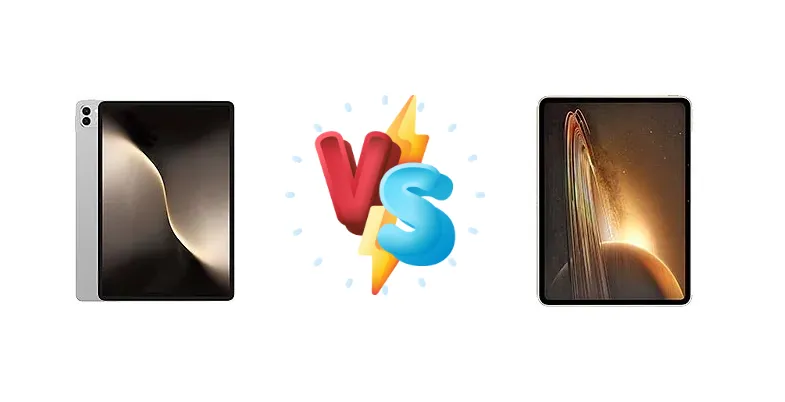
The Android tablet market is heating up, and the Honor MagicPad 3 and Oppo Pad 2 represent two compelling options vying for your attention. The MagicPad 3 boasts the latest Qualcomm Snapdragon 8 Gen 3, while the Oppo Pad 2 leverages the Mediatek Dimensity 9000. This comparison dissects their key differences, focusing on performance, charging, and overall user experience to determine which tablet delivers the most value.
🏆 Quick Verdict
For users prioritizing raw processing power and future-proofing, the Honor MagicPad 3 emerges as the winner. Its Snapdragon 8 Gen 3 chipset offers a significant performance advantage, particularly in demanding tasks like gaming and video editing. However, the Oppo Pad 2 remains a strong contender, offering a balanced experience with competitive charging speeds.
| Network |
|---|
| 2G bands | N/A | N/A |
| 3G bands | N/A | N/A |
| 4G bands | N/A | N/A |
| EDGE | No | No |
| GPRS | No | No |
| Technology | No cellular connectivity | No cellular connectivity |
| Launch |
|---|
| Announced | 2025, July 02 | 2023, March 21 |
| Status | Available. Released 2025, July 02 | Available. Released 2023, March 24 |
| Body |
|---|
| Build | - | Glass front, aluminum frame |
| Dimensions | 293.9 x 201.4 x 5.8 mm (11.57 x 7.93 x 0.23 in) | 258 x 189.4 x 6.5 mm (10.16 x 7.46 x 0.26 in) |
| SIM | No | No |
| Weight | 595 g (1.31 lb) | 552 g (1.22 lb) |
| | - | Stylus support, 2.0ms latency |
| Display |
|---|
| Resolution | 2136 x 3200 pixels, 3:2 ratio (~289 ppi density) | 2000 x 2800 pixels (~296 ppi density) |
| Size | 13.3 inches, 527.0 cm2 (~89.0% screen-to-body ratio) | 11.61 inches, 411.3 cm2 (~84.2% screen-to-body ratio) |
| Type | IPS LCD, 1B colors, 165Hz, HDR Vivid, 1000 nits (peak) | IPS LCD, 1B colors, Dolby Vision, 144Hz, 500 nits (typ) |
| Platform |
|---|
| CPU | Octa-core (1x3.3 GHz Cortex-X4 & 3x3.2 GHz Cortex-A720 & 2x3.0 GHz Cortex-A720 & 2x2.3 GHz Cortex-A520) | Octa-core (1x3.05 GHz Cortex-X2 & 3x2.85 GHz Cortex-A710 & 4x1.80 GHz Cortex-A510) |
| Chipset | Qualcomm SM8650-AC Snapdragon 8 Gen 3 (4 nm) | Mediatek Dimensity 9000 (4 nm) |
| GPU | Adreno 750 (1 GHz) | Mali-G710 MC10 |
| OS | Android 15, MagicOS 9 | Android 13, ColorOS 13.1 |
| Memory |
|---|
| Card slot | No | No |
| Internal | 256GB 8GB RAM, 256GB 12GB RAM, 512GB 16GB RAM, 1TB 16GB RAM | 256GB 8GB RAM, 256GB 12GB RAM, 512GB 12GB RAM |
| | - | UFS 3.1 |
| Main Camera |
|---|
| Dual | 13 MP, f/2.0, AF
2 MP (macro) | - |
| Features | LED flash | Color spectrum sensor, LED flash |
| Single | - | 13 MP, f/2.2, (wide), AF |
| Video | 4K@30fps, 1080p@30fps | 4K@30fps, 1080p@30ps, gyro-EIS |
| Selfie camera |
|---|
| Single | 9 MP, f/2.2 | 8 MP, f/2.3, 103˚ (ultrawide) |
| Video | 4K@30fps, 1080p@30fps | 1080p@30fps |
| Sound |
|---|
| 3.5mm jack | - | No |
| 35mm jack | No | No |
| Loudspeaker | Yes, with stereo speakers (8 speakers) | Yes, with stereo speakers (4 speakers) |
| Comms |
|---|
| Bluetooth | 5.4, A2DP, LE, aptX HD, aptX Adaptive, ASHA | 5.3, A2DP, LE, aptX HD |
| NFC | No | No |
| Positioning | No | GPS, GLONASS, GALILEO, BDS (B1I+B1c) |
| Radio | No | No |
| USB | USB Type-C 3.2, Display Port 1.2, OTG, accessory connector pins | USB Type-C 2.0, OTG, accessory connector |
| WLAN | Wi-Fi 802.11 a/b/g/n/ac/6/7, dual-band | Wi-Fi 802.11 a/b/g/n/ac/6, dual-band |
| Features |
|---|
| Sensors | Accelerometer, proximity (accessories only), gyro | Accelerometer, gyro, compass |
| Battery |
|---|
| Charging | 66W wired
5W reverse wired | 67W wired, PD, QC 2.0 |
| Type | Si/C Li-Ion 12450 mAh | Li-Po 9510 mAh |
| Misc |
|---|
| Colors | Gray, White, Gold | Gray, Gold |
| Models | CGA-W00 | OPD2201, X22N2 |
| Price | About 360 EUR | About 410 EUR |
Honor MagicPad 3
- Superior processing power with Snapdragon 8 Gen 3
- More modern CPU architecture for improved performance
- Potentially better thermal management
- Charging lacks PD/QC support
- Battery capacity unknown
Oppo Pad 2
- Fast 67W charging with PD/QC 2.0 support
- Balanced performance from Dimensity 9000
- Potentially optimized software experience
- Less powerful processor compared to Snapdragon 8 Gen 3
- Older CPU architecture
Display Comparison
While both tablets likely feature high-quality LCD panels (specific panel details are missing), the core difference lies in the processing power driving them. The absence of display specs necessitates focusing on the chipset's ability to render graphics smoothly. The Snapdragon 8 Gen 3's Adreno 750 GPU will likely deliver a superior gaming experience, especially at higher resolutions and refresh rates, assuming both tablets support similar display characteristics. Bezels and color accuracy are unknown, but will be crucial in real-world usage.
Camera Comparison
Given the tablet form factor, camera performance is less critical. However, the absence of detailed camera specs makes a direct comparison impossible. We can assume both tablets will feature capable main sensors for casual photography and video calls. Without knowing sensor sizes, apertures, or image processing algorithms, it's difficult to assess which tablet will deliver superior image quality. The inclusion of OIS (Optical Image Stabilization) would be a significant advantage, but this information is unavailable.
Performance
The Honor MagicPad 3's Qualcomm Snapdragon 8 Gen 3 (4nm) is a clear step ahead of the Oppo Pad 2's Mediatek Dimensity 9000 (4nm). The Snapdragon 8 Gen 3 utilizes a more modern CPU architecture – Cortex-X4, A720, and A520 – compared to the Dimensity 9000’s Cortex-X2, A710, and A510. This translates to faster single-core and multi-core performance. The Snapdragon’s architecture is optimized for sustained performance, potentially leading to less thermal throttling during extended gaming sessions. Both utilize a 4nm process, offering good efficiency, but the architectural advantages favor the Snapdragon.
Battery Life
Both tablets offer impressive fast charging capabilities – 66W for the Honor MagicPad 3 and 67W for the Oppo Pad 2, with the Oppo Pad 2 adding support for PD and QC 2.0. While the wattage difference is minimal, the inclusion of PD and QC 2.0 on the Oppo Pad 2 provides broader compatibility with chargers. The actual 0-100% charging time will depend on battery capacity (which is not provided), but we can expect both tablets to fully charge in under an hour. The efficiency of the Snapdragon 8 Gen 3 might slightly offset a potentially smaller battery capacity in the Honor MagicPad 3.
Buying Guide
Buy the Honor MagicPad 3 if you need uncompromising performance for gaming, content creation, or multitasking. Its Snapdragon 8 Gen 3 provides a noticeable edge. Buy the Oppo Pad 2 if you prioritize a refined user experience with fast charging and a potentially more optimized software experience, and are less concerned with having the absolute fastest processor.
Frequently Asked Questions
❓ Will the Snapdragon 8 Gen 3 in the Honor MagicPad 3 overheat during prolonged gaming sessions?
The Snapdragon 8 Gen 3 is designed with thermal efficiency in mind. While some heat generation is inevitable during intense gaming, the 4nm process and optimized architecture should minimize throttling and maintain consistent performance for extended periods. However, sustained performance will also depend on the tablet's cooling solution, which is currently unknown.
❓ Does the Mediatek Dimensity 9000 in the Oppo Pad 2 support high refresh rate gaming?
The Dimensity 9000 is capable of handling high refresh rate gaming, but the experience may not be as consistently smooth as on the Honor MagicPad 3 with its Snapdragon 8 Gen 3. The Dimensity 9000's GPU is powerful, but the Snapdragon 8 Gen 3's architectural advantages provide a performance edge, particularly in demanding titles. The actual gaming experience will also depend on the game's optimization and the tablet's display capabilities.
❓ How long will it take to fully charge both tablets from 0%?
Both tablets support very fast charging, with the Honor MagicPad 3 offering 66W and the Oppo Pad 2 offering 67W. Assuming similar battery capacities (which are currently unknown), we can expect both to fully charge in approximately 50-60 minutes. The Oppo Pad 2's support for PD and QC 2.0 may allow for slightly faster charging with compatible chargers.