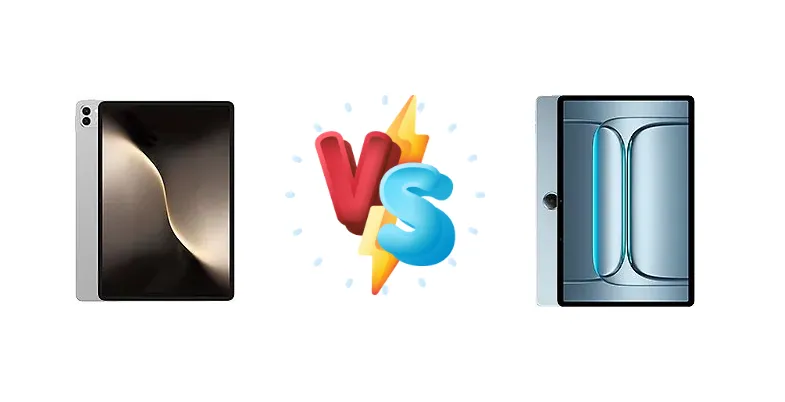
The tablet market is heating up, with options ranging from budget-friendly media consumption devices to powerful productivity machines. The Honor MagicPad 3 enters as a performance-focused contender, leveraging Qualcomm’s latest silicon, while the OnePlus Pad Lite aims to deliver a solid experience at a more accessible price point. This comparison dissects the core differences between these two tablets, helping you determine which best suits your needs.
🏆 Quick Verdict
For users prioritizing raw performance and future-proofing, the Honor MagicPad 3 is the clear winner. Its Snapdragon 8 Gen 3 chipset offers a substantial leap in processing power. However, the OnePlus Pad Lite provides a compelling value proposition for everyday tasks and media consumption, making it ideal for budget-conscious buyers.
| Network |
|---|
| 2G bands | N/A | GSM 850 / 900 / 1800 / 1900 - cellular model only |
| 3G bands | N/A | HSDPA 850 / 900 / 2100 - cellular model only |
| 4G bands | N/A | LTE - cellular model only |
| EDGE | No | - |
| GPRS | No | - |
| Speed | - | HSPA, LTE - cellular model only |
| Technology | No cellular connectivity | GSM / HSPA / LTE |
| Launch |
|---|
| Announced | 2025, July 02 | 2025, July 08 |
| Status | Available. Released 2025, July 02 | Available. Released 2025, August 14 |
| Body |
|---|
| Dimensions | 293.9 x 201.4 x 5.8 mm (11.57 x 7.93 x 0.23 in) | 254.9 x 166.5 x 7.4 mm (10.04 x 6.56 x 0.29 in) |
| SIM | No | Yes - cellular model only |
| Weight | 595 g (1.31 lb) | 530 g (1.17 lb) |
| Display |
|---|
| Resolution | 2136 x 3200 pixels, 3:2 ratio (~289 ppi density) | 1200 x 1920 pixels, 16:10 ratio (~207 ppi density) |
| Size | 13.3 inches, 527.0 cm2 (~89.0% screen-to-body ratio) | 11.0 inches, 347.5 cm2 (~81.9% screen-to-body ratio) |
| Type | IPS LCD, 1B colors, 165Hz, HDR Vivid, 1000 nits (peak) | IPS LCD, 1B colors, 90Hz, 500 nits |
| Platform |
|---|
| CPU | Octa-core (1x3.3 GHz Cortex-X4 & 3x3.2 GHz Cortex-A720 & 2x3.0 GHz Cortex-A720 & 2x2.3 GHz Cortex-A520) | Octa-core (2x2.2 GHz Cortex-A76 & 6x2.0 GHz Cortex-A55) |
| Chipset | Qualcomm SM8650-AC Snapdragon 8 Gen 3 (4 nm) | Mediatek Helio G100 (6 nm) |
| GPU | Adreno 750 (1 GHz) | Mali-G57 MC2 |
| OS | Android 15, MagicOS 9 | Android 15, OxygenOS 15 |
| Memory |
|---|
| Card slot | No | Unspecified |
| Internal | 256GB 8GB RAM, 256GB 12GB RAM, 512GB 16GB RAM, 1TB 16GB RAM | 128GB 6GB RAM, 128GB 8GB RAM |
| Main Camera |
|---|
| Dual | 13 MP, f/2.0, AF
2 MP (macro) | - |
| Features | LED flash | - |
| Single | - | 5 MP |
| Video | 4K@30fps, 1080p@30fps | 1080p@30fps |
| Selfie camera |
|---|
| Single | 9 MP, f/2.2 | 5 MP |
| Video | 4K@30fps, 1080p@30fps | 1080p@30fps |
| Sound |
|---|
| 35mm jack | No | No |
| Loudspeaker | Yes, with stereo speakers (8 speakers) | Yes, with stereo speakers (4 speakers, Hi-Res audio) |
| Comms |
|---|
| Bluetooth | 5.4, A2DP, LE, aptX HD, aptX Adaptive, ASHA | 5.2, A2DP, LE, aptX HD |
| NFC | No | No |
| Positioning | No | GPS, (cellular model only) - unconfirmed |
| Radio | No | No |
| USB | USB Type-C 3.2, Display Port 1.2, OTG, accessory connector pins | USB Type-C 2.0 |
| WLAN | Wi-Fi 802.11 a/b/g/n/ac/6/7, dual-band | Wi-Fi 802.11 a/b/g/n/ac, dual-band |
| Features |
|---|
| Sensors | Accelerometer, proximity (accessories only), gyro | Unspecified |
| Battery |
|---|
| Charging | 66W wired
5W reverse wired | 33W wired |
| Type | Si/C Li-Ion 12450 mAh | Li-Po 9340 mAh |
| Misc |
|---|
| Colors | Gray, White, Gold | Aero Blue |
| Models | CGA-W00 | OPD2480 |
| Price | About 360 EUR | About 200 EUR |
Honor MagicPad 3
- Flagship Snapdragon 8 Gen 3 performance
- 66W fast charging for minimal downtime
- Likely superior display quality (resolution, LTPO)
- 5W reverse wired charging
- Higher price point
- Potentially shorter battery life due to power-hungry chipset
OnePlus Pad Lite
- More affordable price
- Decent performance for everyday tasks
- Good value for money
- Potentially longer battery life (depending on capacity)
- Significantly slower charging speed
- Less powerful processor for demanding tasks
Display Comparison
While display specifications are missing for both devices, the target market suggests differences. The MagicPad 3, positioned as a premium device, likely features a higher resolution and potentially an LTPO panel for adaptive refresh rates, maximizing battery life during static content viewing. The OnePlus Pad Lite will likely prioritize cost-effectiveness, potentially with a standard LCD panel. Bezels are also likely slimmer on the MagicPad 3, contributing to a more immersive experience. Color accuracy will be a key differentiator, with the MagicPad 3 potentially offering wider color gamut coverage.
Camera Comparison
Given the tablet form factor, camera performance isn't a primary focus. However, the MagicPad 3, as a higher-tier device, is expected to have a more sophisticated camera system, potentially with a larger sensor and improved image processing algorithms. The OnePlus Pad Lite will likely feature a more basic camera setup geared towards casual snapshots. Without specific sensor details, it's difficult to make a precise comparison, but the MagicPad 3’s processing power will likely contribute to better image quality in challenging lighting conditions.
Performance
The core difference lies in the chipsets. The Honor MagicPad 3’s Qualcomm Snapdragon 8 Gen 3 (4nm) is a flagship processor built on a cutting-edge node, featuring a unique core configuration: 1x3.3 GHz Cortex-X4, 3x3.2 GHz Cortex-A720, 2x3.0 GHz Cortex-A720, and 2x2.3 GHz Cortex-A520. This translates to significantly faster CPU and GPU performance compared to the OnePlus Pad Lite’s MediaTek Helio G100 (6nm) with its 2x2.2 GHz Cortex-A76 and 6x2.0 GHz Cortex-A55 cores. The 4nm process of the Snapdragon 8 Gen 3 also provides superior thermal efficiency, minimizing throttling during sustained workloads. The MagicPad 3 will likely utilize faster LPDDR5x RAM, further boosting performance. Gamers and power users will overwhelmingly benefit from the MagicPad 3’s superior processing capabilities.
Battery Life
Battery capacity is not specified for either device. However, the charging speeds provide a clear advantage to the Honor MagicPad 3 with its 66W wired charging, allowing for significantly faster top-ups compared to the OnePlus Pad Lite’s 33W charging. While the OnePlus Pad Lite might have a slightly larger battery, the MagicPad 3’s faster charging will minimize downtime. The 5W reverse wired charging on the MagicPad 3 adds a convenient feature for topping up smaller devices on the go.
Buying Guide
Buy the Honor MagicPad 3 if you need a tablet capable of demanding tasks like video editing, high-end gaming, or running resource-intensive applications. Its superior chipset and faster charging will significantly enhance your workflow. Buy the OnePlus Pad Lite if you prefer a tablet primarily for streaming, browsing, and light productivity, and value affordability and a balanced user experience.
Frequently Asked Questions
❓ Will the Snapdragon 8 Gen 3 in the Honor MagicPad 3 overheat during extended gaming sessions?
The Snapdragon 8 Gen 3's 4nm process and advanced thermal management features are designed to minimize throttling. While some heat generation is inevitable during intense gaming, the MagicPad 3 should maintain stable performance for longer periods compared to tablets with less efficient chipsets. However, sustained peak performance will still generate heat.
❓ Is the MediaTek Helio G100 in the OnePlus Pad Lite sufficient for playing popular mobile games like PUBG or Call of Duty?
The Helio G100 can handle popular mobile games, but you'll likely need to lower graphics settings to achieve smooth frame rates. It's suitable for casual gaming, but demanding titles at high settings may experience occasional stuttering or lag. The MagicPad 3 offers a significantly smoother gaming experience.
❓ How long will it take to fully charge the OnePlus Pad Lite from 0% to 100% with the 33W charger?
Based on typical 33W charging speeds, a full charge from 0% to 100% on the OnePlus Pad Lite will likely take around 2 to 2.5 hours, depending on battery capacity. This is considerably slower than the Honor MagicPad 3's 66W charging.
❓ Does the Honor MagicPad 3 support external displays or desktop mode functionality?
While not explicitly stated, given the Snapdragon 8 Gen 3's capabilities and Honor's history with similar devices, it's highly probable that the MagicPad 3 supports external display output via USB-C and may even offer a desktop mode-like experience for enhanced productivity.